Pearson+ LogoPearson+ Logo
Ch. 13 - The Genetic Code and Transcription
Klug - Concepts of Genetics  12th Edition
Klug12th EditionConcepts of Genetics ISBN: 9780135564776Not the one you use?Change textbook
Chapter 13, Problem 14

A glycine residue is in position 210 of the tryptophan synthetase enzyme of wild-type E. coli. If the codon specifying glycine is GGA, how many single-base substitutions will result in an amino acid substitution at position 210? What are they? How many will result if the wild-type codon is GGU?

Verified step by step guidance
1
Identify the wild-type codon and the amino acid it encodes. For the first part, the codon is GGA, which codes for glycine. For the second part, the codon is GGU, also coding for glycine.
List all possible single-base substitutions for the given codon. Since each codon has 3 positions and each position can be changed to 3 other nucleotides (excluding the original), there are \$3 \times 3 = 9$ possible single-base substitutions for each codon.
For each of the 9 possible single-base substitutions, determine the new codon and identify the amino acid it encodes using the genetic code table. This will help you find which substitutions result in an amino acid change (missense mutation) and which do not (silent mutation).
Count the number of substitutions that lead to a different amino acid than glycine. These are the substitutions that cause an amino acid substitution at position 210.
Compare the results for the two wild-type codons (GGA and GGU) to see if the number and identity of amino acid-changing substitutions differ, explaining any differences based on codon redundancy and wobble position effects.

Verified video answer for a similar problem:

This video solution was recommended by our tutors as helpful for the problem above.
Video duration:
1m
Was this helpful?

Key Concepts

Here are the essential concepts you must grasp in order to answer the question correctly.

Genetic Code and Codon Degeneracy

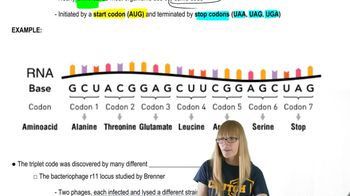
The genetic code consists of nucleotide triplets called codons, each specifying an amino acid. Due to codon degeneracy, multiple codons can encode the same amino acid, especially in the third base position. For glycine, codons GGA and GGU both code for glycine, illustrating this redundancy.
Recommended video:
Guided course
11:43
The Genetic Code

Point Mutations and Single-Base Substitutions

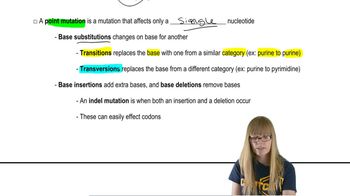
A point mutation is a change in a single nucleotide base in the DNA sequence. Single-base substitutions can be silent (no amino acid change), missense (amino acid change), or nonsense (stop codon). Understanding which substitutions alter the encoded amino acid is key to predicting protein changes.
Recommended video:
Guided course
09:49
Point Mutations

Codon-to-Amino Acid Mapping and Mutation Effects

Each codon corresponds to a specific amino acid. When a single-base substitution occurs, the new codon may code for a different amino acid, causing a missense mutation. Analyzing all possible single-base changes in a codon helps determine how many and which mutations alter the amino acid at a given position.
Recommended video:
Guided course
09:49
Point Mutations
Related Practice
Textbook Question

A short RNA molecule was isolated that demonstrated a hyperchromic shift, indicating secondary structure. Its sequence was determined to be

5'-AGGCGCCGACUCUACU-3'

What DNA sequence would give rise to this RNA molecule through transcription?

697
views
Textbook Question

A short RNA molecule was isolated that demonstrated a hyperchromic shift, indicating secondary structure. Its sequence was determined to be

5'-AGGCGCCGACUCUACU-3'

If the molecule were a tRNA fragment containing a CGA anticodon, what would the corresponding codon be?

558
views
Textbook Question

A short RNA molecule was isolated that demonstrated a hyperchromic shift, indicating secondary structure. Its sequence was determined to be

   5'-AGGCGCCGACUCUACU-3'

If the molecule were an internal part of a message, what amino acid sequence would result from it following translation?

520
views
Textbook Question

Shown here is a hypothetical viral mRNA sequence:

 5'-AUGCAUACCUAUGAGACCCUUGGA-3'

Assuming that it could arise from overlapping genes, how many different polypeptide sequences can be produced? What are the sequences?

592
views
Textbook Question

Refer to the genetic coding dictionary to respond to the following:

A base-substitution mutation that altered the sequence shown in part (a) eliminated the synthesis of all but one polypeptide. The altered sequence is shown here:

5'-AUGCAUACCUAUGUGACCCUUGGA-3'

Determine why.

633
views
Textbook Question

Most proteins have more leucine than histidine residues, but more histidine than tryptophan residues. Correlate the number of codons for these three amino acids with this information.

604
views