Pearson+ LogoPearson+ Logo
Ch. 13 - The Genetic Code and Transcription
Klug - Concepts of Genetics  12th Edition
Klug12th EditionConcepts of Genetics ISBN: 9780135564776Not the one you use?Change textbook
Chapter 13, Problem 7

In the triplet binding technique, radioactivity remains on the filter when the amino acid corresponding to the codon is labeled. Explain the rationale for this technique.

Verified step by step guidance
1
Understand that the triplet binding technique is used to identify which codon (a sequence of three nucleotides) corresponds to a specific amino acid during protein synthesis.
Recognize that in this technique, synthetic RNA triplets (codons) are incubated with ribosomal subunits and aminoacyl-tRNA charged with a radioactive amino acid.
Know that if the RNA triplet matches the anticodon of the charged tRNA, the complex (ribosome + RNA triplet + tRNA with radioactive amino acid) forms and binds to the filter.
Since the ribosome-tRNA complex is large, it cannot pass through the filter, so radioactivity remains on the filter only when the correct codon-amino acid pairing occurs.
Therefore, the presence of radioactivity on the filter indicates a specific codon corresponds to the radioactive amino acid, allowing identification of codon assignments.

Verified video answer for a similar problem:

This video solution was recommended by our tutors as helpful for the problem above.
Video duration:
2m
Was this helpful?

Key Concepts

Here are the essential concepts you must grasp in order to answer the question correctly.

Triplet Binding Technique

The triplet binding technique is an experimental method used to identify which three-nucleotide codons correspond to specific amino acids. It involves forming complexes between ribosomes, synthetic RNA triplets (codons), and aminoacyl-tRNAs, allowing researchers to determine codon assignments by detecting binding events.
Recommended video:
Guided course
11:43
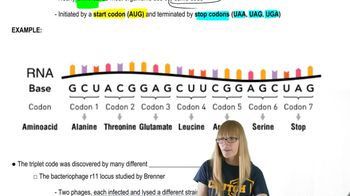
The Genetic Code

Role of Radioactive Labeling

Radioactive labeling tags amino acids attached to tRNAs, enabling detection of their binding to ribosomes. When a labeled aminoacyl-tRNA binds to a ribosome programmed with its complementary codon, the radioactivity remains on the filter during filtration, indicating a specific codon–amino acid interaction.
Recommended video:

Codon-Anticodon Specificity

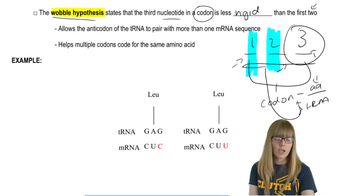
Codon-anticodon specificity refers to the precise base pairing between mRNA codons and tRNA anticodons during translation. This specificity ensures that only the tRNA carrying the amino acid matching the codon binds to the ribosome, which is the basis for detecting correct amino acid incorporation in the triplet binding assay.
Recommended video:
Guided course
03:13
Translation:Wobble Hypothesis