
Textbook Question
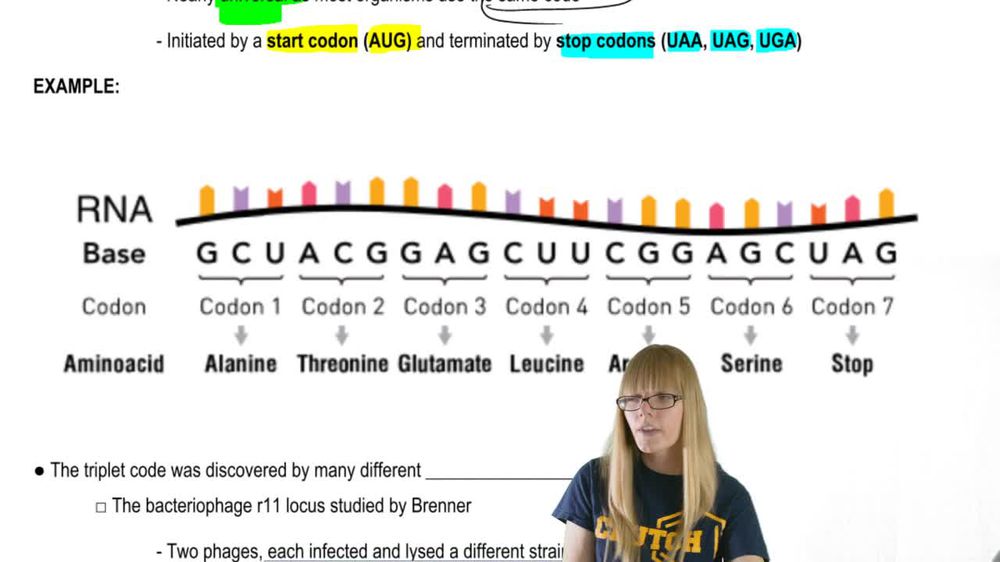
Assuming the genetic code is a triplet, what effect would the addition or loss of two nucleotides have on the reading frame? The addition or loss of three, six, or nine nucleotides?
954
views

 Verified step by step guidance
 11:43
11:43
 03:13 11:43
Assuming the genetic code is a triplet, what effect would the addition or loss of two nucleotides have on the reading frame? The addition or loss of three, six, or nine nucleotides?
The mRNA formed from the repeating tetranucleotide UUAC incorporates only three amino acids, but the use of UAUC incorporates four amino acids. Why?
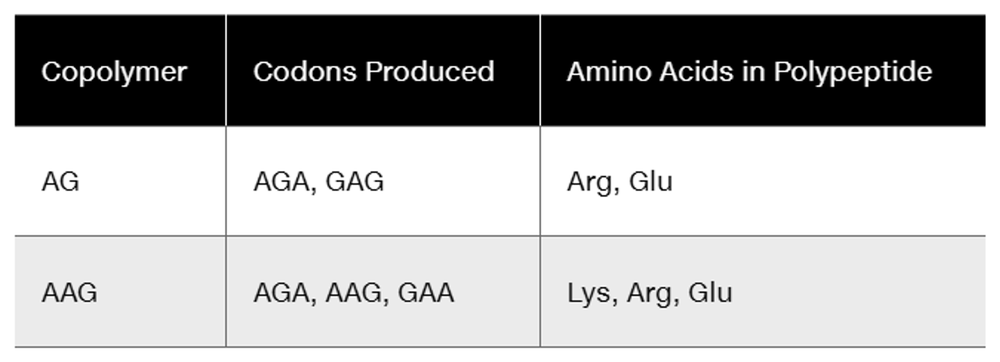
In studies using repeating copolymers, AC . . . incorporates threonine and histidine, and CAACAA . . . incorporates glutamine, asparagine, and threonine. What triplet code can definitely be assigned to threonine?
In the triplet binding technique, radioactivity remains on the filter when the amino acid corresponding to the codon is labeled. Explain the rationale for this technique.
When the amino acid sequences of insulin isolated from different organisms were determined, differences were noted. For example, alanine was substituted for threonine, serine for glycine, and valine for isoleucine at corresponding positions in the protein. List the single-base changes that could occur in codons of the genetic code to produce these amino acid changes.
In studies of the amino acid sequence of wild-type and mutant forms of tryptophan synthetase in E. coli, the following changes have been observed:
Determine a set of triplet codes in which only a single-nucleotide change produces each amino acid change.