Most mutations are thought to be deleterious. Why, then, is it reasonable to state that mutations are essential to the evolutionary process?
Table of contents
- 1. Introduction to Genetics51m
- 2. Mendel's Laws of Inheritance3h 37m
- 3. Extensions to Mendelian Inheritance2h 41m
- 4. Genetic Mapping and Linkage2h 28m
- 5. Genetics of Bacteria and Viruses1h 21m
- 6. Chromosomal Variation1h 48m
- 7. DNA and Chromosome Structure56m
- 8. DNA Replication1h 10m
- 9. Mitosis and Meiosis1h 34m
- 10. Transcription1h 0m
- 11. Translation58m
- 12. Gene Regulation in Prokaryotes1h 19m
- 13. Gene Regulation in Eukaryotes44m
- 14. Genetic Control of Development44m
- 15. Genomes and Genomics1h 50m
- 16. Transposable Elements47m
- 17. Mutation, Repair, and Recombination1h 6m
- 18. Molecular Genetic Tools19m
- 19. Cancer Genetics29m
- 20. Quantitative Genetics1h 26m
- 21. Population Genetics50m
- 22. Evolutionary Genetics29m
17. Mutation, Repair, and Recombination
Types of Mutations
Problem 8
Textbook Question
When the amino acid sequences of insulin isolated from different organisms were determined, differences were noted. For example, alanine was substituted for threonine, serine for glycine, and valine for isoleucine at corresponding positions in the protein. List the single-base changes that could occur in codons of the genetic code to produce these amino acid changes.
Verified step by step guidance1
Identify the codons for the original amino acids (threonine, glycine, isoleucine) and the substituted amino acids (alanine, serine, valine) using the standard genetic code table.
Write down the possible codons for each original amino acid and each substituted amino acid, since many amino acids are encoded by multiple codons.
Compare the codons of each original amino acid with the codons of the substituted amino acid to find codon pairs that differ by only a single nucleotide base.
For each amino acid substitution, list the specific single-base changes (e.g., a change from A to G, or C to T) in the codon that would result in the amino acid change.
Summarize the single-base substitutions for all three amino acid changes, showing how a point mutation in the DNA sequence could lead to the observed amino acid substitutions in the protein.
Verified video answer for a similar problem:This video solution was recommended by our tutors as helpful for the problem above
Video duration:
1mPlay a video:
Was this helpful?
Key Concepts
Here are the essential concepts you must grasp in order to answer the question correctly.
Genetic Code and Codon Structure
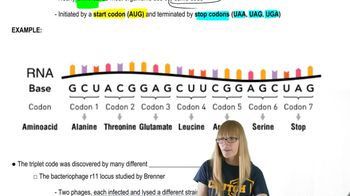
The genetic code consists of triplets of nucleotides called codons, each specifying a particular amino acid. Understanding how codons correspond to amino acids is essential to determine how single-base changes (mutations) can alter the encoded amino acid. Codons are read in a 5' to 3' direction and are degenerate, meaning multiple codons can code for the same amino acid.
Recommended video:
Guided course
The Genetic Code
Point Mutations and Single-Base Substitutions
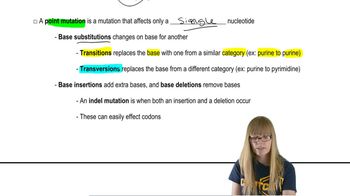
Point mutations involve the change of a single nucleotide base in the DNA sequence, which can lead to a different codon and thus a different amino acid in the protein. These substitutions can be transitions (purine to purine or pyrimidine to pyrimidine) or transversions (purine to pyrimidine or vice versa), affecting the protein's structure and function.
Recommended video:
Guided course
Point Mutations
Amino Acid Properties and Codon Changes
Amino acids differ in their chemical properties, and substitutions often reflect changes in codons that alter these properties. By comparing the codons for the original and substituted amino acids, one can identify the specific single-base changes responsible. This analysis helps explain evolutionary differences and functional impacts in proteins like insulin.
Recommended video:
Guided course
Point Mutations
Related Videos
Related Practice
Textbook Question
713
views