Pearson+ LogoPearson+ Logo
Ch. 13 - The Genetic Code and Transcription
Klug - Concepts of Genetics  12th Edition
Klug12th EditionConcepts of Genetics ISBN: 9780135564776Not the one you use?Change textbook
Chapter 13, Problem 33b

Isoginkgetin is a cell-permeable chemical isolated from the Ginkgo biloba tree that binds to and inhibits snRNPs.
Would this be most problematic for E. coli cells, yeast cells, or human cells? Why?

Verified step by step guidance
1
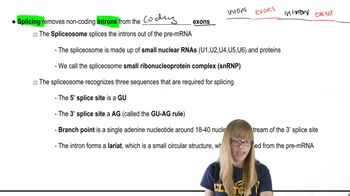
Understand the role of snRNPs (small nuclear ribonucleoproteins): These are essential components of the spliceosome, which is responsible for the removal of introns from pre-mRNA during RNA splicing in eukaryotic cells.
Recognize that E. coli cells are prokaryotic and do not have introns in their genes. Therefore, they do not require snRNPs or a spliceosome for gene expression.
Identify that yeast cells are eukaryotic and, like human cells, have introns in their genes. They rely on snRNPs for RNA splicing to produce mature mRNA.
Understand that human cells, being eukaryotic, also depend on snRNPs for RNA splicing. However, human cells typically have more complex splicing requirements due to the presence of alternative splicing, which allows a single gene to produce multiple proteins.
Conclude that the inhibition of snRNPs by isoginkgetin would not affect E. coli cells but would be problematic for yeast and human cells. Among these, human cells might be more severely affected due to their reliance on alternative splicing for generating protein diversity.

Verified video answer for a similar problem:

This video solution was recommended by our tutors as helpful for the problem above.
Video duration:
3m
Was this helpful?

Key Concepts

Here are the essential concepts you must grasp in order to answer the question correctly.

snRNPs (small nuclear ribonucleoproteins)

snRNPs are essential components of the spliceosome, a complex responsible for the splicing of pre-mRNA in eukaryotic cells. They play a critical role in the removal of introns and the joining of exons, which is vital for producing mature mRNA that can be translated into proteins.
Recommended video:
Guided course
08:39
mRNA Processing

Eukaryotic vs. Prokaryotic Cells

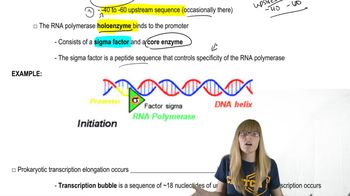
Eukaryotic cells, such as those in yeast and humans, have a defined nucleus and complex organelles, while prokaryotic cells, like E. coli, lack a nucleus and have a simpler structure. This distinction is crucial because snRNPs are primarily involved in processes that occur in eukaryotic cells, making them less relevant in prokaryotic organisms.
Recommended video:
Guided course
10:14
Prokaryotic Transcription

Impact of Inhibiting snRNPs

Inhibiting snRNPs would disrupt the splicing process in eukaryotic cells, leading to the production of improperly processed mRNA and potentially nonfunctional proteins. This disruption can severely affect cellular function and viability, particularly in human and yeast cells, which rely on accurate mRNA splicing for gene expression.
Recommended video:
Guided course
11:19
Segmentation Genes
Related Practice
Textbook Question

M. Klemke et al. (2001) discovered an interesting coding phenomenon in which an exon within a neurologic hormone receptor gene in mammals appears to produce two different protein entities (and ALEX). The following is the DNA sequence of the exon's end derived from a rat.

 5'-gtcccaaccatgcccaccgatcttccgcctgcttctgaagATGCGGGCCCAG

The lowercase letters represent the initial coding portion for the protein, and the uppercase letters indicate the portion where the ALEX entity is initiated. (For simplicity, and to correspond with the RNA coding dictionary, it is customary to represent the coding (non-template) strand of the DNA segment.)

Are there any evolutionary advantages to having the same DNA sequence code for two protein products? Are there any disadvantages?

610
views
Textbook Question

Recent observations indicate that alternative splicing is a common way for eukaryotes to expand their repertoire of gene functions. Studies indicate that approximately 50 percent of human genes exhibit alternative splicing and approximately 15 percent of disease-causing mutations involve aberrant alternative splicing. Different tissues show remarkably different frequencies of alternative splicing, with the brain accounting for approximately 18 percent of such events [Xu et al. (2002). Nucl. Acids Res. 30:3754–3766].

Why might some tissues engage in more alternative splicing than others?

439
views
Textbook Question

Isoginkgetin is a cell-permeable chemical isolated from the Ginkgo biloba tree that binds to and inhibits snRNPs.

What types of problems would you anticipate in cells treated with isoginkgetin?

596
views