Pearson+ LogoPearson+ Logo
Ch. 13 - The Genetic Code and Transcription
Klug - Concepts of Genetics  12th Edition
Klug12th EditionConcepts of Genetics ISBN: 9780135564776Not the one you use?Change textbook
Chapter 13, Problem 1a

Why did geneticists believe, even before direct experimental evidence was obtained, that the genetic code would turn out to be composed of triplet sequences and be nonoverlapping? Experimentally, how were these suppositions shown to be correct?

Verified step by step guidance
1
Understand the concept of the genetic code: The genetic code is the set of rules by which information encoded in DNA or RNA sequences is translated into proteins. Each amino acid is specified by a sequence of nucleotides in the mRNA, known as a codon.
Explain why geneticists hypothesized a triplet code: Geneticists reasoned that a triplet code was necessary because there are 20 amino acids to encode, and a single nucleotide (4 possibilities: A, U, G, C) or a doublet (4^2 = 16 combinations) would not provide enough combinations to specify all amino acids. A triplet code (4^3 = 64 combinations) provides sufficient combinations to encode all amino acids.
Discuss the nonoverlapping nature of the genetic code: Geneticists proposed that the code is nonoverlapping because overlapping sequences would lead to ambiguity in translation. For example, if codons overlapped, a single nucleotide change could affect multiple amino acids, which is not consistent with observed protein synthesis.
Describe experimental evidence for the triplet code: Experiments by Crick and colleagues using frameshift mutations demonstrated that inserting or deleting one or two nucleotides disrupted the reading frame, leading to nonfunctional proteins. However, inserting or deleting three nucleotides restored the reading frame, supporting the triplet nature of the code.
Explain experimental evidence for nonoverlapping codons: Studies of point mutations showed that a single nucleotide change affected only one amino acid in the protein sequence, rather than multiple amino acids. This provided strong evidence that codons are read sequentially and do not overlap.

Verified video answer for a similar problem:

This video solution was recommended by our tutors as helpful for the problem above.
Video duration:
1m
Was this helpful?

Key Concepts

Here are the essential concepts you must grasp in order to answer the question correctly.

Genetic Code

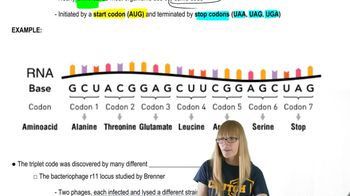
The genetic code is a set of rules that defines how the sequence of nucleotides in DNA is translated into the amino acid sequence of proteins. It is composed of codons, which are triplet sequences of nucleotides. Each codon corresponds to a specific amino acid or a stop signal during protein synthesis, making the code essential for understanding how genetic information is expressed.
Recommended video:
Guided course
11:43
The Genetic Code

Triplet Codons

Triplet codons are sequences of three nucleotides that encode a single amino acid in the process of translation. Geneticists hypothesized that the code was triplet-based because there are 20 standard amino acids, and using combinations of three nucleotides (4^3 = 64 possible combinations) provides sufficient diversity to encode all amino acids and stop signals. This triplet nature was crucial for the nonoverlapping characteristic of the genetic code.
Recommended video:
Guided course
11:43
The Genetic Code

Experimental Validation

Experimental validation of the genetic code's triplet and nonoverlapping nature was achieved through various methods, including the use of synthetic RNA and ribosomes. By introducing specific RNA sequences and observing the resulting protein synthesis, researchers demonstrated that the reading frame of the RNA was maintained without overlap, confirming that each codon was read independently and sequentially, thus supporting the initial hypotheses.
Recommended video:
Guided course
05:48
Transformation