Pearson+ LogoPearson+ Logo
Ch. 13 - The Genetic Code and Transcription
Klug - Concepts of Genetics  12th Edition
Klug12th EditionConcepts of Genetics ISBN: 9780135564776Not the one you use?Change textbook
Chapter 13, Problem 22

Present an overview of various forms of posttranscriptional RNA processing in eukaryotes. For each, provide an example.

Verified step by step guidance
1
Understand that posttranscriptional RNA processing refers to the modifications that a primary RNA transcript undergoes to become a mature RNA molecule.
Identify the main types of posttranscriptional RNA processing in eukaryotes: 5' capping, 3' polyadenylation, splicing, RNA editing, and RNA transport.
5' capping: This involves the addition of a 7-methylguanylate cap to the 5' end of the RNA transcript. Example: The capping of mRNA in eukaryotic cells.
3' polyadenylation: This process adds a poly(A) tail to the 3' end of the RNA molecule. Example: The polyadenylation of mRNA, which aids in stability and export from the nucleus.
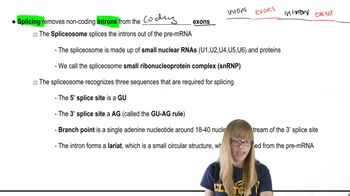
Splicing: This involves the removal of introns and joining of exons. Example: The splicing of pre-mRNA in eukaryotic cells to form mature mRNA.

Verified video answer for a similar problem:

This video solution was recommended by our tutors as helpful for the problem above.
Video duration:
1m
Was this helpful?

Key Concepts

Here are the essential concepts you must grasp in order to answer the question correctly.

Posttranscriptional RNA Processing

Posttranscriptional RNA processing refers to the modifications that RNA undergoes after transcription but before translation in eukaryotic cells. This includes several key processes that enhance the stability and functionality of RNA molecules, ensuring that they are properly prepared for protein synthesis.
Recommended video:
Guided course
08:39
mRNA Processing

Capping and Polyadenylation

Capping involves the addition of a 7-methylguanylate cap to the 5' end of the RNA transcript, which protects the RNA from degradation and assists in ribosome binding during translation. Polyadenylation adds a poly(A) tail to the 3' end, which also stabilizes the RNA and facilitates its export from the nucleus.
Recommended video:
Guided course
08:39
mRNA Processing

Splicing

Splicing is the process by which introns, or non-coding regions, are removed from the pre-mRNA transcript, and exons, or coding regions, are joined together. This process is crucial for generating mature mRNA that accurately reflects the coding sequence of the gene, allowing for the correct synthesis of proteins.
Recommended video:
Guided course
08:39
mRNA Processing
Related Practice
Textbook Question

Describe the structure of RNA polymerase in bacteria. What is the core enzyme? What is the role of the σ subunit?

875
views
Textbook Question

Write a paragraph describing the abbreviated chemical reactions that summarize RNA polymerase-directed transcription.

534
views
Textbook Question

Messenger RNA molecules are very difficult to isolate in bacteria because they are rather quickly degraded in the cell. Can you suggest a reason why this occurs? Eukaryotic mRNAs are more stable and exist longer in the cell than do bacterial mRNAs. Is this an advantage or a disadvantage for a pancreatic cell making large quantities of insulin?

614
views
Textbook Question

One form of posttranscriptional modification of most eukaryotic pre-mRNAs is the addition of a poly-A sequence at the 3' end. The absence of a poly-A sequence leads to rapid degradation of the transcript. Poly-A sequences of various lengths are also added to many bacterial RNA transcripts where, instead of promoting stability, they enhance degradation. In both cases, RNA secondary structures, stabilizing proteins, or degrading enzymes interact with poly-A sequences. Considering the activities of RNAs, what might be general functions of 3'-polyadenylation?

567
views
Textbook Question

Describe the role of two forms of RNA editing that lead to changes in the size and sequence of pre-mRNAs. Briefly describe several examples of each form of editing, including their impact on respective protein products.

524
views
Textbook Question

Substitution RNA editing is known to involve either C-to-U or A-to-I conversions. What common chemical event accounts for each?

589
views