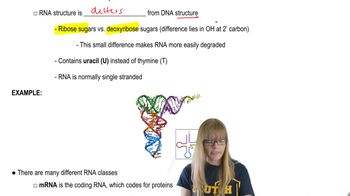
Present an overview of various forms of posttranscriptional RNA processing in eukaryotes. For each, provide an example.

Substitution RNA editing is known to involve either C-to-U or A-to-I conversions. What common chemical event accounts for each?
Verified step by step guidance
Verified video answer for a similar problem:
Key Concepts
RNA Editing
C-to-U Conversion
A-to-I Conversion
One form of posttranscriptional modification of most eukaryotic pre-mRNAs is the addition of a poly-A sequence at the 3' end. The absence of a poly-A sequence leads to rapid degradation of the transcript. Poly-A sequences of various lengths are also added to many bacterial RNA transcripts where, instead of promoting stability, they enhance degradation. In both cases, RNA secondary structures, stabilizing proteins, or degrading enzymes interact with poly-A sequences. Considering the activities of RNAs, what might be general functions of 3'-polyadenylation?
Describe the role of two forms of RNA editing that lead to changes in the size and sequence of pre-mRNAs. Briefly describe several examples of each form of editing, including their impact on respective protein products.
It has been suggested that the present-day triplet genetic code evolved from a doublet code when there were fewer amino acids available for primitive protein synthesis.
Can you find any support for the doublet code notion in the existing coding dictionary?
It has been suggested that the present-day triplet genetic code evolved from a doublet code when there were fewer amino acids available for primitive protein synthesis.
The amino acids Ala, Val, Gly, Asp, and Glu are all early members of biosynthetic pathways and are more evolutionarily conserved than other amino acids. They therefore probably represent 'early' amino acids. Of what significance is this information in terms of the evolution of the genetic code? Also, which base, of the first two within a coding triplet, would likely have been the more significant in originally specifying these amino acids?
It has been suggested that the present-day triplet genetic code evolved from a doublet code when there were fewer amino acids available for primitive protein synthesis.
As determined by comparisons of ancient and recently evolved proteins, cysteine, tyrosine, and phenylalanine appear to be late-arriving amino acids. In addition, they are considered to have been absent in the abiotic Earth. All three of these amino acids have only two codons each, while many others, earlier in origin, have more. Is this mere coincidence, or might there be some underlying explanation?
