Pearson+ LogoPearson+ Logo
Ch. 13 - The Genetic Code and Transcription
Klug - Concepts of Genetics  12th Edition
Klug12th EditionConcepts of Genetics ISBN: 9780135564776Not the one you use?Change textbook
Chapter 13, Problem 19

Describe the structure of RNA polymerase in bacteria. What is the core enzyme? What is the role of the σ subunit?

Verified step by step guidance
1
Begin by explaining that bacterial RNA polymerase is a multi-subunit enzyme responsible for synthesizing RNA from a DNA template during transcription.
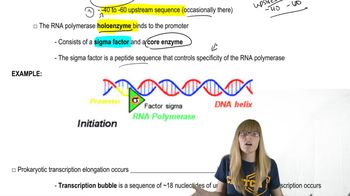
Describe the overall structure of bacterial RNA polymerase, which consists of a core enzyme and an additional subunit called sigma (σ). The core enzyme is composed of five subunits: two alpha (\alpha) subunits, one beta (\beta), one beta prime (\beta\'), and one omega (\omega) subunit.
Clarify that the core enzyme (\alpha_2\beta\beta\'\omega) is capable of elongating the RNA chain but cannot initiate transcription on its own because it lacks specificity for promoter regions on DNA.
Explain that the sigma (σ) subunit associates with the core enzyme to form the holoenzyme, which is necessary for the initiation phase of transcription. The σ subunit recognizes and binds to specific promoter sequences on the DNA, guiding the RNA polymerase to the correct start site.
Summarize that once transcription is initiated, the σ subunit often dissociates from the core enzyme, allowing the core enzyme to continue RNA synthesis during elongation.

Verified video answer for a similar problem:

This video solution was recommended by our tutors as helpful for the problem above.
Video duration:
2m
Was this helpful?

Key Concepts

Here are the essential concepts you must grasp in order to answer the question correctly.

Structure of Bacterial RNA Polymerase

Bacterial RNA polymerase is a multi-subunit enzyme responsible for synthesizing RNA from a DNA template. It typically consists of a core enzyme made up of five subunits (2 α, β, β', and ω) and a sigma (σ) factor that associates transiently. This complex structure allows the enzyme to perform transcription efficiently.
Recommended video:

Core Enzyme of RNA Polymerase

The core enzyme of bacterial RNA polymerase includes the subunits α2, β, β', and ω. It carries out the catalytic activity of RNA synthesis but cannot initiate transcription on its own. The core enzyme binds to DNA and elongates the RNA chain once transcription has started.
Recommended video:

Role of the Sigma (σ) Subunit

The sigma (σ) subunit is a detachable factor that directs the RNA polymerase core enzyme to specific promoter regions on the DNA. It enables the enzyme to recognize and bind to the correct initiation sites, facilitating the start of transcription. After initiation, the σ subunit often dissociates from the core enzyme.
Recommended video:
Guided course
10:14
Prokaryotic Transcription