Pearson+ LogoPearson+ Logo
Ch. 14 - Translation and Proteins
Klug - Concepts of Genetics  12th Edition
Klug12th EditionConcepts of Genetics ISBN: 9780135564776Not the one you use?Change textbook
Chapter 14, Problem 35

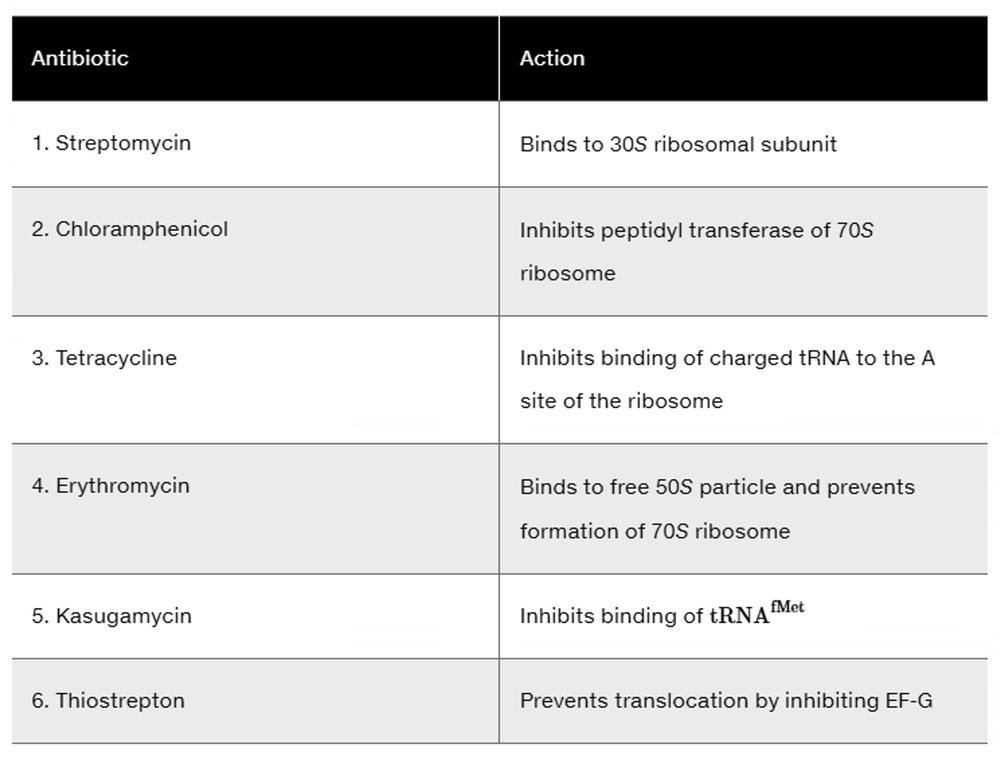
Many antibiotics are effective as drugs to fight off bacterial infections because they inhibit protein synthesis in bacterial cells. Using the information provided in the following table that highlights several antibiotics and their mode of action, discuss which phase of translation is inhibited: initiation, elongation, or termination. What other components of the translational machinery could be targeted to inhibit bacterial protein synthesis?
Table listing six antibiotics and their actions inhibiting bacterial protein synthesis at various translation stages.

Verified step by step guidance
1
Review the phases of translation: initiation (assembly of the ribosome on mRNA and start codon recognition), elongation (addition of amino acids to the growing polypeptide chain), and termination (release of the completed polypeptide when a stop codon is reached).
Examine the mode of action of each antibiotic listed in the table to determine which specific step of translation it affects. For example, if an antibiotic prevents the formation of the initiation complex, it inhibits initiation; if it blocks the movement of the ribosome along mRNA or the addition of amino acids, it inhibits elongation; if it interferes with release factors or ribosome disassembly, it inhibits termination.
Identify the molecular targets of these antibiotics, such as the 30S or 50S ribosomal subunits, tRNA binding sites (A, P, or E sites), or factors involved in translation (e.g., initiation factors, elongation factors, or release factors).
Discuss other components of the translational machinery that could be targeted to inhibit bacterial protein synthesis, such as aminoacyl-tRNA synthetases (which charge tRNAs with amino acids), ribosomal RNA, or specific translation factors unique to bacteria.
Summarize how targeting different phases or components of translation can effectively inhibit bacterial protein synthesis and why this specificity is important for antibiotic function.

Verified video answer for a similar problem:

This video solution was recommended by our tutors as helpful for the problem above.
Video duration:
1m
Was this helpful?

Key Concepts

Here are the essential concepts you must grasp in order to answer the question correctly.

Phases of Translation

Translation is the process of protein synthesis and occurs in three main phases: initiation, elongation, and termination. Initiation involves assembly of the ribosome on mRNA and the start tRNA, elongation adds amino acids to the growing polypeptide chain, and termination releases the completed protein when a stop codon is reached.
Recommended video:
Guided course
07:58
Translation initiation

Mechanism of Antibiotic Action on Translation

Many antibiotics inhibit bacterial protein synthesis by targeting specific steps in translation. For example, some block initiation by preventing ribosome assembly, others inhibit elongation by interfering with tRNA binding or peptide bond formation, and some affect termination by disrupting release factors. Understanding these mechanisms helps identify which phase is inhibited.
Recommended video:
Guided course
07:58
Translation initiation

Components of the Translational Machinery as Drug Targets

The translational machinery includes ribosomal subunits, mRNA, tRNAs, aminoacyl-tRNA synthetases, and various translation factors. Antibiotics can target any of these components to inhibit protein synthesis, such as binding to the 30S or 50S ribosomal subunits, blocking tRNA charging, or interfering with elongation factors, thereby halting bacterial growth.
Recommended video:
Guided course
07:58
Translation initiation
Related Practice
Textbook Question

Three independently assorting genes (A, B, and C) are known to control the following biochemical pathway that provides the basis for flower color in a hypothetical plant:

Three homozygous recessive mutations are also known, each of which interrupts a different one of these steps. Determine the phenotypic results in the F1 and F2 generations resulting from the P1 crosses of true-breeding plants listed here:

colorless (aaBBCC) × green (AABBcc)

676
views
Textbook Question

How would the results vary in cross (a) of Problem 32 if genes A and B were linked with no crossing over between them? How would the results of cross (a) vary if genes A and B were linked and 20 map units (mu) apart?

758
views
Textbook Question

Deep in a previously unexplored South American rain forest, a plant species was discovered with true-breeding varieties whose flowers were pink, rose, orange, or purple. A very astute plant geneticist made a single cross, carried to the F₂ generation, as shown:

P₁: purple × pink

F₁: all purple

F₂: 27/64 purple 16/64 pink 12/64 rose 9/64 orange

Based solely on these data, he proposed both a mode of inheritance for flower pigmentation and a biochemical pathway for the synthesis of these pigments. Carefully study the data. Create a hypothesis of your own to explain the mode of inheritance. Then propose a biochemical pathway consistent with your hypothesis. How could you test the hypothesis by making other crosses?

529
views
Textbook Question

The flow of genetic information from DNA to protein is mediated by messenger RNA. If you introduce short DNA strands (called antisense oligonucleotides) that are complementary to mRNAs, hydrogen bonding may occur and 'label' the DNA/RNA hybrid for ribonuclease-H degradation of the RNA. One study [Lloyd et al. (2001). Nucl. Acids Res. 29:3664–3673] compared the effect of different-length antisense oligonucleotides upon ribonuclease-H–mediated degradation of tumor necrosis factor (TNFα) mRNA. TNFα exhibits antitumor and pro-inflammatory activities. The following graph indicates the efficacy of various-sized antisense oligonucleotides in causing ribonuclease-H cleavage. Describe how antisense oligonucleotides interrupt the flow of genetic information in a cell.

1212
views
Textbook Question

The flow of genetic information from DNA to protein is mediated by messenger RNA. If you introduce short DNA strands (called antisense oligonucleotides) that are complementary to mRNAs, hydrogen bonding may occur and 'label' the DNA/RNA hybrid for ribonuclease-H degradation of the RNA. One study [Lloyd et al. (2001). Nucl. Acids Res. 29:3664–3673] compared the effect of different-length antisense oligonucleotides upon ribonuclease-H–mediated degradation of tumor necrosis factor (TNFα) mRNA. TNFα exhibits antitumor and pro-inflammatory activities. The following graph indicates the efficacy of various-sized antisense oligonucleotides in causing ribonuclease-H cleavage. What general conclusion can be drawn from the graph?

539
views
Textbook Question

The flow of genetic information from DNA to protein is mediated by messenger RNA. If you introduce short DNA strands (called antisense oligonucleotides) that are complementary to mRNAs, hydrogen bonding may occur and 'label' the DNA/RNA hybrid for ribonuclease-H degradation of the RNA. One study [Lloyd et al. (2001). Nucl. Acids Res. 29:3664–3673] compared the effect of different-length antisense oligonucleotides upon ribonuclease-H–mediated degradation of tumor necrosis factor (TNFα) mRNA. TNFα exhibits antitumor and pro-inflammatory activities. The following graph indicates the efficacy of various-sized antisense oligonucleotides in causing ribonuclease-H cleavage. What factors other than oligonucleotide length are likely to influence antisense efficacy in vivo?

662
views