
Pearson+ LogoPearson+ Logo
Ch. 14 - Translation and Proteins
Klug - Concepts of Genetics  12th Edition
Klug12th EditionConcepts of Genetics ISBN: 9780135564776Not the one you use?Change textbook
Chapter 14, Problem 32c

Three independently assorting genes (A, B, and C) are known to control the following biochemical pathway that provides the basis for flower color in a hypothetical plant:
Biochemical pathway showing flower color progression: colorless to yellow to green to speckled via genes A, B, and C.
Three homozygous recessive mutations are also known, each of which interrupts a different one of these steps. Determine the phenotypic results in the F1 and F2 generations resulting from the P1 crosses of true-breeding plants listed here:
colorless (aaBBCC) × green (AABBcc)

Verified step by step guidance
1
Identify the genotypes of the parent plants: one is colorless with genotype aaBBCC, and the other is green with genotype AABBcc. Each gene (A, B, C) controls a step in the pathway, and recessive homozygous mutations interrupt these steps.
Determine the F1 genotype by crossing the parents: since the parents are homozygous, the F1 offspring will be heterozygous at all loci where parents differ. The F1 genotype will be AaBbCc.
Analyze the F1 phenotype by considering the pathway and dominance: since A, B, and C are dominant alleles, the F1 plant will have all dominant alleles present, allowing the pathway to proceed fully to the speckled phenotype.
Set up the F2 generation by self-crossing the F1 plants (AaBbCc × AaBbCc). Use a Punnett square or the product rule to determine the genotypic ratios for each gene independently, as the genes assort independently.
Determine the phenotypic classes in the F2 by applying the pathway logic: for each genotype, check if the dominant allele is present at each gene to allow progression through the pathway steps (colorless → yellow → green → speckled). For example, if a plant is homozygous recessive at gene A (aa), it will be colorless regardless of B and C genotypes, and so on.

Verified video answer for a similar problem:

This video solution was recommended by our tutors as helpful for the problem above.
Video duration:
2m
Was this helpful?

Key Concepts

Here are the essential concepts you must grasp in order to answer the question correctly.

Independent Assortment of Genes

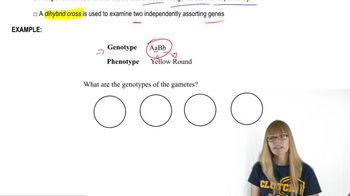
Independent assortment refers to the principle that genes located on different chromosomes are inherited independently of each other. In this question, genes A, B, and C assort independently, meaning the alleles for each gene segregate without influencing the others, which affects the genotypic and phenotypic ratios in offspring.
Recommended video:
Guided course
04:58
Gamete Genetics and Independent Assortment

Biochemical Pathway and Gene Function

The biochemical pathway shows a sequential process where each gene controls a step converting one pigment to another: A converts colorless to yellow, B converts yellow to green, and C converts green to speckled. Mutations in any gene block the pathway at that step, resulting in accumulation of the previous pigment and affecting flower color.
Recommended video:
Guided course
08:26
Functional Genomics

Genotypic and Phenotypic Ratios in Crosses

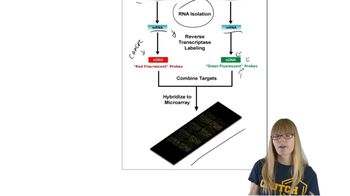
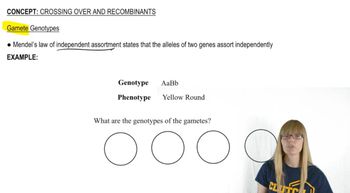
Understanding how to predict F1 and F2 generation phenotypes requires knowledge of Mendelian genetics, including how homozygous recessive mutations affect phenotype and how to use Punnett squares to determine offspring genotypes and phenotypes from given parental crosses.
Recommended video:
Guided course
07:52
Gamete Genotypes
Related Practice
Textbook Question

Exon shuffling is a proposal that relates exons in DNA to the repositioning of functional domains in proteins. What evidence exists in support of exon shuffling?

904
views
Textbook Question

Three independently assorting genes (A, B, and C) are known to control the following biochemical pathway that provides the basis for flower color in a hypothetical plant:

Three homozygous recessive mutations are also known, each of which interrupts a different one of these steps. Determine the phenotypic results in the F1 and F2 generations resulting from the P1 crosses of true-breeding plants listed here:

speckled (AABBCC) × yellow (AAbbCC)

845
views
Textbook Question

Three independently assorting genes (A, B, and C) are known to control the following biochemical pathway that provides the basis for flower color in a hypothetical plant:

Three homozygous recessive mutations are also known, each of which interrupts a different one of these steps. Determine the phenotypic results in the F1 and F2 generations resulting from the P1 crosses of true-breeding plants listed here:

yellow (AAbbCC) × green (AABBcc)

529
views
Textbook Question

How would the results vary in cross (a) of Problem 32 if genes A and B were linked with no crossing over between them? How would the results of cross (a) vary if genes A and B were linked and 20 map units (mu) apart?

758
views
Textbook Question

Deep in a previously unexplored South American rain forest, a plant species was discovered with true-breeding varieties whose flowers were pink, rose, orange, or purple. A very astute plant geneticist made a single cross, carried to the F₂ generation, as shown:

P₁: purple × pink

F₁: all purple

F₂: 27/64 purple 16/64 pink 12/64 rose 9/64 orange

Based solely on these data, he proposed both a mode of inheritance for flower pigmentation and a biochemical pathway for the synthesis of these pigments. Carefully study the data. Create a hypothesis of your own to explain the mode of inheritance. Then propose a biochemical pathway consistent with your hypothesis. How could you test the hypothesis by making other crosses?

529
views
Textbook Question

Many antibiotics are effective as drugs to fight off bacterial infections because they inhibit protein synthesis in bacterial cells. Using the information provided in the following table that highlights several antibiotics and their mode of action, discuss which phase of translation is inhibited: initiation, elongation, or termination. What other components of the translational machinery could be targeted to inhibit bacterial protein synthesis?

843
views