How do the ENCODE data vastly help determine which enhancers regulate which genes?

Explain how the following mutations would affect transcription of the yeast GAL1 gene in the presence of galactose.
A deletion within the GAL4 gene that removes the region encoding amino acids 1 to 100.
Verified step by step guidance
Verified video answer for a similar problem:
Key Concepts
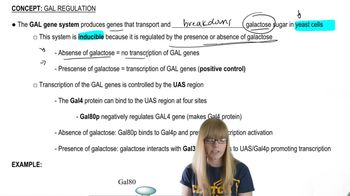
Function of the GAL4 Protein
Impact of Protein Domain Deletions on Function
Regulation of GAL1 Gene Expression by Galactose
DNA supercoiling, which occurs when coiling tension is generated ahead of the replication fork, is relieved by DNA gyrase. Supercoiling may also be involved in transcription regulation. Researchers discovered that enhancers operating over a long distance (2500 bp) are dependent on DNA supercoiling, while enhancers operating over shorter distances (110 bp) are not so dependent [Liu et al. (2001). Proc. Natl. Acad. Sci. USA 98:14,883–14,888]. Using a diagram, suggest a way in which supercoiling may positively influence enhancer activity over long distances.
Because the degree of DNA methylation appears to be a relatively reliable genetic marker for some forms of cancer, researchers have explored the possibility of altering DNA methylation as a form of cancer therapy. Initial studies indicate that while hypomethylation suppresses the formation of some tumors, other tumors thrive. Why would one expect different cancers to respond differently to either hypomethylation or hypermethylation therapies?
Explain how the following mutations would affect transcription of the yeast GAL1 gene in the presence of galactose.
A deletion of the entire GAL3 gene.
Explain how the following mutations would affect transcription of the yeast GAL1 gene in the presence of galactose.
A mutation within the GAL80 gene that blocks the ability of Gal80 protein to interact with Gal3p.
Explain how the following mutations would affect transcription of the yeast GAL1 gene in the presence of galactose.
A deletion of one of the four UASG elements upstream from the GAL1 gene.
