Pearson+ LogoPearson+ Logo
Ch. 17 - Transcriptional Regulation in Eukaryotes
Klug - Concepts of Genetics  12th Edition
Klug12th EditionConcepts of Genetics ISBN: 9780135564776Not the one you use?Change textbook
Chapter 17, Problem 22c

Explain how the following mutations would affect transcription of the yeast GAL1 gene in the presence of galactose.
A mutation within the GAL80 gene that blocks the ability of Gal80 protein to interact with Gal3p.

Verified step by step guidance
1
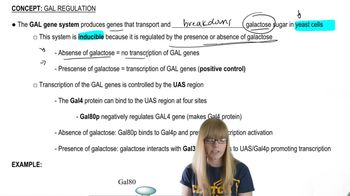
Understand the normal regulatory mechanism of the GAL1 gene in yeast: In the presence of galactose, Gal3p binds galactose and interacts with Gal80 protein, which normally inhibits the transcriptional activator Gal4p. This interaction releases Gal4p to activate transcription of GAL1.
Identify the role of the GAL80 gene product: Gal80 protein acts as a repressor by binding to Gal4p and preventing it from activating transcription when galactose is absent.
Analyze the effect of the mutation in GAL80 that blocks its interaction with Gal3p: Since Gal80 cannot bind Gal3p, the normal galactose-induced relief of repression cannot occur.
Predict the consequence on GAL1 transcription in the presence of galactose: Because Gal80 remains bound to Gal4p (not released by Gal3p), Gal4p remains inhibited, leading to reduced or no transcription of GAL1 despite the presence of galactose.
Summarize the overall effect: The mutation causes a failure in the induction of GAL1 transcription by galactose, effectively keeping the gene turned off even when galactose is available.

Verified video answer for a similar problem:

This video solution was recommended by our tutors as helpful for the problem above.
Video duration:
3m
Was this helpful?

Key Concepts

Here are the essential concepts you must grasp in order to answer the question correctly.

GAL1 Gene Regulation in Yeast

The GAL1 gene in yeast encodes galactokinase, essential for galactose metabolism. Its transcription is tightly regulated by the presence of galactose, involving a network of proteins that either activate or repress gene expression depending on environmental conditions.
Recommended video:
Guided course
03:51
GAL Regulation

Role of Gal80 and Gal3 Proteins

Gal80 is a repressor protein that binds to the activator Gal4, preventing transcription of GAL genes. Gal3 acts as a sensor for galactose and, upon binding galactose, interacts with Gal80 to relieve its repression, allowing transcription to proceed.
Recommended video:

Effect of Mutations Disrupting Gal80-Gal3 Interaction

A mutation in GAL80 that blocks its interaction with Gal3 prevents Gal80 from being inactivated in the presence of galactose. This results in continued repression of GAL1 transcription despite galactose availability, as Gal80 remains bound to Gal4, inhibiting gene activation.
Recommended video:
Guided course
03:38
Maternal Effect
Related Practice
Textbook Question

Because the degree of DNA methylation appears to be a relatively reliable genetic marker for some forms of cancer, researchers have explored the possibility of altering DNA methylation as a form of cancer therapy. Initial studies indicate that while hypomethylation suppresses the formation of some tumors, other tumors thrive. Why would one expect different cancers to respond differently to either hypomethylation or hypermethylation therapies?

619
views
Textbook Question

Explain how the following mutations would affect transcription of the yeast GAL1 gene in the presence of galactose.

A deletion within the GAL4 gene that removes the region encoding amino acids 1 to 100.

517
views
Textbook Question

Explain how the following mutations would affect transcription of the yeast GAL1 gene in the presence of galactose.

A deletion of the entire GAL3 gene.

436
views
Textbook Question

Explain how the following mutations would affect transcription of the yeast GAL1 gene in the presence of galactose.

A deletion of one of the four UASG elements upstream from the GAL1 gene.

558
views
Textbook Question

Explain how the following mutations would affect transcription of the yeast GAL1 gene in the presence of galactose.

A point mutation in the GAL1 core promoter that alters the sequence of the TATA box.

510
views
Textbook Question

The interphase nucleus is a highly structured organelle with chromosome territories, interchromatin compartments, and transcription factories. In cultured human cells, researchers have identified approximately 8000 transcription factories per cell, each containing an average of eight tightly associated RNAP II molecules actively transcribing RNA. If each RNAP II molecule is transcribing a different gene, how might such a transcription factory appear? Provide a simple diagram that shows eight different genes being transcribed in a transcription factory and include the promoters, structural genes, and nascent transcripts in your presentation.

506
views