Pearson+ LogoPearson+ Logo
Ch. 17 - Transcriptional Regulation in Eukaryotes
Klug - Concepts of Genetics  12th Edition
Klug12th EditionConcepts of Genetics ISBN: 9780135564776Not the one you use?Change textbook
Chapter 17, Problem 31

Transcription factors play key roles in the regulation of gene expression, but to do so, they must act within the nucleus. Like most proteins, however, transcription factors are translated in the cytoplasm. To enter the nucleus, transcription factors contain nuclear localization signals, which in some cases can work only when bound to some other molecule such as a steroid hormone. After entering the nucleus, transcription factors must bind to appropriate DNA sites and must interact with other transcription proteins at promoters, enhancers, and silencers. Transcription factors then activate or repress transcription through their activation or repression domains. Many drug therapies target transcription factors. Based on the information provided above, suggest three specific mechanisms through which a successful drug therapy, targeted to a transcription factor, might work.

Verified step by step guidance
1
Identify the key functional stages of transcription factors based on the passage: (1) entry into the nucleus via nuclear localization signals, (2) binding to DNA at promoters, enhancers, or silencers, and (3) activation or repression of transcription through their activation or repression domains.
Consider a drug that could interfere with the nuclear localization signal, preventing the transcription factor from entering the nucleus and thus blocking its ability to regulate gene expression.
Think about a drug that could inhibit the binding of the transcription factor to specific DNA sequences, such as promoters or enhancers, thereby preventing it from influencing transcription.
Explore the possibility of a drug that targets the activation or repression domains of the transcription factor, blocking its ability to activate or repress transcription even if it successfully binds DNA.
Summarize these mechanisms as distinct strategies: blocking nuclear entry, preventing DNA binding, and inhibiting transcriptional activation or repression, each representing a potential mode of drug action on transcription factors.

Verified video answer for a similar problem:

This video solution was recommended by our tutors as helpful for the problem above.
Video duration:
2m
Was this helpful?

Key Concepts

Here are the essential concepts you must grasp in order to answer the question correctly.

Nuclear Localization Signals (NLS)

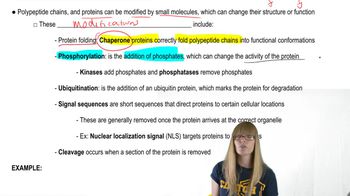
Nuclear localization signals are short amino acid sequences that direct proteins, like transcription factors, from the cytoplasm into the nucleus. Some NLSs require binding to other molecules, such as steroid hormones, to become active. Drugs can target these signals to block or enhance nuclear entry, thereby controlling transcription factor access to DNA.
Recommended video:
Guided course
04:30
Post Translational Modifications

DNA Binding and Regulatory Elements

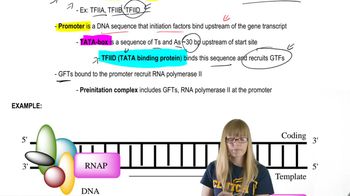
Transcription factors regulate gene expression by binding specific DNA sequences at promoters, enhancers, or silencers. This binding is essential for recruiting or blocking the transcription machinery. Therapeutic agents can interfere with this DNA binding to modulate gene expression, either preventing or promoting transcription factor attachment.
Recommended video:
Guided course
05:30
Human Transposable Elements

Activation and Repression Domains of Transcription Factors

Activation and repression domains are regions within transcription factors that interact with other proteins to increase or decrease transcription. Drugs can target these domains to inhibit or mimic their function, altering the transcription factor’s ability to regulate gene expression and thus influencing cellular behavior.
Recommended video:
Guided course
09:16
Eukaryotic Transcription
Related Practice
Textbook Question

Marine stickleback fish have pelvic fins with long spines that provide protection from larger predatory fish. Some stickleback fish were trapped in lakes and have adapted to life in a different environment. Many lake populations of stickleback fish lack pelvic fins. Shapiro et al. (2004) (Nature 428:717.723) mapped the mutation associated with the loss of pelvic fins to the Pitx1 locus, a gene expressed in pelvic fins, the pituitary gland, and the jaw. However, the coding sequence of the Pitx1 gene is identical in marine and lake stickleback [Chan et al. (2010). Science 327:5963,302–305]. Moreover, when the Pitx1 coding region is deleted, the fish die with defects in the pituitary gland and the jaw, and they lack pelvic fins. Explain how a mutation near, but outside of, the coding region of Pitx1 may cause a loss of pelvic fins without pleiotropic effects on the pituitary gland and jaw.

623
views
Textbook Question

Although a single activator may bind many enhancers in the genome to control several target genes, in many cases, the enhancers have some sequence conservation but are not all identical. Keeping this in mind, consider the following hypothetical example:

- Undifferentiated cells adopt different fates depending on the concentration of activator protein, Act1.

- A high concentration of Act1 leads to cell fate 1, an intermediate level leads to cell fate 2, and low levels to cell fate 3.

- Research shows that Act1 regulates the expression of three different target genes (A, B, and C) with each having an enhancer recognized by Act1 but a slightly different sequence that alters the affinity of Act1 for the enhancer. Act1 has a high affinity for binding the enhancer for gene A, a low affinity for the gene B enhancer, and an intermediate affinity for the gene C enhancer.

From these data, speculate on how Act1 concentrations can specify different cell fates through these three target genes? Furthermore, which target genes specify which fates?

597
views
Textbook Question

Hereditary spherocytosis (HS) is a disorder characterized by sphere-shaped red blood cells, anemia, and other abnormal traits. Ankyrin-1 (ANK1) is a protein that links membrane proteins to the cytoskeleton. Loss of this activity is associated biochemically to HS. However, Gallagher et al. (2010) (J. Clin. Invest. 120:4453–4465) show that HS can also be caused by mutations within a region from -282 to -101 relative to the transcriptional start site, which lead to constitutive transcriptional repression in erythroid cells due to local chromatin condensation. Propose a hypothesis for the function of the -282 to -101 region of the ANK1 gene.

789
views