Pearson+ LogoPearson+ Logo
Ch. 18 - Post-transcriptional Regulation in Eukaryotes
Klug - Concepts of Genetics  12th Edition
Klug12th EditionConcepts of Genetics ISBN: 9780135564776Not the one you use?Change textbook
Chapter 18, Problem 1c

How do we know that double-stranded RNA molecules can control gene expression?

Verified step by step guidance
1
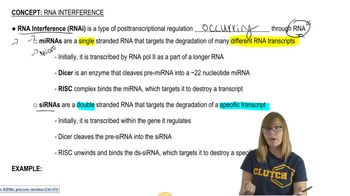
Understand the concept of RNA interference (RNAi), which is a biological process where double-stranded RNA (dsRNA) molecules inhibit gene expression by causing the degradation of specific messenger RNA (mRNA) molecules.
Review experimental evidence where researchers introduced synthetic double-stranded RNA into cells and observed a decrease in the expression of target genes, indicating that dsRNA can specifically silence genes.
Examine how the presence of dsRNA triggers the cellular machinery, such as the Dicer enzyme, to process dsRNA into small interfering RNAs (siRNAs), which then guide the RNA-induced silencing complex (RISC) to degrade complementary mRNA.
Consider control experiments where single-stranded RNA or unrelated dsRNA sequences do not cause gene silencing, demonstrating the specificity and necessity of dsRNA in controlling gene expression.
Summarize that the combination of these experimental approaches—introduction of dsRNA, observation of gene silencing, and identification of the molecular pathway—provides strong evidence that double-stranded RNA molecules can control gene expression posttranscriptionally.

Verified video answer for a similar problem:

This video solution was recommended by our tutors as helpful for the problem above.
Video duration:
49s
Was this helpful?

Key Concepts

Here are the essential concepts you must grasp in order to answer the question correctly.

RNA Interference (RNAi)

RNA interference is a biological process where double-stranded RNA (dsRNA) molecules inhibit gene expression by degrading complementary messenger RNA (mRNA). This mechanism allows cells to regulate genes posttranscriptionally and is a key method for gene silencing.
Recommended video:
Guided course
06:59
RNA Interference

Experimental Evidence Using dsRNA

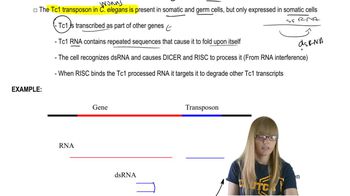
Scientists demonstrated that introducing dsRNA into cells leads to specific gene silencing by observing reduced protein or mRNA levels of target genes. These experiments, such as those in C. elegans, provided direct evidence that dsRNA can control gene expression.
Recommended video:

Role of Dicer and RISC Complex

Dicer is an enzyme that processes dsRNA into small interfering RNAs (siRNAs), which are then incorporated into the RNA-induced silencing complex (RISC). RISC uses siRNAs to recognize and degrade target mRNA, explaining the molecular mechanism behind dsRNA-mediated gene regulation.
Recommended video: