Pearson+ LogoPearson+ Logo
Ch. 18 - Post-transcriptional Regulation in Eukaryotes
Klug - Concepts of Genetics  12th Edition
Klug12th EditionConcepts of Genetics ISBN: 9780135564776Not the one you use?Change textbook
Chapter 18, Problem 1d

How do we know that microRNAs negatively regulate target mRNAs?

Verified step by step guidance
1
Understand that microRNAs (miRNAs) are small non-coding RNA molecules that regulate gene expression by binding to complementary sequences on target mRNAs, leading to their degradation or translational repression.
Review experimental approaches such as reporter assays where a reporter gene is fused to the target mRNA sequence; observe that the presence of specific miRNAs reduces reporter gene expression, indicating negative regulation.
Examine loss-of-function and gain-of-function experiments: knocking down or deleting a miRNA leads to increased levels of its target mRNA or protein, while overexpressing the miRNA decreases target expression.
Consider biochemical methods like RNA immunoprecipitation to show physical association between miRNAs and their target mRNAs within the RNA-induced silencing complex (RISC), supporting direct regulation.
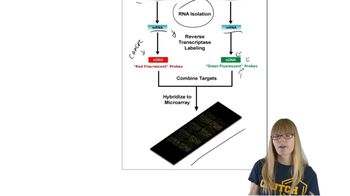
Analyze genome-wide studies such as microarray or RNA sequencing data that reveal inverse correlations between miRNA levels and their predicted target mRNAs, reinforcing the concept of negative regulation.

Verified video answer for a similar problem:

This video solution was recommended by our tutors as helpful for the problem above.
Video duration:
2m
Was this helpful?

Key Concepts

Here are the essential concepts you must grasp in order to answer the question correctly.

MicroRNA (miRNA) Function

MicroRNAs are small non-coding RNA molecules that regulate gene expression by binding to complementary sequences on target mRNAs, leading to mRNA degradation or inhibition of translation. This posttranscriptional regulation reduces the production of specific proteins.
Recommended video:
Guided course
08:26
Functional Genomics

Experimental Evidence for miRNA Regulation

Researchers use techniques such as reporter assays, loss- and gain-of-function experiments, and RNA immunoprecipitation to demonstrate that miRNAs bind target mRNAs and reduce their expression. Observing decreased protein levels or mRNA stability upon miRNA activity confirms their negative regulatory role.
Recommended video:

Mechanisms of Posttranscriptional Gene Regulation

Posttranscriptional regulation involves controlling mRNA stability, localization, and translation after transcription. miRNAs contribute by guiding RNA-induced silencing complexes (RISCs) to target mRNAs, which results in mRNA cleavage or translational repression, thereby fine-tuning gene expression.
Recommended video:
Guided course
09:22
Review of Regulation