Pearson+ LogoPearson+ Logo
Ch. 18 - Post-transcriptional Regulation in Eukaryotes
Klug - Concepts of Genetics  12th Edition
Klug12th EditionConcepts of Genetics ISBN: 9780135564776Not the one you use?Change textbook
Chapter 18, Problem 22

What role do ubiquitin ligases play in the regulation of gene expression?

Verified step by step guidance
1
Understand that ubiquitin ligases are enzymes that attach ubiquitin molecules to specific target proteins, a process called ubiquitination.
Recognize that ubiquitination can tag proteins for degradation by the proteasome, thereby controlling the levels of certain proteins within the cell.
Identify that in the context of gene expression, ubiquitin ligases regulate the stability and activity of transcription factors and other regulatory proteins that influence gene expression.
Consider that by targeting these regulatory proteins for degradation or altering their function, ubiquitin ligases can either promote or inhibit the transcription of specific genes.
Summarize that ubiquitin ligases play a crucial role in fine-tuning gene expression by modulating the presence and activity of proteins involved in the transcriptional machinery.

Verified video answer for a similar problem:

This video solution was recommended by our tutors as helpful for the problem above.
Video duration:
2m
Was this helpful?

Key Concepts

Here are the essential concepts you must grasp in order to answer the question correctly.

Ubiquitin-Proteasome System

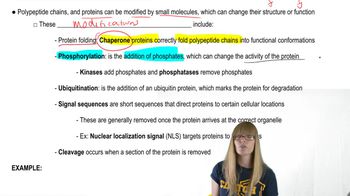
The ubiquitin-proteasome system is a cellular mechanism that tags proteins with ubiquitin molecules, marking them for degradation by the proteasome. This process regulates protein levels and activity, thereby controlling various cellular functions including gene expression.
Recommended video:
Guided course
04:30
Post Translational Modifications

Ubiquitin Ligases (E3 Enzymes)

Ubiquitin ligases are enzymes that facilitate the transfer of ubiquitin to specific target proteins. By selecting substrates for ubiquitination, they determine which proteins are degraded or modified, playing a critical role in controlling protein stability and function.
Recommended video:
Guided course
05:44
Repair Pathways

Regulation of Gene Expression via Protein Degradation

Gene expression can be regulated by controlling the abundance of transcription factors and other regulatory proteins through ubiquitin-mediated degradation. Ubiquitin ligases modulate gene expression by targeting these proteins, thus influencing transcriptional activity and cellular responses.
Recommended video:
Guided course
09:22
Review of Regulation
Related Practice
Textbook Question

How and why are eukaryotic mRNAs transported and localized to discrete regions of the cell?

462
views
Textbook Question

How is it possible that a given mRNA in a cell is found throughout the cytoplasm but the protein that it encodes is only found in a few specific regions?

437
views
Textbook Question

How may the covalent modification of a protein with a phosphate group alter its function?

349
views
Textbook Question

We discussed several specific cis-elements in mRNAs that regulate splicing, stability, decay, localization, and translation. However, it is likely that many other uncharacterized cis-elements exist. One way in which they may be characterized is through the use of a reporter gene such as the gene encoding the green fluorescent protein (GFP) from jellyfish. GFP emits green fluorescence when excited by blue light. Explain how one might be able to devise an assay to test for the effect of various cis-elements on posttranscriptional gene regulation using cells that transcribe a GFP mRNA with genetically inserted cis-elements.

472
views
Textbook Question

Incorrectly spliced RNAs often lead to human pathologies. Scientists have examined cancer cells for splice-specific changes and found that many of the changes disrupt tumor-suppressor gene function [Xu and Lee (2003). Nucl. Acids Res. 31:5635–5643]. In general, what would be the effects of splicing changes on these RNAs and the function of tumor-suppressor gene function? How might loss of splicing specificity be associated with cancer?

483
views
Textbook Question

Mutations in the low-density lipoprotein receptor (LDLR) gene are a primary cause of familial hypercholesterolemia. One such mutation is a SNP in exon 12 of the LDLR. In premenopausal women, but not in men or postmenopausal women, this SNP leads to skipping of exon 12 and production of a truncated nonfunctional protein. It is hypothesized that this SNP compromises a splice enhancer [Zhu et al. (2007). Hum Mol Genet. 16:1765–1772]. What are some possible ways in which this SNP can lead to this defect, but only in premenopausal women?

839
views