Pearson+ LogoPearson+ Logo
Ch. 18 - Post-transcriptional Regulation in Eukaryotes
Klug - Concepts of Genetics  12th Edition
Klug12th EditionConcepts of Genetics ISBN: 9780135564776Not the one you use?Change textbook
Chapter 18, Problem 19

How and why are eukaryotic mRNAs transported and localized to discrete regions of the cell?

Verified step by step guidance
1
Understand that eukaryotic mRNAs are transported and localized within the cell to ensure that proteins are synthesized at specific locations where they are needed, which is crucial for cell function and development.
Recognize that mRNA localization involves three main steps: (1) recognition of the mRNA by RNA-binding proteins through specific sequences called 'zip codes' in the mRNA, (2) transport of the mRNA-protein complex along the cytoskeleton (microtubules or actin filaments) using motor proteins, and (3) anchoring of the mRNA at the target site to allow localized translation.
Explore the role of RNA-binding proteins that bind to cis-acting elements within the mRNA, which serve as signals for transport and localization, ensuring specificity in the destination of each mRNA molecule.
Examine how motor proteins such as kinesins, dyneins, or myosins interact with the cytoskeleton to physically move the mRNA complexes to discrete cellular regions, facilitating spatial regulation of gene expression.
Consider the biological significance of mRNA localization, including its role in cell polarity, embryonic development, synaptic plasticity in neurons, and efficient protein targeting, which together contribute to cellular organization and function.

Verified video answer for a similar problem:

This video solution was recommended by our tutors as helpful for the problem above.
Video duration:
2m
Was this helpful?

Key Concepts

Here are the essential concepts you must grasp in order to answer the question correctly.

mRNA Transport Mechanisms in Eukaryotic Cells

Eukaryotic mRNAs are actively transported from the nucleus to specific cytoplasmic locations via motor proteins along the cytoskeleton. This targeted movement ensures that proteins are synthesized near their site of function, enhancing cellular efficiency and spatial regulation.
Recommended video:
Guided course
09:16
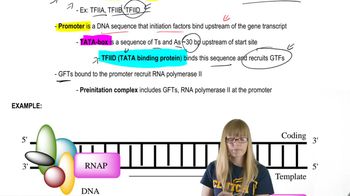
Eukaryotic Transcription

mRNA Localization Signals and Binding Proteins

Specific sequences within mRNAs, called localization signals or zip codes, are recognized by RNA-binding proteins. These complexes guide the mRNA to distinct cellular regions, enabling precise spatial control of gene expression.
Recommended video:

Functional Importance of mRNA Localization

Localized mRNA translation allows cells to rapidly respond to environmental cues and maintain polarity by producing proteins at precise sites. This is crucial in processes like embryonic development, synaptic plasticity, and cell migration.
Recommended video:
Guided course
08:26
Functional Genomics