Pearson+ LogoPearson+ Logo
Ch. 19 - Epigenetics
Klug - Concepts of Genetics  12th Edition
Klug12th EditionConcepts of Genetics ISBN: 9780135564776Not the one you use?Change textbook
Chapter 19, Problem 23c

Amino acids are classified as positively charged, negatively charged, or electrically neutral.
How does acetylation of lysine affect its interaction with DNA, and how is this related to the activation of gene expression?

Verified step by step guidance
1
Understand the properties of lysine: Lysine is a positively charged amino acid due to its amine group in the side chain. This positive charge allows lysine to interact with the negatively charged phosphate backbone of DNA through electrostatic interactions.
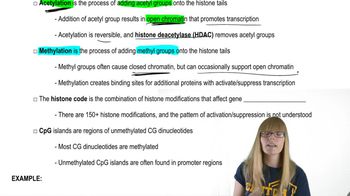
Explain acetylation: Acetylation is a chemical modification where an acetyl group (CH₃CO) is added to the amine group of lysine. This process neutralizes the positive charge on lysine, reducing its ability to interact with negatively charged DNA.
Relate acetylation to chromatin structure: DNA is wrapped around histone proteins to form chromatin. When lysine residues in histones are acetylated, the reduced interaction between histones and DNA leads to a more relaxed chromatin structure, known as euchromatin.
Connect chromatin relaxation to gene expression: The relaxed chromatin structure allows transcription factors and RNA polymerase easier access to the DNA, facilitating the transcription of genes and thereby activating gene expression.
Summarize the relationship: Acetylation of lysine reduces its positive charge, weakens its interaction with DNA, relaxes chromatin structure, and promotes gene expression by making the DNA more accessible to the transcriptional machinery.

Verified video answer for a similar problem:

This video solution was recommended by our tutors as helpful for the problem above.
Video duration:
1m
Was this helpful?

Key Concepts

Here are the essential concepts you must grasp in order to answer the question correctly.

Amino Acid Classification

Amino acids are organic compounds that serve as the building blocks of proteins. They can be classified based on their side chains into three categories: positively charged (basic), negatively charged (acidic), and electrically neutral (polar or nonpolar). This classification is crucial for understanding how amino acids interact with other molecules, including DNA.
Recommended video:

Acetylation

Acetylation is a post-translational modification where an acetyl group is added to a molecule, often a lysine residue in proteins. This modification can neutralize the positive charge of lysine, reducing its affinity for negatively charged DNA. Consequently, acetylation can influence the accessibility of DNA for transcription factors, thereby playing a significant role in gene expression regulation.
Recommended video:
Guided course
07:55
Histone Protein Modifications

Gene Expression Regulation

Gene expression regulation refers to the processes that control the timing and amount of gene product (RNA or protein) produced in a cell. Modifications like acetylation can alter chromatin structure, making DNA more or less accessible for transcription. This dynamic regulation is essential for cellular responses to environmental signals and developmental cues.
Recommended video:
Guided course
02:09
Penetrance and Expressivity