
Textbook Question
From the following table, draw up a list of histone H3 modifications associated with gene activation. Then draw up a list of H3 modifications associated with repression.
Are there any overlaps on the lists?
482
views

 Verified step by step guidance
 07:
07:
 07:55
07:55From the following table, draw up a list of histone H3 modifications associated with gene activation. Then draw up a list of H3 modifications associated with repression.
Are there any overlaps on the lists?
From the following table, draw up a list of histone H3 modifications associated with gene activation. Then draw up a list of H3 modifications associated with repression.
Are these overlaps explained by different modifications?
From the following table, draw up a list of histone H3 modifications associated with gene activation. Then draw up a list of H3 modifications associated with repression.
If not, how can you reconcile these differences?
Methylation of H3K9 by itself silences genes, but if H3K4 and H4K20 are also methylated, the combination of modifications stimulates transcription. What conclusions can you draw about this?
Amino acids are classified as positively charged, negatively charged, or electrically neutral.
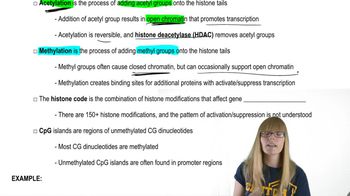
How does acetylation of lysine affect its interaction with DNA, and how is this related to the activation of gene expression?
Amino acids are classified as positively charged, negatively charged, or electrically neutral.
How does this property of lysine allow it to interact with DNA?