Ch. 19 - Epigenetics
Klug - Concepts of Genetics  12th Edition
Klug12th EditionConcepts of Genetics ISBN: 9780135564776Not the one you use?Change textbook
Chapter 19, Problem 22c

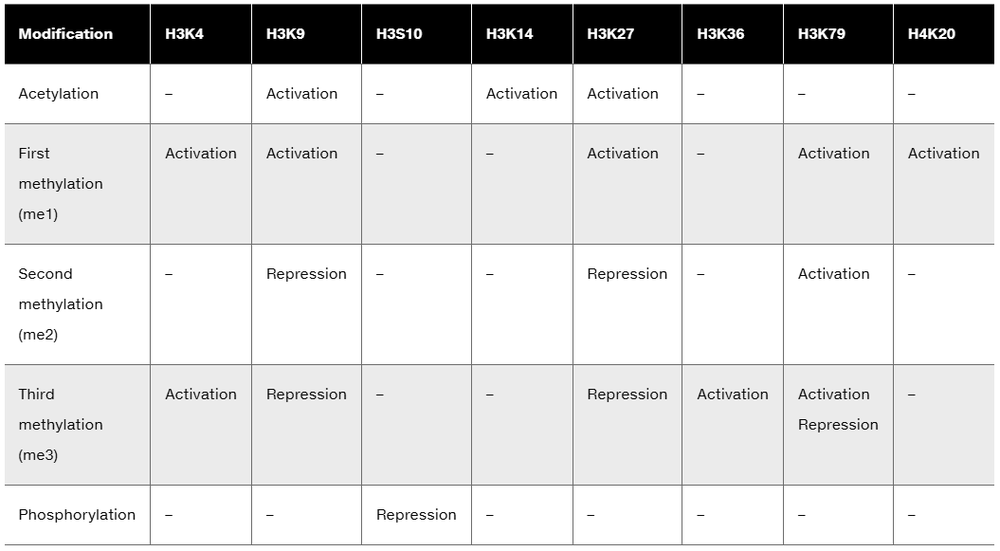
From the following table, draw up a list of histone H3 modifications associated with gene activation. Then draw up a list of H3 modifications associated with repression.
If not, how can you reconcile these differences?
Table listing histone H3 modifications showing activation or repression marks across various residues and modification types.

Verified step by step guidance
1
Step 1: Understand that histone H3 modifications are chemical changes to the histone protein that affect chromatin structure and gene expression. These modifications can either activate or repress gene transcription depending on their type and location.
Step 2: List common histone H3 modifications associated with gene activation. These typically include methylation at lysine 4 (H3K4me), acetylation at lysine 9 (H3K9ac), and acetylation at lysine 27 (H3K27ac). These modifications generally open chromatin structure, making DNA more accessible for transcription.
Step 3: List common histone H3 modifications associated with gene repression. These often include methylation at lysine 9 (H3K9me) and lysine 27 (H3K27me). These marks promote chromatin compaction, reducing access of transcription machinery to DNA.
Step 4: Recognize that some modifications can have context-dependent effects, and the same modification might be associated with activation in one context and repression in another. This is due to the complex interplay of multiple histone marks, the presence of specific binding proteins, and the overall chromatin environment.
Step 5: To reconcile differences, consider the 'histone code' hypothesis, which suggests that combinations of histone modifications, rather than single marks alone, determine the functional outcome on gene expression. Also, cross-talk between modifications and recruitment of different effector proteins can explain why some modifications have variable effects.

Verified video answer for a similar problem:

This video solution was recommended by our tutors as helpful for the problem above.
Video duration:
1m
Was this helpful?

Key Concepts

Here are the essential concepts you must grasp in order to answer the question correctly.

Histone Modifications and Their Role in Gene Regulation

Histone modifications are chemical changes to histone proteins, such as methylation or acetylation, that influence chromatin structure and gene expression. These modifications can either promote gene activation by loosening chromatin or cause repression by tightening it, thereby controlling access to DNA.
Recommended video:
Guided course
07:55
Histone Protein Modifications

Specific Histone H3 Modifications Linked to Activation and Repression

Certain modifications on histone H3 correlate with gene activity states: for example, H3K4me3 and H3K27ac are commonly associated with active transcription, while H3K9me3 and H3K27me3 are linked to gene silencing. Recognizing these marks helps distinguish active from repressed chromatin regions.
Recommended video:
Guided course
07:55
Histone Protein Modifications

Context-Dependent Nature of Histone Modifications

Histone modifications do not act in isolation; their effects depend on the combination of marks, chromatin context, and interacting proteins. This complexity can explain apparent contradictions, as the same modification might have different outcomes depending on cellular conditions or genomic location.
Recommended video:
Guided course
07:55
Histone Protein Modifications
Related Practice
Textbook Question

Prader–Willi syndrome (PWS) is a genetic disorder with a clinical profile of obesity, intellectual disability, and short stature. It can be caused in several ways. Most common is a deletion on the paternal copy of chromosome 15, but it can also be caused by an epigenetic imprinting disorder and uniparental disomy, an event in which the affected child receives two copies of the maternal chromosome 15. A child with PWS comes to your clinic for a diagnosis of the molecular basis for this condition. The gel below shows the results of testing with short tandem repeats (STRs) from the region of chromosome 15 associated with the disorder.

Based on your interpretation of the data, what is the cause of PWS in this case? Explain your reasoning. 

1061
views
Textbook Question

From the following table, draw up a list of histone H3 modifications associated with gene activation. Then draw up a list of H3 modifications associated with repression.

Are there any overlaps on the lists?

458
views
Textbook Question

From the following table, draw up a list of histone H3 modifications associated with gene activation. Then draw up a list of H3 modifications associated with repression.

Are these overlaps explained by different modifications?

470
views
Textbook Question

Amino acids are classified as positively charged, negatively charged, or electrically neutral.

Which category includes lysine?

550
views
Textbook Question

Amino acids are classified as positively charged, negatively charged, or electrically neutral.

How does this property of lysine allow it to interact with DNA?

598
views
Textbook Question

Amino acids are classified as positively charged, negatively charged, or electrically neutral.

How does acetylation of lysine affect its interaction with DNA, and how is this related to the activation of gene expression?

436
views