How do we know that mitotic chromosomes are derived from chromatin?
Ch. 2 - Mitosis and Meiosis

Chapter 2, Problem 4
Discuss the concepts of homologous chromosomes, diploidy, and haploidy. What characteristics do two homologous chromosomes share?
Verified step by step guidance1
Start by defining homologous chromosomes: these are pairs of chromosomes in a diploid organism that have the same length, centromere position, and carry genes for the same traits at corresponding loci, but may have different alleles.
Explain diploidy as the state of having two complete sets of chromosomes, one set inherited from each parent, which means each chromosome has a homologous partner.
Describe haploidy as having only one complete set of chromosomes, typical of gametes (sperm and egg cells), which contain only one chromosome from each homologous pair.
Discuss the shared characteristics of homologous chromosomes, emphasizing that they have the same gene sequence and structure, but can differ in the specific versions (alleles) of those genes they carry.
Summarize by highlighting that homologous chromosomes pair during meiosis, allowing for genetic recombination and proper segregation, which is fundamental to sexual reproduction and genetic diversity.

Verified video answer for a similar problem:
This video solution was recommended by our tutors as helpful for the problem above.
Video duration:
3mWas this helpful?
Key Concepts
Here are the essential concepts you must grasp in order to answer the question correctly.
Homologous Chromosomes
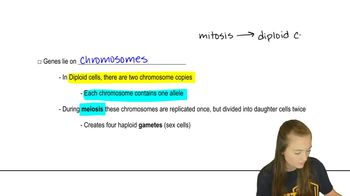
Homologous chromosomes are pairs of chromosomes in a diploid organism that have the same length, shape, and gene sequence. One chromosome of each pair is inherited from each parent. They carry the same genes at corresponding loci but may have different alleles, which contributes to genetic variation.
Recommended video:
Guided course
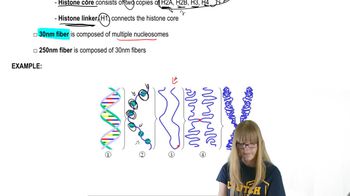
Chromosome Structure
Diploidy
Diploidy refers to cells that contain two complete sets of chromosomes, one from each parent. In diploid organisms, chromosomes exist in homologous pairs, allowing for genetic recombination during meiosis. Most somatic cells in animals and plants are diploid.
Recommended video:
Guided course
Diploid Genetics
Haploidy
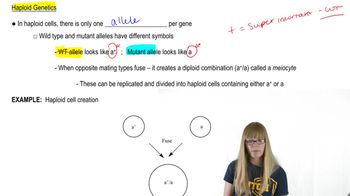
Haploidy describes cells that have only one set of chromosomes, such as gametes (sperm and egg cells). Haploid cells are produced through meiosis and combine during fertilization to restore diploidy. This ensures genetic diversity and proper chromosome number across generations.
Recommended video:
Guided course
Haploid Genetics
Related Practice
Textbook Question
552
views
Textbook Question
Write a short essay that contrasts mitosis and meiosis, including their respective roles in organisms, the mechanisms by which they achieve their respective outcomes, and the consequences should either process fail to be executed with absolute fidelity.
619
views
Textbook Question
What role do the following cellular components play in the storage, expression, or transmission of genetic information?
(a) Chromatin
(b) Nucleolus
(c) Ribosome
(d) Mitochondrion
(e) Centriole
(f) Centromere
844
views
Textbook Question
If two chromosomes of a species are the same length and have similar centromere placements and yet are not homologous, what is different about them?
854
views
Textbook Question
Describe the events that characterize each stage of mitosis.
1040
views
Textbook Question
How are chromosomes named on the basis of their centromere placement?
904
views