Pearson+ LogoPearson+ Logo
Ch. 2 - Mitosis and Meiosis
Klug - Concepts of Genetics  12th Edition
Klug12th EditionConcepts of Genetics ISBN: 9780135564776Not the one you use?Change textbook
Chapter 2, Problem 2

Write a short essay that contrasts mitosis and meiosis, including their respective roles in organisms, the mechanisms by which they achieve their respective outcomes, and the consequences should either process fail to be executed with absolute fidelity.

Verified step by step guidance
1
Begin by defining mitosis and meiosis, highlighting that mitosis is a process of cell division resulting in two genetically identical daughter cells, primarily for growth and tissue repair, while meiosis is a specialized cell division that produces four genetically diverse haploid gametes for sexual reproduction.
Explain the roles of each process in organisms: mitosis maintains genetic stability and supports asexual reproduction and somatic cell renewal, whereas meiosis introduces genetic variation through recombination and reduces chromosome number by half to maintain species chromosome number across generations.
Describe the mechanisms of mitosis, including phases such as prophase, metaphase, anaphase, and telophase, emphasizing the replication of chromosomes followed by their equal segregation into daughter cells, ensuring genetic identity.
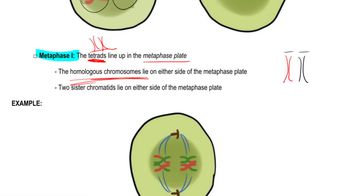
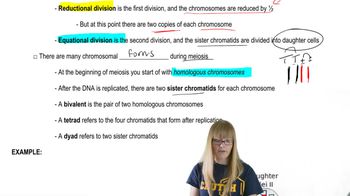
Outline the mechanisms of meiosis, noting the two sequential divisions (meiosis I and II), the pairing and crossing over of homologous chromosomes during prophase I, and the reductional division that halves the chromosome number, leading to genetic diversity.
Discuss the consequences of errors in each process: failure in mitosis can lead to aneuploidy or cancer due to uncontrolled cell division or loss of genetic information, while errors in meiosis can cause infertility, miscarriages, or genetic disorders such as Down syndrome due to improper chromosome segregation.

Verified video answer for a similar problem:

This video solution was recommended by our tutors as helpful for the problem above.
Video duration:
3m
Was this helpful?

Key Concepts

Here are the essential concepts you must grasp in order to answer the question correctly.

Differences Between Mitosis and Meiosis

Mitosis is a type of cell division that produces two genetically identical daughter cells, maintaining the chromosome number, and is involved in growth and tissue repair. Meiosis, in contrast, produces four genetically diverse haploid cells (gametes) by halving the chromosome number, essential for sexual reproduction.
Recommended video:
Guided course
09:06
Meiosis Steps

Mechanisms of Mitosis and Meiosis

Mitosis involves one round of DNA replication followed by a single division, ensuring equal chromosome segregation. Meiosis includes one round of DNA replication but two successive divisions (meiosis I and II), promoting genetic diversity through processes like crossing over and independent assortment.
Recommended video:
Guided course
05:30
Meiosis Overview

Consequences of Errors in Mitosis and Meiosis

Errors in mitosis can lead to uncontrolled cell growth or cancer due to abnormal chromosome numbers, while mistakes in meiosis often cause genetic disorders such as Down syndrome, resulting from nondisjunction or improper chromosome segregation during gamete formation.
Recommended video:
Guided course
05:30
Meiosis Overview