Pearson+ LogoPearson+ Logo
Ch. 20 - Recombinant DNA Technology
Klug - Concepts of Genetics  12th Edition
Klug12th EditionConcepts of Genetics ISBN: 9780135564776Not the one you use?Change textbook
Chapter 20, Problem 32c

In humans, congenital heart disease is a common birth defect that affects approximately 1 out of 125 live births. Using reverse transcription PCR (RT-PCR), Samir Zaidi and colleagues [(2013) Nature 498:220.223] determined that approximately 10 percent of the cases resulted from point mutations, often involving histone function. To capture products of gene expression in developing hearts, they used oligo(dT) in their reverse transcription protocol.
If one were interested in comparing the quantitative distribution of gene expression in, say, the right and left sides of a developing heart, how might one proceed using RT-PCR?

Verified step by step guidance
1
Step 1: Begin by isolating RNA from the right and left sides of the developing heart. This involves extracting total RNA from tissue samples collected from each side. Ensure the RNA is of high quality and free from contaminants such as DNA or proteins.
Step 2: Use reverse transcription to convert the isolated RNA into complementary DNA (cDNA). In this case, oligo(dT) primers can be used to target the poly-A tails of mRNA, ensuring that the cDNA represents the gene expression profile of the tissue.
Step 3: Design specific primers for the genes of interest that you want to compare between the right and left sides of the heart. These primers should be optimized for RT-PCR to ensure specificity and efficiency.
Step 4: Perform quantitative RT-PCR (qRT-PCR) using the cDNA from both sides of the heart. Include appropriate controls, such as housekeeping genes, to normalize the data and account for variations in RNA input or reverse transcription efficiency.
Step 5: Analyze the qRT-PCR data to compare the relative expression levels of the target genes between the right and left sides of the developing heart. Use statistical methods to determine if the differences in gene expression are significant.

Verified video answer for a similar problem:

This video solution was recommended by our tutors as helpful for the problem above.
Video duration:
25s
Was this helpful?

Key Concepts

Here are the essential concepts you must grasp in order to answer the question correctly.

Reverse Transcription PCR (RT-PCR)

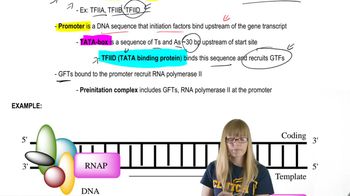
RT-PCR is a laboratory technique used to convert RNA into complementary DNA (cDNA) using the enzyme reverse transcriptase. This process allows researchers to amplify specific RNA sequences, making it easier to study gene expression levels. In the context of the developing heart, RT-PCR can be employed to compare gene expression between different regions, such as the right and left sides.
Recommended video:
Guided course
09:16
Eukaryotic Transcription

Gene Expression Quantification

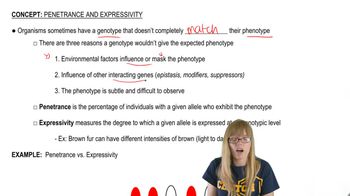
Gene expression quantification involves measuring the amount of mRNA produced from a gene, which reflects its activity in a given tissue or developmental stage. Techniques like RT-PCR can provide quantitative data on gene expression levels, allowing for comparisons between different samples, such as the right and left sides of the heart. This information is crucial for understanding the functional differences in gene activity during heart development.
Recommended video:
Guided course
02:09
Penetrance and Expressivity

Point Mutations and Histone Function

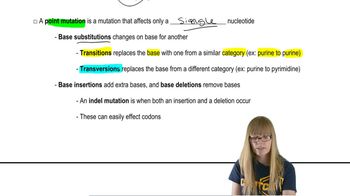
Point mutations are small changes in the DNA sequence that can affect gene function and regulation. In the context of congenital heart disease, these mutations may disrupt histone proteins, which play a key role in DNA packaging and gene expression regulation. Understanding how these mutations influence histone function can provide insights into the molecular mechanisms underlying heart development and associated defects.
Recommended video:
Guided course
09:49
Point Mutations
Related Practice
Textbook Question

Most of the techniques described in this chapter (blotting, cloning, PCR, etc.) are dependent on hybridization (annealing) between different populations of nucleic acids. The length of the strands, temperature, and percentage of GC nucleotides weigh considerably on hybridization. Two other components commonly used in hybridization protocols are monovalent ions and formamide. A formula that takes monovalent Na⁺ ions (M[Na⁺]) and formamide concentrations into consideration to compute a Tₘ (temperature of melting) is as follows:

Tₘ=81.5+16.6(log M[Na+])+0.41(%GC)−0.72(%formamide)

Given that formamide competes for hydrogen bond locations on nucleic acid bases and monovalent cations are attracted to the negative charges on nucleic acids, explain why the Tₘ varies as described in part (a).

446
views
Textbook Question

In humans, congenital heart disease is a common birth defect that affects approximately 1 out of 125 live births. Using reverse transcription PCR (RT-PCR), Samir Zaidi and colleagues [(2013) Nature 498:220.223] determined that approximately 10 percent of the cases resulted from point mutations, often involving histone function. To capture products of gene expression in developing hearts, they used oligo(dT) in their reverse transcription protocol.

How would such a high %T in a primer influence annealing temperature?

671
views
Textbook Question

In humans, congenital heart disease is a common birth defect that affects approximately 1 out of 125 live births. Using reverse transcription PCR (RT-PCR), Samir Zaidi and colleagues [(2013) Nature 498:220.223] determined that approximately 10 percent of the cases resulted from point mutations, often involving histone function. To capture products of gene expression in developing hearts, they used oligo(dT) in their reverse transcription protocol.

Compared with oligo(dT) primers, a pool of random sequence primers requires a trickier assessment of annealing temperature. Why?

486
views
Textbook Question

The U.S. Department of Justice has established a database that catalogs PCR amplification products from short tandem repeats of the Y chromosome (Y-STRs) in humans. The database contains polymorphisms of five U.S. ethnic groups (African-Americans, European Americans, Hispanics, Native Americans, and Asian-Americans) as well as the worldwide population.

Given that STRs are repeats of varying lengths, for example (TCTG)₉₋₁₇ or (TAT)₆₋₁₄, explain how PCR could reveal differences (polymorphisms) among individuals. How could the Department of Justice make use of those differences?

488
views
Textbook Question

The U.S. Department of Justice has established a database that catalogs PCR amplification products from short tandem repeats of the Y chromosome (Y-STRs) in humans. The database contains polymorphisms of five U.S. ethnic groups (African-Americans, European Americans, Hispanics, Native Americans, and Asian-Americans) as well as the worldwide population.

Y-STRs from the nonrecombining region of the Y chromosome (NRY) have special relevance for forensic purposes. Why?

514
views
Textbook Question

The U.S. Department of Justice has established a database that catalogs PCR amplification products from short tandem repeats of the Y chromosome (Y-STRs) in humans. The database contains polymorphisms of five U.S. ethnic groups (African-Americans, European Americans, Hispanics, Native Americans, and Asian-Americans) as well as the worldwide population.

What would be the value of knowing the ethnic population differences for Y-STR polymorphisms?

536
views