Pearson+ LogoPearson+ Logo
Ch. 20 - Recombinant DNA Technology
Klug - Concepts of Genetics  12th Edition
Klug12th EditionConcepts of Genetics ISBN: 9780135564776Not the one you use?Change textbook
Chapter 20, Problem 34

There are a variety of circumstances under which rapid results using multiple markers in PCR amplifications are highly desired, such as in forensics, pathogen analysis, or detection of genetically modified organisms. In multiplex PCR, multiple sets of primers are used, often with less success than when applied to PCR as individual sets. Numerous studies have been conducted to optimize procedures, but each has described the process as time consuming and often unsuccessful. Considering the information given in Problem 30, why should multiplex PCR be any different than single primer set PCR in terms of dependability and ease of optimization?

Verified step by step guidance
1
Understand the concept of PCR (Polymerase Chain Reaction): PCR is a technique used to amplify specific DNA sequences using primers, DNA polymerase, and thermal cycling. Single primer set PCR uses one pair of primers to amplify a single target sequence, while multiplex PCR uses multiple primer sets to amplify multiple target sequences simultaneously.
Recognize the challenges of multiplex PCR: Multiplex PCR introduces complexity because multiple primer sets are used in the same reaction. This can lead to issues such as primer-dimer formation, competition between primers for binding sites, and non-specific amplification, which are less common in single primer set PCR.
Consider the optimization process: In single primer set PCR, optimization involves adjusting factors like annealing temperature, magnesium ion concentration, and cycle conditions for one primer pair. In multiplex PCR, these factors must be optimized for multiple primer sets simultaneously, which is more challenging and time-consuming.
Analyze primer design: In multiplex PCR, primers must be carefully designed to avoid overlapping or interfering with each other. This includes ensuring that primers have similar melting temperatures and avoiding sequences that could lead to non-specific binding or primer-dimer formation.
Reflect on the dependability: Multiplex PCR is less dependable than single primer set PCR because the increased complexity makes it more prone to errors and requires more precise optimization. The simultaneous amplification of multiple targets increases the likelihood of technical issues, making it harder to achieve consistent and reliable results.

Verified video answer for a similar problem:

This video solution was recommended by our tutors as helpful for the problem above.
Video duration:
1m
Was this helpful?

Key Concepts

Here are the essential concepts you must grasp in order to answer the question correctly.

Multiplex PCR

Multiplex PCR is a variation of the standard polymerase chain reaction (PCR) that allows for the simultaneous amplification of multiple target DNA sequences in a single reaction. This technique utilizes multiple sets of primers, which can lead to competition among the primers for the same resources, potentially resulting in lower efficiency and specificity compared to single-primer PCR. Understanding the dynamics of primer interactions and the optimization of reaction conditions is crucial for improving the reliability of multiplex PCR.
Recommended video:
Guided course
04:17
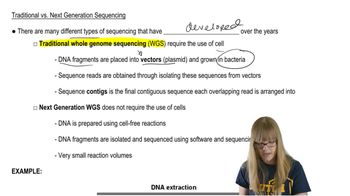
Traditional vs. Next-Gen

Primer Design and Optimization

The design and optimization of primers are critical for the success of both multiplex and single-primer PCR. Primers must be specific to their target sequences and have similar melting temperatures to ensure they amplify efficiently under the same conditions. In multiplex PCR, the challenge increases as the presence of multiple primers can lead to non-specific binding and amplification, making careful design and optimization essential to achieve reliable results.
Recommended video:
Guided course
11:59
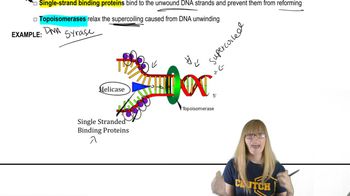
Steps to DNA Replication

PCR Efficiency and Specificity

PCR efficiency refers to the ability of the PCR process to amplify the target DNA accurately and rapidly, while specificity indicates the ability to amplify only the intended target without non-specific products. In multiplex PCR, achieving high efficiency and specificity is more complex due to the presence of multiple primers, which can compete for binding sites and resources. Understanding these concepts is vital for addressing the challenges associated with multiplex PCR and improving its dependability.
Recommended video:
Guided course
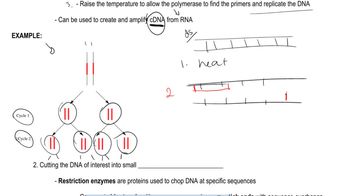
07:39
Genetic Cloning
Related Practice
Textbook Question

The U.S. Department of Justice has established a database that catalogs PCR amplification products from short tandem repeats of the Y chromosome (Y-STRs) in humans. The database contains polymorphisms of five U.S. ethnic groups (African-Americans, European Americans, Hispanics, Native Americans, and Asian-Americans) as well as the worldwide population.

Y-STRs from the nonrecombining region of the Y chromosome (NRY) have special relevance for forensic purposes. Why?

514
views
Textbook Question

The U.S. Department of Justice has established a database that catalogs PCR amplification products from short tandem repeats of the Y chromosome (Y-STRs) in humans. The database contains polymorphisms of five U.S. ethnic groups (African-Americans, European Americans, Hispanics, Native Americans, and Asian-Americans) as well as the worldwide population.

What would be the value of knowing the ethnic population differences for Y-STR polymorphisms?

536
views
Textbook Question

The U.S. Department of Justice has established a database that catalogs PCR amplification products from short tandem repeats of the Y chromosome (Y-STRs) in humans. The database contains polymorphisms of five U.S. ethnic groups (African-Americans, European Americans, Hispanics, Native Americans, and Asian-Americans) as well as the worldwide population.

For forensic applications, the probability of a 'match' for a crime scene DNA sample and a suspect's DNA often culminates in a guilty or innocent verdict. How is a 'match' determined, and what are the uses and limitations of such probabilities?

461
views