Pearson+ LogoPearson+ Logo
Ch. 21 - Genomic Analysis
Klug - Concepts of Genetics  12th Edition
Klug12th EditionConcepts of Genetics ISBN: 9780135564776Not the one you use?Change textbook
Chapter 21, Problem 11

Describe the human genome in terms of genome size, the percentage of the genome that codes for proteins, how much is composed of repetitive sequences, and how many genes it contains. Describe two other features of the human genome.

Verified step by step guidance
1
Start by defining the human genome as the complete set of DNA, including all of its genes, present in a human cell.
Explain the genome size by stating the approximate number of base pairs it contains, which is about 3 billion base pairs.
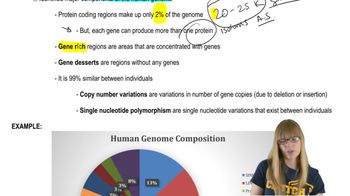
Describe the percentage of the genome that codes for proteins, noting that only about 1-2% of the human genome consists of protein-coding sequences.
Discuss the composition of repetitive sequences, highlighting that a significant portion, roughly 50%, of the genome is made up of repetitive DNA elements such as transposons and satellite DNA.
Mention the approximate number of genes in the human genome, which is around 20,000 to 25,000, and then describe two additional features such as the presence of non-coding RNA genes and regulatory elements that control gene expression.

Verified video answer for a similar problem:

This video solution was recommended by our tutors as helpful for the problem above.
Video duration:
1m
Was this helpful?

Key Concepts

Here are the essential concepts you must grasp in order to answer the question correctly.

Human Genome Size and Gene Content

The human genome consists of approximately 3 billion base pairs of DNA, organized into 23 pairs of chromosomes. It contains about 20,000 to 25,000 protein-coding genes, which are segments of DNA that provide instructions for making proteins essential for cellular functions.
Recommended video:
Guided course
06:51
Human Genome Composition

Protein-Coding vs. Non-Coding DNA

Only about 1-2% of the human genome codes for proteins, while the vast majority is non-coding DNA. Non-coding regions include regulatory elements, introns, and sequences with unknown functions, highlighting the complexity beyond just protein-coding genes.
Recommended video:
Guided course
11:43
The Genetic Code

Repetitive Sequences and Other Genomic Features

Repetitive sequences make up roughly 50% of the human genome and include elements like transposons and satellite DNA. Other notable features include regulatory sequences that control gene expression and structural elements such as telomeres and centromeres that maintain chromosome integrity.
Recommended video:
Guided course
08:41
Sequencing Difficulties