Pearson+ LogoPearson+ Logo
Ch. 22 - Applications of Genetic Engineering and Biotechnology
Klug - Concepts of Genetics  12th Edition
Klug12th EditionConcepts of Genetics ISBN: 9780135564776Not the one you use?Change textbook
Chapter 22, Problem 4b

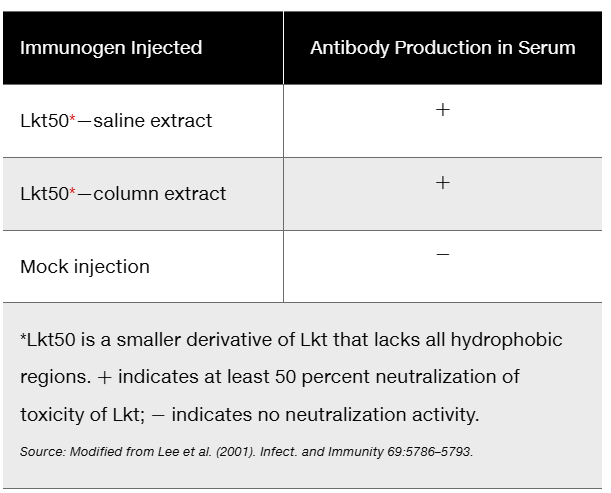
One of the major causes of sickness, death, and economic loss in the cattle industry is Mannheimia haemolytica, which causes bovine pasteurellosis, or shipping fever. Noninvasive delivery of a vaccine using transgenic plants expressing immunogens would reduce labor costs and trauma to livestock. An early step toward developing an edible vaccine is to determine whether an injected version of an antigen (usually a derivative of the pathogen) is capable of stimulating the development of antibodies in a test organism. The following table assesses the ability of a transgenic portion of a toxin (Lkt) of M. haemolytica to stimulate development of specific antibodies in rabbits.
Table showing antibody production in serum of rabbits injected with Lkt50 extracts, indicating immune response only with Lkt50.
With regards to development of a usable edible vaccine, what work remains to be done?

Verified step by step guidance
1
Step 1: Understand the context of the problem. The goal is to develop an edible vaccine using transgenic plants expressing immunogens. The table provided evaluates the ability of a transgenic portion of a toxin (Lkt50) to stimulate antibody production in rabbits, which is a preliminary step in vaccine development.
Step 2: Analyze the data in the table. The table shows that both saline and column extracts of Lkt50 stimulate antibody production (+), while the mock injection does not (-). This indicates that Lkt50 is capable of eliciting an immune response in rabbits.
Step 3: Identify the next steps for edible vaccine development. Since the injected version of Lkt50 stimulates antibody production, the next step is to test whether the transgenic plants expressing Lkt50 can produce the immunogen in a form that is bioavailable and effective when consumed orally.
Step 4: Consider additional testing requirements. Oral delivery of the vaccine must be tested to ensure that the immunogen survives digestion and stimulates antibody production in the target organism (e.g., cattle). This involves assessing the stability of Lkt50 in the digestive system and its ability to elicit an immune response.
Step 5: Evaluate safety and efficacy. Before the edible vaccine can be used commercially, it is essential to conduct trials to confirm that the vaccine is safe for livestock, does not cause adverse effects, and provides effective protection against M. haemolytica infection.

Verified video answer for a similar problem:

This video solution was recommended by our tutors as helpful for the problem above.
Video duration:
2m
Was this helpful?

Key Concepts

Here are the essential concepts you must grasp in order to answer the question correctly.

Transgenic Plants

Transgenic plants are genetically modified organisms that have had foreign genes inserted into their genome. This technology allows for the expression of specific proteins, such as immunogens, which can be used in vaccine development. In the context of edible vaccines, transgenic plants can produce antigens that stimulate an immune response when consumed, potentially simplifying vaccine delivery and reducing costs.
Recommended video:
Guided course
02:56
Plant Gamete Terminology

Antibody Production

Antibody production is a crucial aspect of the immune response, where B cells produce antibodies in response to antigens. The presence of specific antibodies in serum indicates that the immune system has recognized and responded to a pathogen or its derivative. Understanding how different immunogens, like the Lkt toxin from Mannheimia haemolytica, stimulate antibody production is essential for evaluating the effectiveness of potential vaccines.
Recommended video:

Edible Vaccines

Edible vaccines are a novel approach to immunization that involves delivering antigens through food, typically produced by transgenic plants. This method aims to elicit an immune response without the need for injections, making vaccination more accessible and less traumatic for livestock. However, challenges remain in ensuring that these vaccines are effective, stable, and capable of inducing a strong immune response in the target organisms.
Recommended video:
Guided course
08:34
Cancer Causes
Related Practice
Textbook Question

Write a short essay that summarizes the impacts that genomic applications are having on society and discuss which of the ethical issues presented by these applications is the most daunting to society.

467
views
Textbook Question

Why are most recombinant human proteins produced in animal or plant hosts instead of bacterial host cells?

584
views
Textbook Question

One of the major causes of sickness, death, and economic loss in the cattle industry is Mannheimia haemolytica, which causes bovine pasteurellosis, or shipping fever. Noninvasive delivery of a vaccine using transgenic plants expressing immunogens would reduce labor costs and trauma to livestock. An early step toward developing an edible vaccine is to determine whether an injected version of an antigen (usually a derivative of the pathogen) is capable of stimulating the development of antibodies in a test organism. The following table assesses the ability of a transgenic portion of a toxin (Lkt) of M. haemolytica to stimulate development of specific antibodies in rabbits.

What general conclusion can you draw from the data?

513
views
Textbook Question

Sequencing the human genome, the development of microarray technology, and personal genomics promise to improve our understanding of normal and abnormal cell behavior. How are these approaches dramatically changing our understanding and treatment of complex diseases such as cancer?

723
views
Textbook Question

A couple with European ancestry seeks genetic counseling before having children because of a history of cystic fibrosis (CF) in the husband's family. ASO testing for CF reveals that the husband is heterozygous for the Δ508 mutation and that the wife is heterozygous for the R117 mutation. You are the couple's genetic counselor. When consulting with you, they express their conviction that they are not at risk for having an affected child because they each carry different mutations and cannot have a child who is homozygous for either mutation. What would you say to them?

492
views
Textbook Question

As genetic testing becomes widespread, medical records will contain the results of such testing. Who should have access to this information? Should employers, potential employers, or insurance companies be allowed to have this information? Would you favor or oppose having the government establish and maintain a central database containing the results of individuals' genome scans?

430
views