Pearson+ LogoPearson+ Logo
Ch. 23 - Developmental Genetics
Klug - Concepts of Genetics  12th Edition
Klug12th EditionConcepts of Genetics ISBN: 9780135564776Not the one you use?Change textbook
Chapter 23, Problem 14

Embryogenesis and oncogenesis (generation of cancer) share a number of features including cell proliferation, apoptosis, cell migration and invasion, formation of new blood vessels, and differential gene activity. Embryonic cells are relatively undifferentiated, and cancer cells appear to be undifferentiated or dedifferentiated. Homeotic gene expression directs early development, and mutant expression leads to loss of the differentiated state or an alternative cell identity. M. T. Lewis [(2000). Breast Can. Res. 2:158–169] suggested that breast cancer may be caused by the altered expression of homeotic genes. When he examined 11 such genes in cancers, 8 were underexpressed while 3 were overexpressed compared with controls. Given what you know about homeotic genes, could they be involved in oncogenesis?

Verified step by step guidance
1
Understand the role of homeotic genes: Homeotic genes are responsible for regulating the development of body structures during embryogenesis. They control the identity and differentiation of cells, ensuring that tissues and organs form in the correct locations. Mutations or altered expression of these genes can lead to developmental abnormalities or changes in cell identity.
Compare embryogenesis and oncogenesis: Both processes involve key features such as cell proliferation, apoptosis (programmed cell death), cell migration, invasion, and differential gene activity. Cancer cells often exhibit characteristics similar to embryonic cells, such as being undifferentiated or dedifferentiated, which suggests a potential link between the two processes.
Analyze the altered expression of homeotic genes in cancer: The study mentioned in the problem found that 8 homeotic genes were underexpressed and 3 were overexpressed in breast cancer compared to controls. This suggests that the normal regulatory functions of these genes may be disrupted, potentially leading to loss of differentiation or changes in cell identity, which are hallmarks of cancer.
Consider the implications of underexpression and overexpression: Underexpression of homeotic genes may result in cells losing their specialized functions, reverting to a less differentiated state. Overexpression could lead to inappropriate activation of developmental pathways, causing abnormal growth or invasion, which are characteristic of cancer cells.
Conclude the potential involvement of homeotic genes in oncogenesis: Based on their role in regulating cell identity and differentiation, and the observed changes in their expression in cancer, it is plausible that homeotic genes could contribute to oncogenesis. Further research would be needed to establish the specific mechanisms and pathways involved.

Verified video answer for a similar problem:

This video solution was recommended by our tutors as helpful for the problem above.
Video duration:
1m
Was this helpful?

Key Concepts

Here are the essential concepts you must grasp in order to answer the question correctly.

Homeotic Genes

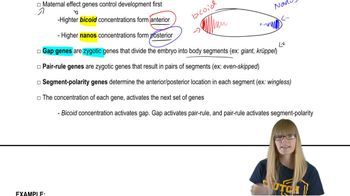
Homeotic genes are crucial regulatory genes that control the body plan and the identity of body segments during embryonic development. They determine the formation of specific structures in the correct locations, and mutations in these genes can lead to developmental abnormalities. In the context of cancer, altered expression of homeotic genes can disrupt normal differentiation processes, potentially leading to the formation of tumors.
Recommended video:
Guided course
11:19
Segmentation Genes

Cell Differentiation

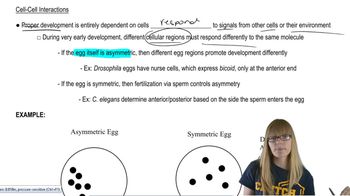
Cell differentiation is the process by which unspecialized cells, such as embryonic stem cells, develop into specialized cells with distinct functions. This process is tightly regulated by gene expression and signaling pathways. In cancer, cells may lose their differentiated state, becoming more stem-like or undifferentiated, which contributes to uncontrolled growth and the ability to invade other tissues.
Recommended video:
Guided course
03:52
Cell-cell interactions

Oncogenesis

Oncogenesis refers to the process by which normal cells transform into cancer cells, involving genetic mutations and changes in cellular behavior. Key features of oncogenesis include increased cell proliferation, evasion of apoptosis, and enhanced migration and invasion capabilities. Understanding the genetic and molecular mechanisms behind oncogenesis, including the role of homeotic genes, is essential for developing targeted cancer therapies.
Related Practice
Textbook Question

You observe that a particular gene is being transcribed during development. How can you tell whether the expression of this gene is under transcriptional or translational control?

451
views
Textbook Question

The homeotic mutation Antennapedia causes mutant Drosophila to have legs in place of antennae and is a dominant gain-of-function mutation. What are the properties of such mutations? How does the Antennapedia gene change antennae into legs?

828
views
Textbook Question

The Drosophila homeotic mutation spineless aristapedia (ssᵃ) results in the formation of a miniature tarsal structure (normally part of the leg) on the end of the antenna. What insight is provided by (ssᵃ) concerning the role of genes during determination?

489
views
Textbook Question

Early development depends on the temporal and spatial interplay between maternally supplied material and mRNA and the onset of zygotic gene expression. Maternally encoded mRNAs must be produced, positioned, and degraded [Surdej and Jacobs-Lorena (1998). Mol. Cell Biol. 18:2892–2900]. For example, transcription of the bicoid gene that determines anterior–posterior polarity in Drosophila is maternal. The mRNA is synthesized in the ovary by nurse cells and then transported to the oocyte, where it localizes to the anterior ends of oocytes. After egg deposition, bicoid mRNA is translated and unstable bicoid protein forms a decreasing concentration gradient from the anterior end of the embryo. At the start of gastrulation, bicoid mRNA has been degraded. Consider two models to explain the degradation of bicoid mRNA: (1) degradation may result from signals within the mRNA (intrinsic model), or (2) degradation may result from the mRNA's position within the egg (extrinsic model). Experimentally, how could one distinguish between these two models?

914
views
Textbook Question

Formation of germ cells in Drosophila and many other embryos is dependent on their position in the embryo and their exposure to localized cytoplasmic determinants. Nuclei exposed to cytoplasm in the posterior end of Drosophila eggs (the pole plasm) form cells that develop into germ cells under the direction of maternally derived components. R. Amikura et al. [(2001). Proc. Nat. Acad. Sci. (USA) 98:9133–9138] consistently found mitochondria-type ribosomes outside mitochondria in the germ plasma of Drosophila embryos and postulated that they are intimately related to germ-cell specification. If you were studying this phenomenon, what would you want to know about the activity of these ribosomes?

625
views
Textbook Question

One of the most interesting aspects of early development is the remodeling of the cell cycle from rapid cell divisions, apparently lacking G1 and G2 phases, to slower cell cycles with measurable G1 and G2 phases and checkpoints. During this remodeling, maternal mRNAs that specify cyclins are deadenylated, and zygotic genes are activated to produce cyclins. Audic et al. [(2001). Mol. and Cell. Biol. 21:1662–1671] suggest that deadenylation requires transcription of zygotic genes. Present a diagram that captures the significant features of these findings.

452
views