Pearson+ LogoPearson+ Logo
Ch. 23 - Developmental Genetics
Klug - Concepts of Genetics  12th Edition
Klug12th EditionConcepts of Genetics ISBN: 9780135564776Not the one you use?Change textbook
Chapter 23, Problem 21

The floral homeotic genes of Arabidopsis belong to the MADS-box gene family, while in Drosophila, homeotic genes belong to the homeobox gene family. In both Arabidopsis and Drosophila, members of the Polycomb gene family control expression of these divergent homeotic genes. How do Polycomb genes control expression of two very different sets of homeotic genes?

Verified step by step guidance
1
Understand the role of Polycomb genes: Polycomb genes are a group of genes that encode proteins involved in epigenetic regulation. They control gene expression by modifying chromatin structure, making certain regions of DNA more or less accessible for transcription.
Recognize the conserved mechanism: Despite the differences in the homeotic gene families (MADS-box in Arabidopsis and homeobox in Drosophila), Polycomb genes regulate both by repressing gene expression through chromatin remodeling. This is a conserved mechanism across species.
Explain chromatin remodeling: Polycomb proteins form complexes, such as Polycomb Repressive Complex 1 (PRC1) and Polycomb Repressive Complex 2 (PRC2). PRC2 adds methyl groups to histone H3 at lysine 27 (H3K27me3), a modification associated with transcriptional repression. PRC1 recognizes this mark and compacts chromatin further.
Apply this to homeotic genes: In both Arabidopsis and Drosophila, Polycomb complexes repress the expression of homeotic genes in regions where they should not be active. This ensures proper spatial and temporal expression patterns during development.
Conclude the shared principle: Although the specific homeotic genes differ between Arabidopsis and Drosophila, the Polycomb gene family uses the same epigenetic mechanisms to regulate their expression, highlighting the evolutionary conservation of this regulatory system.

Verified video answer for a similar problem:

This video solution was recommended by our tutors as helpful for the problem above.
Video duration:
2m
Was this helpful?

Key Concepts

Here are the essential concepts you must grasp in order to answer the question correctly.

Homeotic Genes

Homeotic genes are crucial for determining the identity of body parts during development. In organisms like Arabidopsis and Drosophila, these genes dictate the formation of specific structures, such as flowers in plants or segments in insects. They are categorized into different families, such as MADS-box in plants and homeobox in animals, reflecting their evolutionary divergence yet functional similarities.
Recommended video:
Guided course
11:19
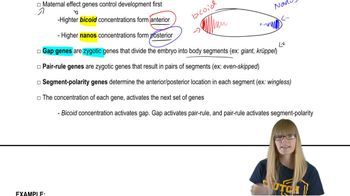
Segmentation Genes

Polycomb Group Genes

Polycomb group (PcG) genes are a set of regulatory genes that maintain the repression of target genes through epigenetic mechanisms. They play a vital role in developmental processes by ensuring that homeotic genes are expressed at the right time and place. In both Arabidopsis and Drosophila, PcG proteins modify chromatin structure, thereby silencing specific homeotic genes to prevent inappropriate expression.
Recommended video:
Guided course
09:09
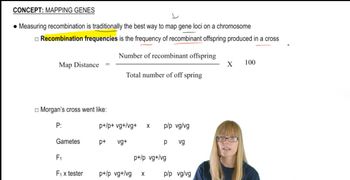
Mapping Genes

Epigenetic Regulation

Epigenetic regulation refers to heritable changes in gene expression that do not involve alterations to the underlying DNA sequence. This includes mechanisms such as DNA methylation and histone modification, which can activate or silence genes. In the context of Polycomb genes, epigenetic regulation is essential for controlling the expression of homeotic genes, allowing for precise developmental outcomes despite the genetic differences between species.
Recommended video:
Related Practice
Textbook Question

The apterous gene in Drosophila encodes a protein required for wing patterning and growth. It is also known to function in nerve development, fertility, and viability. When human and mouse genes whose protein products closely resemble apterous were used to generate transgenic Drosophila [Rincon-Limas et al. (1999). Proc. Nat. Acad. Sci. (USA) 96:2165–2170], the apterous mutant phenotype was rescued. In addition, the whole-body expression patterns in the transgenic Drosophila were similar to normal apterous.

What is meant by the term rescued in this context?

455
views
Textbook Question

The apterous gene in Drosophila encodes a protein required for wing patterning and growth. It is also known to function in nerve development, fertility, and viability. When human and mouse genes whose protein products closely resemble apterous were used to generate transgenic Drosophila [Rincon-Limas et al. (1999). Proc. Nat. Acad. Sci. (USA) 96:2165–2170], the apterous mutant phenotype was rescued. In addition, the whole-body expression patterns in the transgenic Drosophila were similar to normal apterous.

What do these results indicate about the molecular nature of development?

658
views
Textbook Question

In Arabidopsis, flower development is controlled by sets of homeotic genes. How many classes of these genes are there, and what structures are formed by their individual and combined expression?

720
views
Textbook Question

Vulval development in C. elegans is dependent on the response of some of the central epidermal progenitor cells in the region of the developing vulva to a chemical signal from the gonad. Signaling from the gonad is blocked by action of the vulvaless mutant let-23 so that none of the central progenitor cells form vulval structures. In the vulvaless mutant, n300, the central progenitor cells do not form.

Which gene is likely to act earlier in the vulval developmental pathway?

523
views
Textbook Question

Vulval development in C. elegans is dependent on the response of some of the central epidermal progenitor cells in the region of the developing vulva to a chemical signal from the gonad. Signaling from the gonad is blocked by action of the vulvaless mutant let-23 so that none of the central progenitor cells form vulval structures. In the vulvaless mutant, n300, the central progenitor cells do not form.

What phenotype (vulva formed or vulvaless) would you expect from the double mutant? Why?

763
views
Textbook Question

Much of what we know about gene interactions in development has been learned using nematodes, yeast, flies, and bacteria. This is due, in part, to the relative ease of genetic manipulation of these well-characterized genomes. However, of great interest are gene interactions involving complex diseases in humans. Wang and White [(2011). Nature Methods 8(4):341–346] describe work using RNAi to examine the interactive proteome in mammalian cells. They mention that knockdown inefficiencies and off-target effects of introduced RNAi species are areas that need particular improvement if the methodology is to be fruitful.

How might one use RNAi to study developmental pathways?

493
views