Pearson+ LogoPearson+ Logo
Ch. 23 - Developmental Genetics
Klug - Concepts of Genetics  12th Edition
Klug12th EditionConcepts of Genetics ISBN: 9780135564776Not the one you use?Change textbook
Chapter 23, Problem 20

In Arabidopsis, flower development is controlled by sets of homeotic genes. How many classes of these genes are there, and what structures are formed by their individual and combined expression?

Verified step by step guidance
1
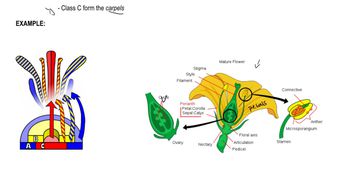
Understand that in Arabidopsis, flower development is governed by the ABC model of floral organ identity, which involves three classes of homeotic genes: A, B, and C.
Class A genes are responsible for the development of sepals in the first whorl and, in combination with Class B genes, petals in the second whorl.
Class B genes, when expressed with Class A genes, form petals in the second whorl, and when expressed with Class C genes, form stamens in the third whorl.
Class C genes are responsible for the development of carpels in the fourth whorl and, in combination with Class B genes, stamens in the third whorl. Additionally, Class C genes repress Class A gene expression in the inner whorls.
Summarize that the combined expression of these three classes of genes determines the identity of the floral organs in the four concentric whorls: sepals (A), petals (A+B), stamens (B+C), and carpels (C).

Verified video answer for a similar problem:

This video solution was recommended by our tutors as helpful for the problem above.
Video duration:
1m
Was this helpful?

Key Concepts

Here are the essential concepts you must grasp in order to answer the question correctly.

Homeotic Genes

Homeotic genes are a group of regulatory genes that determine the identity of body parts during development. In plants like Arabidopsis, these genes play a crucial role in specifying the formation of floral organs by controlling the expression of downstream target genes. Mutations in homeotic genes can lead to the transformation of one organ type into another, illustrating their importance in developmental biology.
Recommended video:
Guided course
11:19
Segmentation Genes

Classes of Homeotic Genes

In Arabidopsis, homeotic genes are categorized into two main classes: the ABC model genes, which include A, B, and C class genes. Each class is responsible for the development of specific floral structures: A class genes promote sepal formation, B class genes are involved in petal and stamen development, and C class genes dictate carpel formation. The interaction of these classes determines the overall structure of the flower.
Recommended video:
Guided course
02:34
Plant HOX genes

Gene Expression and Floral Structures

The expression of homeotic genes in specific combinations leads to the formation of distinct floral structures. For example, the combined expression of A and B class genes results in petals, while the presence of B and C class genes leads to stamens. This combinatorial control is essential for the proper development of flowers, ensuring that each organ is formed in the correct position and with the right identity.
Recommended video:
Guided course
02:09
Penetrance and Expressivity
Related Practice
Textbook Question

A number of genes that control expression of Hox genes in Drosophila have been identified. One of these homozygous mutants is extra sex combs, where some of the head and all of the thorax and abdominal segments develop as the last abdominal segment. In other words, all affected segments develop as posterior segments. What does this phenotype tell you about which set of Hox genes is controlled by the extra sex combs gene?

616
views
Textbook Question

The apterous gene in Drosophila encodes a protein required for wing patterning and growth. It is also known to function in nerve development, fertility, and viability. When human and mouse genes whose protein products closely resemble apterous were used to generate transgenic Drosophila [Rincon-Limas et al. (1999). Proc. Nat. Acad. Sci. (USA) 96:2165–2170], the apterous mutant phenotype was rescued. In addition, the whole-body expression patterns in the transgenic Drosophila were similar to normal apterous.

What is meant by the term rescued in this context?

455
views
Textbook Question

The apterous gene in Drosophila encodes a protein required for wing patterning and growth. It is also known to function in nerve development, fertility, and viability. When human and mouse genes whose protein products closely resemble apterous were used to generate transgenic Drosophila [Rincon-Limas et al. (1999). Proc. Nat. Acad. Sci. (USA) 96:2165–2170], the apterous mutant phenotype was rescued. In addition, the whole-body expression patterns in the transgenic Drosophila were similar to normal apterous.

What do these results indicate about the molecular nature of development?

658
views
Textbook Question

The floral homeotic genes of Arabidopsis belong to the MADS-box gene family, while in Drosophila, homeotic genes belong to the homeobox gene family. In both Arabidopsis and Drosophila, members of the Polycomb gene family control expression of these divergent homeotic genes. How do Polycomb genes control expression of two very different sets of homeotic genes?

575
views
Textbook Question

Vulval development in C. elegans is dependent on the response of some of the central epidermal progenitor cells in the region of the developing vulva to a chemical signal from the gonad. Signaling from the gonad is blocked by action of the vulvaless mutant let-23 so that none of the central progenitor cells form vulval structures. In the vulvaless mutant, n300, the central progenitor cells do not form.

Which gene is likely to act earlier in the vulval developmental pathway?

523
views
Textbook Question

Vulval development in C. elegans is dependent on the response of some of the central epidermal progenitor cells in the region of the developing vulva to a chemical signal from the gonad. Signaling from the gonad is blocked by action of the vulvaless mutant let-23 so that none of the central progenitor cells form vulval structures. In the vulvaless mutant, n300, the central progenitor cells do not form.

What phenotype (vulva formed or vulvaless) would you expect from the double mutant? Why?

763
views