Pearson+ LogoPearson+ Logo
Ch. 24 - Cancer Genetics
Klug - Concepts of Genetics  12th Edition
Klug12th EditionConcepts of Genetics ISBN: 9780135564776Not the one you use?Change textbook
Chapter 24, Problem 9

Define tumor-suppressor genes. Why is a mutated single copy of a tumor-suppressor gene expected to behave as a recessive gene?

Verified step by step guidance
1
Step 1: Define tumor-suppressor genes as genes that encode proteins responsible for regulating cell growth, repairing DNA damage, and ensuring cells do not divide uncontrollably, thereby preventing tumor formation.
Step 2: Explain that tumor-suppressor genes typically require both copies (alleles) to be inactivated or mutated to lose their function, which is why they are often considered recessive at the cellular level.
Step 3: Describe that when only one copy of a tumor-suppressor gene is mutated, the other normal copy can usually produce enough functional protein to maintain normal cell regulation.
Step 4: Clarify that this functional redundancy means a single mutated copy does not lead to loss of tumor-suppressor activity, so the mutated allele behaves recessively because the phenotype (loss of tumor suppression) only appears when both alleles are mutated.
Step 5: Summarize that the recessive behavior of tumor-suppressor gene mutations contrasts with dominant oncogenes, where a single mutated copy can promote cancer development.

Verified video answer for a similar problem:

This video solution was recommended by our tutors as helpful for the problem above.
Video duration:
1m
Was this helpful?

Key Concepts

Here are the essential concepts you must grasp in order to answer the question correctly.

Tumor-Suppressor Genes

Tumor-suppressor genes are genes that regulate cell growth and division, preventing uncontrolled proliferation. They act as cellular brakes by repairing DNA damage or initiating apoptosis, thereby protecting against cancer development.
Recommended video:
Guided course
09:09
Mapping Genes

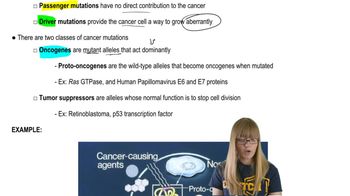
Recessive Nature of Tumor-Suppressor Gene Mutations

A mutation in a single copy of a tumor-suppressor gene usually does not cause loss of function because the other normal allele can compensate. Therefore, the mutated allele behaves recessively, requiring both copies to be inactivated for tumorigenesis.
Recommended video:
Guided course
04:46
Cancer Mutations

Two-Hit Hypothesis

The two-hit hypothesis explains that both alleles of a tumor-suppressor gene must be mutated or inactivated to lose function. The first 'hit' is often inherited or acquired, and the second 'hit' occurs somatically, leading to cancer progression.
Recommended video:
Guided course
03:13
Translation:Wobble Hypothesis