Pearson+ LogoPearson+ Logo
Ch. 24 - Cancer Genetics
Klug - Concepts of Genetics  12th Edition
Klug12th EditionConcepts of Genetics ISBN: 9780135564776Not the one you use?Change textbook
Chapter 24, Problem 11

Part of the Ras protein is associated with the plasma membrane, and part extends into the cytoplasm. How does the Ras protein transmit a signal from outside the cell into the cytoplasm? What happens in cases where the ras gene is mutated?

Verified step by step guidance
1
Ras protein is a small GTPase that acts as a molecular switch in signal transduction pathways, particularly in the transmission of signals from cell surface receptors to the inside of the cell.
When a growth factor binds to a receptor tyrosine kinase (RTK) on the cell surface, the receptor becomes activated and undergoes autophosphorylation, creating binding sites for adaptor proteins.
Adaptor proteins, such as Grb2, bind to the phosphorylated RTK and recruit a guanine nucleotide exchange factor (GEF) like SOS, which facilitates the exchange of GDP for GTP on Ras, activating it.
Activated Ras (Ras-GTP) interacts with and activates downstream effectors, such as the Raf kinase, initiating a kinase cascade that ultimately leads to changes in gene expression and cellular responses.
In cases where the ras gene is mutated, it can lead to constitutive activation of Ras, meaning it remains in the GTP-bound active state, which can result in uncontrolled cell division and contribute to cancer development.

Verified video answer for a similar problem:

This video solution was recommended by our tutors as helpful for the problem above.
Video duration:
2m
Was this helpful?

Key Concepts

Here are the essential concepts you must grasp in order to answer the question correctly.

Signal Transduction

Signal transduction is the process by which a cell responds to external signals, often involving a series of molecular events. In the case of the Ras protein, it acts as a molecular switch that relays signals from cell surface receptors to intracellular pathways, facilitating communication between the extracellular environment and the cytoplasm.
Recommended video:

Ras Protein Function

The Ras protein is a small GTPase that plays a critical role in cell signaling pathways, particularly those regulating cell growth and differentiation. When activated by binding to GTP, Ras interacts with various downstream effectors, propagating the signal within the cell. This activation is crucial for normal cellular functions.
Recommended video:

Mutations in the Ras Gene

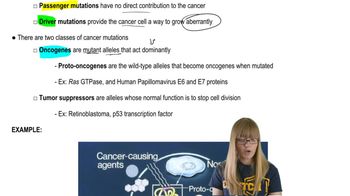
Mutations in the ras gene can lead to constitutive activation of the Ras protein, meaning it remains in an active state regardless of external signals. This can result in uncontrolled cell proliferation and is commonly associated with various cancers. Understanding these mutations is essential for developing targeted therapies in cancer treatment.
Recommended video:
Guided course
04:46
Cancer Mutations