Pearson+ LogoPearson+ Logo
Ch. 25 - Quantitative Genetics and Multifactorial Traits
Klug - Concepts of Genetics  12th Edition
Klug12th EditionConcepts of Genetics ISBN: 9780135564776Not the one you use?Change textbook
Chapter 25, Problem 4a

A dark-red strain and a white strain of wheat are crossed and produce an intermediate, medium-red F₁. When the F₁ plants are interbred, an F₂ generation is produced in a ratio of 1 dark-red: 4 medium-dark-red: 6 medium-red: 4 light-red: 1 white. Further crosses reveal that the dark-red and white F₂ plants are true breeding
Based on the ratios in the F₂ population, how many genes are involved in the production of color?

Verified step by step guidance
1
Recognize that the F₁ generation shows an intermediate phenotype (medium-red) between the two parental strains (dark-red and white), which suggests incomplete dominance or additive gene action rather than simple dominance.
Examine the F₂ phenotypic ratio given: 1 dark-red : 4 medium-dark-red : 6 medium-red : 4 light-red : 1 white. Notice that this ratio resembles the expansion of a binomial expression raised to the fourth power, which hints at multiple genes contributing additively to the trait.
Recall that when multiple genes contribute additively to a trait, the F₂ phenotypic ratios often follow the pattern of the coefficients in the expansion of \((a + b)^n\), where \(n\) is the number of genes involved. The coefficients for \((a + b)^4\) are 1, 4, 6, 4, 1, matching the observed ratio.
Conclude that the number of genes involved corresponds to the exponent \(n\) in the binomial expansion that fits the observed ratio. Here, since the ratio matches the coefficients of \((a + b)^4\), it suggests that 4 genes are involved in producing the color.
Confirm this conclusion by considering that the dark-red and white F₂ plants are true breeding, indicating homozygosity at all loci, which aligns with the idea of multiple additive genes segregating independently.

Verified video answer for a similar problem:

This video solution was recommended by our tutors as helpful for the problem above.
Video duration:
2m
Was this helpful?

Key Concepts

Here are the essential concepts you must grasp in order to answer the question correctly.

Incomplete Dominance and Intermediate Phenotypes

Incomplete dominance occurs when heterozygous individuals display a phenotype intermediate between the two homozygous parents. In this question, the F₁ generation shows a medium-red color, which is between dark-red and white, indicating that neither allele is completely dominant. This concept helps explain the blending of traits seen in the offspring.
Recommended video:
Guided course
04:37
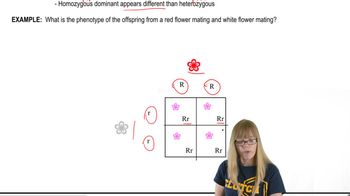
Variations on Dominance

Polygenic Inheritance and Quantitative Trait Ratios

Polygenic inheritance involves multiple genes contributing additively to a single trait, producing a range of phenotypes. The complex F₂ ratio (1:4:6:4:1) suggests several genes influence wheat color, with each gene adding to the pigment intensity. Recognizing this pattern helps determine the number of genes involved based on the distribution of phenotypes.
Recommended video:
Guided course
13:40
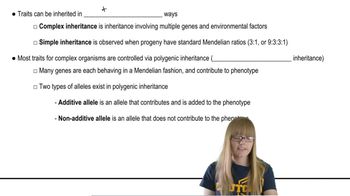
Traits and Variance

True Breeding and Homozygosity

True breeding plants consistently produce offspring with the same phenotype, indicating homozygosity for the genes controlling that trait. The fact that dark-red and white F₂ plants are true breeding means they are homozygous for all relevant alleles, which is crucial for interpreting the genetic ratios and confirming the number of genes involved.
Recommended video:
Guided course
13:04
Hardy Weinberg
Related Practice
Textbook Question

How do we know that monozygotic twins are not identical genotypically as adults?

493
views
Textbook Question

Write a short essay that discusses the difference between the more traditional Mendelian and neo-Mendelian modes of inheritance (qualitative inheritance) and quantitative inheritance.

445
views
Textbook Question

Define the following:

(a) Polygenic

(b) Additive alleles

(c) Correlation

(d) Monozygotic and dizygotic twins

(e) Heritability

(f) QTL

(g) Continuous variation

625
views
Textbook Question

A dark-red strain and a white strain of wheat are crossed and produce an intermediate, medium-red F₁. When the F₁ plants are interbred, an F₂ generation is produced in a ratio of 1 dark-red: 4 medium-dark-red: 6 medium-red: 4 light-red: 1 white. Further crosses reveal that the dark-red and white F₂ plants are true breeding

How many additive alleles are needed to produce each possible phenotype?

436
views
Textbook Question

A dark-red strain and a white strain of wheat are crossed and produce an intermediate, medium-red F₁. When the F₁ plants are interbred, an F₂ generation is produced in a ratio of 1 dark-red: 4 medium-dark-red: 6 medium-red: 4 light-red: 1 white. Further crosses reveal that the dark-red and white F₂ plants are true breeding

Assign symbols to these alleles, and list possible genotypes that give rise to the medium-red and light-red phenotypes.

502
views
Textbook Question

A dark-red strain and a white strain of wheat are crossed and produce an intermediate, medium-red F₁. When the F₁ plants are interbred, an F₂ generation is produced in a ratio of 1 dark-red: 4 medium-dark-red: 6 medium-red: 4 light-red: 1 white. Further crosses reveal that the dark-red and white F₂ plants are true breeding

Predict the outcome of the F1 and F2 generations in a cross between a true-breeding medium-red plant and a white plant.

721
views