Pearson+ LogoPearson+ Logo
Ch. 25 - Quantitative Genetics and Multifactorial Traits
Klug - Concepts of Genetics  12th Edition
Klug12th EditionConcepts of Genetics ISBN: 9780135564776Not the one you use?Change textbook
Chapter 25, Problem 29d

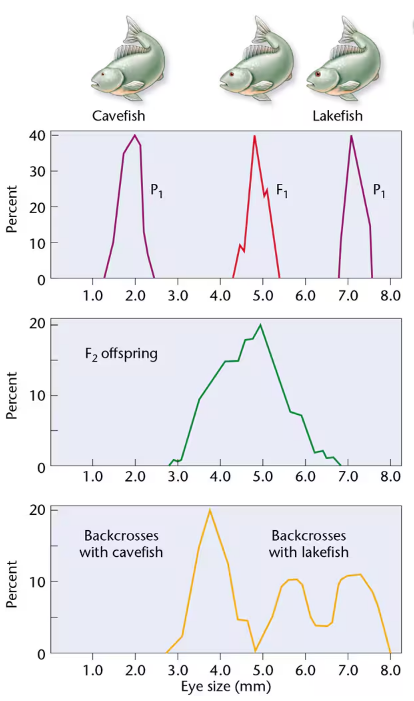
In 1988, Horst Wilkens investigated blind cavefish, comparing them with members of a sibling species with normal vision that are found in a lake [Wilkens, H. (1988). Evol. Biol. 25:271–367]. We will call them cavefish and lakefish. Wilkens found that cavefish eyes are about seven times smaller than lakefish eyes. F₁ hybrids have eyes of intermediate size. These data, as well as the F₁ × F₁ cross and those from backcrosses (F₁ × cavefish and F₁ × lakefish), are depicted below. Examine Wilkens's results and respond to the following questions:
Wilkens examined about 1000 F₂ progeny and estimated that 6–7 genes are involved in determining eye size. Is the sample size adequate to justify this conclusion? Propose an experimental protocol to test the hypothesis.
Graph showing eye size distributions in cavefish, lakefish, F1 hybrids, F2 offspring, and backcrosses with both fish types.

Verified step by step guidance
1
Step 1: Understand the problem. The question is asking whether the sample size of 1000 F₂ progeny is adequate to justify the conclusion that 6–7 genes are involved in determining eye size in cavefish. Additionally, it asks for an experimental protocol to test this hypothesis.
Step 2: Recall the concept of polygenic inheritance. Traits controlled by multiple genes, such as eye size, often show continuous variation. The number of genes involved can be estimated using statistical methods, such as the number of phenotypic classes observed in the F₂ generation. The sample size must be large enough to detect these classes reliably.
Step 3: Evaluate the adequacy of the sample size. To justify the conclusion that 6–7 genes are involved, the sample size must be sufficient to distinguish between phenotypic classes. The formula for estimating the number of phenotypic classes is 2n, where n is the number of genes. For 6–7 genes, this would result in 64–128 phenotypic classes. A sample size of 1000 may be adequate if the phenotypic differences are distinct and measurable.
Step 4: Propose an experimental protocol. To test the hypothesis, perform a controlled cross between cavefish and lakefish to produce F₁ hybrids. Then, cross F₁ hybrids to produce F₂ progeny. Measure eye size in the F₂ generation and analyze the distribution of phenotypes. Use statistical methods, such as chi-square tests, to determine if the observed phenotypic distribution matches the expected distribution for 6–7 genes.
Step 5: Include additional controls and replicates. To ensure reliability, repeat the experiment with multiple independent crosses and measure eye size using standardized methods. Consider environmental factors that might influence eye size and control for these variables in the experimental design.

Verified video answer for a similar problem:

This video solution was recommended by our tutors as helpful for the problem above.
Video duration:
1m
Was this helpful?

Key Concepts

Here are the essential concepts you must grasp in order to answer the question correctly.

Genetic Variation

Genetic variation refers to the differences in DNA sequences among individuals within a population. In the context of Wilkens's study, the variation in eye size between cavefish and lakefish suggests that multiple genes contribute to this trait. Understanding genetic variation is crucial for analyzing how traits are inherited and expressed, particularly in hybrid offspring.
Recommended video:
Guided course
09:28
Genomic Variation

Quantitative Trait Loci (QTL)

Quantitative Trait Loci (QTL) are regions of the genome that are associated with a quantitative trait, such as eye size. The identification of 6-7 genes influencing eye size in Wilkens's study implies that these genes may be located in specific QTLs. QTL mapping is a common method used to determine the genetic basis of complex traits, which is essential for validating the hypothesis regarding eye size inheritance.
Recommended video:

Sample Size and Statistical Power

Sample size and statistical power are critical in experimental design, as they determine the reliability of the results. A larger sample size increases the likelihood of detecting true effects and reduces the impact of random variation. In Wilkens's study, examining about 1000 F₂ progeny provides a substantial sample size, which is generally adequate for estimating the number of genes involved in a trait, thus supporting the conclusion drawn from the data.
Recommended video:
Guided course
11:06
Mathematical Measurements
Related Practice
Textbook Question

In 1988, Horst Wilkens investigated blind cavefish, comparing them with members of a sibling species with normal vision that are found in a lake [Wilkens, H. (1988). Evol. Biol. 25:271–367]. We will call them cavefish and lakefish. Wilkens found that cavefish eyes are about seven times smaller than lakefish eyes. F₁ hybrids have eyes of intermediate size. These data, as well as the F₁ × F₁ cross and those from backcrosses (F₁ × cavefish and F₁ × lakefish), are depicted below. Examine Wilkens's results and respond to the following questions:

Based strictly on the F₁ and F₂ results of Wilkens's initial crosses, what possible explanation concerning the inheritance of eye size seems most feasible? 

517
views
Textbook Question

In 1988, Horst Wilkens investigated blind cavefish, comparing them with members of a sibling species with normal vision that are found in a lake [Wilkens, H. (1988). Evol. Biol. 25:271–367]. We will call them cavefish and lakefish. Wilkens found that cavefish eyes are about seven times smaller than lakefish eyes. F₁ hybrids have eyes of intermediate size. These data, as well as the F₁×F₁ cross and those from backcrosses (F₁×cavefish and F₁×lakefish), are depicted below. Examine Wilkens's results and respond to the following questions:

Based on the results of the F₁ backcross with cavefish, is your explanation supported? Explain. 

513
views
Textbook Question

In 1988, Horst Wilkens investigated blind cavefish, comparing them with members of a sibling species with normal vision that are found in a lake [Wilkens, H. (1988). Evol. Biol. 25:271–367]. We will call them cavefish and lakefish. Wilkens found that cavefish eyes are about seven times smaller than lakefish eyes. F₁ hybrids have eyes of intermediate size. These data, as well as the F₁×F₁ cross and those from backcrosses (F₁×cavefish and F₁×lakefish), are depicted below. Examine Wilkens's results and respond to the following questions:

Based on the results of the F₁ backcross with lakefish, is your explanation supported? Explain.

475
views
Textbook Question

In 1988, Horst Wilkens investigated blind cavefish, comparing them with members of a sibling species with normal vision that are found in a lake [Wilkens, H. (1988). Evol. Biol. 25:271–367]. We will call them cavefish and lakefish. Wilkens found that cavefish eyes are about seven times smaller than lakefish eyes. F₁ hybrids have eyes of intermediate size. These data, as well as the F₁ × F₁ cross and those from backcrosses (F₁ × cavefish and F₁ × lakefish), are depicted below. Examine Wilkens's results and respond to the following questions:

A comparison of the embryonic eye in cavefish and lakefish revealed that both reach approximately 4 mm in diameter. However, lakefish eyes continue to grow, while cavefish eye size is greatly reduced. Speculate on the role of the genes involved in this problem.

435
views