Pearson+ LogoPearson+ Logo
Ch. 25 - Quantitative Genetics and Multifactorial Traits
Klug - Concepts of Genetics  12th Edition
Klug12th EditionConcepts of Genetics ISBN: 9780135564776Not the one you use?Change textbook
Chapter 25, Problem 29b

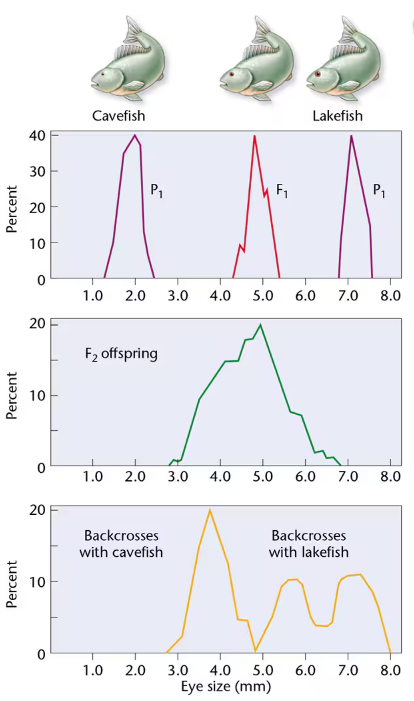
In 1988, Horst Wilkens investigated blind cavefish, comparing them with members of a sibling species with normal vision that are found in a lake [Wilkens, H. (1988). Evol. Biol. 25:271–367]. We will call them cavefish and lakefish. Wilkens found that cavefish eyes are about seven times smaller than lakefish eyes. F₁ hybrids have eyes of intermediate size. These data, as well as the F₁×F₁ cross and those from backcrosses (F₁×cavefish and F₁×lakefish), are depicted below. Examine Wilkens's results and respond to the following questions:
Based on the results of the F₁ backcross with cavefish, is your explanation supported? Explain. 
Graph showing eye size distributions in cavefish, lakefish, hybrids, F2 offspring, and backcrosses with cavefish and lakefish.

Verified step by step guidance
1
Step 1: Understand the genetic basis of the trait being studied. In this case, the size of the eyes in cavefish and lakefish is being investigated. The intermediate eye size in F₁ hybrids suggests incomplete dominance or polygenic inheritance.
Step 2: Analyze the results of the F₁ backcross with lakefish. A backcross involves crossing an F₁ hybrid with one of its parental types (in this case, lakefish). This helps determine the inheritance pattern of the trait by observing the distribution of phenotypes in the offspring.
Step 3: Consider the phenotypic ratios observed in the offspring of the backcross. If the offspring exhibit a range of eye sizes, this may indicate that multiple genes are involved in determining eye size, rather than a single gene with simple dominance/recessiveness.
Step 4: Evaluate whether the results of the backcross support your explanation. For example, if the offspring show a bias toward lakefish-like eye sizes, this could suggest that lakefish alleles are dominant or that the trait is influenced by environmental factors.
Step 5: Conclude by connecting the observed data to the genetic mechanism. If the backcross results align with your hypothesis (e.g., incomplete dominance or polygenic inheritance), then your explanation is supported. Otherwise, consider alternative genetic models that could explain the data.

Verified video answer for a similar problem:

This video solution was recommended by our tutors as helpful for the problem above.
Video duration:
3m
Was this helpful?

Key Concepts

Here are the essential concepts you must grasp in order to answer the question correctly.

Hybrid Vigor and Intermediate Traits

Hybrid vigor, or heterosis, refers to the phenomenon where hybrid offspring exhibit traits that are intermediate between their parent species. In the case of the cavefish and lakefish, the F₁ hybrids have eyes of intermediate size, suggesting that the traits for eye size are influenced by multiple genes. Understanding this concept is crucial for analyzing the genetic basis of the observed phenotypes in the hybrids.
Recommended video:
Guided course
13:40
Traits and Variance

Backcrossing

Backcrossing is a breeding method where hybrid offspring are crossed with one of their parent species. This technique helps to determine the inheritance patterns of specific traits. In this scenario, the F₁ backcross with lakefish allows researchers to assess whether the traits of the hybrids align more closely with the lakefish or cavefish, providing insights into the genetic contributions of each parent.
Recommended video:

Quantitative Trait Loci (QTL)

Quantitative Trait Loci (QTL) are regions of the genome that are associated with the variation of a quantitative trait, such as eye size. The study of QTL is essential for understanding the genetic architecture underlying complex traits. In the context of Wilkens's research, identifying QTL related to eye size can help explain the differences observed between cavefish and lakefish, as well as the intermediate traits in their hybrids.
Recommended video:
Related Practice
Textbook Question

Floral traits in plants often play key roles in diversification, in that slight modifications of those traits, if genetically determined, may quickly lead to reproductive restrictions and evolution. Insight into genetic involvement in flower formation is often acquired through selection experiments that expose realized heritability. Lendvai and Levin (2003) conducted a series of artificial selection experiments on flower size (diameter) in Phlox drummondii. Data from their selection experiments are presented in the following table in modified form and content.

Assuming that the realized heritability in phlox is relatively high, what factors might account for such a high response?

418
views
Textbook Question

Floral traits in plants often play key roles in diversification, in that slight modifications of those traits, if genetically determined, may quickly lead to reproductive restrictions and evolution. Insight into genetic involvement in flower formation is often acquired through selection experiments that expose realized heritability. Lendvai and Levin (2003) conducted a series of artificial selection experiments on flower size (diameter) in Phlox drummondii. Data from their selection experiments are presented in the following table in modified form and content.

In terms of evolutionary potential, is a population with high heritability likely to be favored compared to one with a low realized heritability? 

454
views
Textbook Question

In 1988, Horst Wilkens investigated blind cavefish, comparing them with members of a sibling species with normal vision that are found in a lake [Wilkens, H. (1988). Evol. Biol. 25:271–367]. We will call them cavefish and lakefish. Wilkens found that cavefish eyes are about seven times smaller than lakefish eyes. F₁ hybrids have eyes of intermediate size. These data, as well as the F₁ × F₁ cross and those from backcrosses (F₁ × cavefish and F₁ × lakefish), are depicted below. Examine Wilkens's results and respond to the following questions:

Based strictly on the F₁ and F₂ results of Wilkens's initial crosses, what possible explanation concerning the inheritance of eye size seems most feasible? 

517
views
Textbook Question

In 1988, Horst Wilkens investigated blind cavefish, comparing them with members of a sibling species with normal vision that are found in a lake [Wilkens, H. (1988). Evol. Biol. 25:271–367]. We will call them cavefish and lakefish. Wilkens found that cavefish eyes are about seven times smaller than lakefish eyes. F₁ hybrids have eyes of intermediate size. These data, as well as the F₁×F₁ cross and those from backcrosses (F₁×cavefish and F₁×lakefish), are depicted below. Examine Wilkens's results and respond to the following questions:

Based on the results of the F₁ backcross with lakefish, is your explanation supported? Explain.

475
views
Textbook Question

In 1988, Horst Wilkens investigated blind cavefish, comparing them with members of a sibling species with normal vision that are found in a lake [Wilkens, H. (1988). Evol. Biol. 25:271–367]. We will call them cavefish and lakefish. Wilkens found that cavefish eyes are about seven times smaller than lakefish eyes. F₁ hybrids have eyes of intermediate size. These data, as well as the F₁ × F₁ cross and those from backcrosses (F₁ × cavefish and F₁ × lakefish), are depicted below. Examine Wilkens's results and respond to the following questions:

Wilkens examined about 1000 F₂ progeny and estimated that 6–7 genes are involved in determining eye size. Is the sample size adequate to justify this conclusion? Propose an experimental protocol to test the hypothesis.

370
views
Textbook Question

In 1988, Horst Wilkens investigated blind cavefish, comparing them with members of a sibling species with normal vision that are found in a lake [Wilkens, H. (1988). Evol. Biol. 25:271–367]. We will call them cavefish and lakefish. Wilkens found that cavefish eyes are about seven times smaller than lakefish eyes. F₁ hybrids have eyes of intermediate size. These data, as well as the F₁ × F₁ cross and those from backcrosses (F₁ × cavefish and F₁ × lakefish), are depicted below. Examine Wilkens's results and respond to the following questions:

A comparison of the embryonic eye in cavefish and lakefish revealed that both reach approximately 4 mm in diameter. However, lakefish eyes continue to grow, while cavefish eye size is greatly reduced. Speculate on the role of the genes involved in this problem.

435
views