Pearson+ LogoPearson+ Logo
Ch. 25 - Quantitative Genetics and Multifactorial Traits
Klug - Concepts of Genetics  12th Edition
Klug12th EditionConcepts of Genetics ISBN: 9780135564776Not the one you use?Change textbook
Chapter 25, Problem 22

In a cross between a strain of large guinea pigs and a strain of small guinea pigs, the F₁ are phenotypically uniform, with an average size about intermediate between that of the two parental strains. Among 1014 F₂ individuals, 3 are about the same size as the small parental strain and 5 are about the same size as the large parental strain. How many gene pairs are involved in the inheritance of size in these strains of guinea pigs?

Verified step by step guidance
1
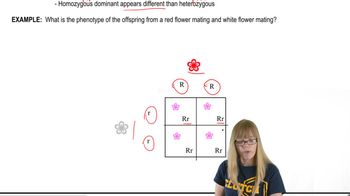
Recognize that the problem describes incomplete dominance or additive gene action, where the F₁ phenotype is intermediate between the two parental phenotypes, and the F₂ shows a range of phenotypes including parental types and intermediates.
Identify that the number of gene pairs (n) involved can be estimated by analyzing the proportion of F₂ individuals that resemble the parental phenotypes, which correspond to the homozygous genotypes at all loci.
Recall that for n gene pairs with additive effects, the proportion of F₂ individuals showing the parental phenotype is given by the formula \(\left(\frac{1}{4}\right)^n\) for each parental type, because each gene pair segregates independently and the parental phenotype requires homozygosity at all loci.
Calculate the observed frequency of each parental phenotype in the F₂ generation by dividing the number of individuals with that phenotype by the total number of F₂ individuals (e.g., for the small phenotype, frequency = \(\frac{3}{1014}\)).
Set up the equation \(\left(\frac{1}{4}\right)^n = \text{observed frequency}\) and solve for n by taking the logarithm of both sides: \(n = \frac{\log(\text{observed frequency})}{\log(\frac{1}{4})}\). This will give the number of gene pairs involved.

Verified video answer for a similar problem:

This video solution was recommended by our tutors as helpful for the problem above.
Video duration:
1m
Was this helpful?

Key Concepts

Here are the essential concepts you must grasp in order to answer the question correctly.

Incomplete Dominance and Intermediate Phenotypes

Incomplete dominance occurs when the heterozygote phenotype is intermediate between the two homozygotes, as seen in the F₁ guinea pigs with sizes between large and small parents. This suggests that neither allele is completely dominant, resulting in blending traits rather than a dominant-recessive pattern.
Recommended video:
Guided course
04:37
Variations on Dominance

Polygenic Inheritance

Polygenic inheritance involves multiple gene pairs contributing additively to a single trait, such as size. The continuous variation and intermediate phenotypes in the F₂ generation indicate that size is controlled by several genes, each with small effects, rather than a single gene.
Recommended video:
Guided course
05:13
Organelle Inheritance

Segregation Ratios and Estimating Number of Gene Pairs

The number of gene pairs can be estimated by analyzing the frequency of parental phenotypes in the F₂ generation. The proportion of individuals resembling parental extremes follows a (1/4)^n pattern, where n is the number of gene pairs, allowing calculation of n from observed counts of extreme phenotypes.
Recommended video:
Guided course
07:56
Sex-Linked Genes
Related Practice
Textbook Question

Many traits of economic or medical significance are determined by quantitative trait loci (QTLs) in which many genes, usually scattered throughout the genome, contribute to expression.

What is meant by the term cosegregate in the context of QTL mapping? Why are markers such as RFLPs, SNPs, and microsatellites often used in QTL mapping?

454
views
Textbook Question

A 3-inch plant was crossed with a 15-inch plant, and all F₁ plants were 9 inches. The F₂ plants exhibited a 'normal distribution,' with heights of 3, 4, 5, 6, 7, 8, 9, 10, 11, 12, 13, 14, and 15 inches.

What ratio will constitute the 'normal distribution' in the F₂?

376
views
Textbook Question

A 3-inch plant was crossed with a 15-inch plant, and all F₁ plants were 9 inches. The F₂ plants exhibited a 'normal distribution,' with heights of 3, 4, 5, 6, 7, 8, 9, 10, 11, 12, 13, 14, and 15 inches.

What will be the outcome if the F₁ plants are testcrossed with plants that are homozygous for all nonadditive alleles?

627
views
Textbook Question

Type A1B brachydactyly (short middle phalanges) is a genetically determined trait that maps to the short arm of chromosome 5 in humans. If you classify individuals as either having or not having brachydactyly, the trait appears to follow a single-locus, incompletely dominant pattern of inheritance. However, if one examines the fingers and toes of affected individuals, one sees a range of expression from extremely short to only slightly short. What might cause such variation in the expression of brachydactyly?

454
views
Textbook Question

In a series of crosses between two true-breeding strains of peaches, the F₁ generation was uniform, producing 30-g peaches. The F₂ fruit mass ranges from 38 to 22 g at intervals of 2 g.

Using these data, determine the number of polygenic loci involved in the inheritance of peach mass.

683
views
Textbook Question

In a series of crosses between two true-breeding strains of peaches, the F₁ generation was uniform, producing 30-g peaches. The F₂ fruit mass ranges from 38 to 22 g at intervals of 2 g.

Using gene symbols of your choice, give the genotypes of the parents and the F₂.

608
views