Pearson+ LogoPearson+ Logo
Ch. 25 - Quantitative Genetics and Multifactorial Traits
Klug - Concepts of Genetics  12th Edition
Klug12th EditionConcepts of Genetics ISBN: 9780135564776Not the one you use?Change textbook
Chapter 25, Problem 24b

In a series of crosses between two true-breeding strains of peaches, the F₁ generation was uniform, producing 30-g peaches. The F₂ fruit mass ranges from 38 to 22 g at intervals of 2 g.
Using gene symbols of your choice, give the genotypes of the parents and the F₂.

Verified step by step guidance
1
Step 1: Identify the inheritance pattern. The problem suggests quantitative inheritance, where multiple genes contribute to the trait (fruit mass). This is typical of polygenic traits, which show continuous variation.
Step 2: Assign gene symbols. Let’s assume two loci (A and B) control fruit mass, with each dominant allele (A or B) contributing 2 g to the base mass. The recessive alleles (a and b) contribute 0 g. The base mass is 22 g, and the maximum mass is 38 g.
Step 3: Determine the genotypes of the parents. Since the parents are true-breeding strains, one parent must be homozygous dominant (AABB) and the other homozygous recessive (aabb). This ensures the F₁ generation is uniform and heterozygous (AaBb).
Step 4: Analyze the F₂ generation. The F₁ individuals (AaBb) are self-crossed, producing offspring with combinations of alleles at both loci. Use a Punnett square to determine all possible genotypes and their corresponding phenotypes (fruit mass).
Step 5: Calculate the phenotypic range. Each dominant allele adds 2 g to the base mass of 22 g. For example, AABB contributes 8 g (22 + 8 = 38 g), AaBb contributes 4 g (22 + 4 = 30 g), and aabb contributes 0 g (22 g). List all possible genotypes and their associated fruit masses.

Verified video answer for a similar problem:

This video solution was recommended by our tutors as helpful for the problem above.
Video duration:
2m
Was this helpful?

Key Concepts

Here are the essential concepts you must grasp in order to answer the question correctly.

True-breeding Strains

True-breeding strains are organisms that, when mated, produce offspring that are identical to themselves for specific traits. In genetics, this means that the parents are homozygous for the traits being studied, ensuring that the F₁ generation will display a uniform phenotype, as seen in the 30-g peaches.
Recommended video:
Guided course
03:08
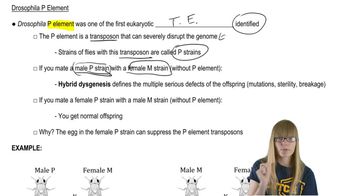
Drosophila P Element

F₁ and F₂ Generations

The F₁ generation is the first filial generation resulting from a cross between two true-breeding parents. In this case, the F₁ peaches are uniform at 30 g. The F₂ generation arises from self-fertilizing the F₁ individuals, leading to a phenotypic range, as observed with fruit masses ranging from 22 g to 38 g.
Recommended video:
Guided course
08:52
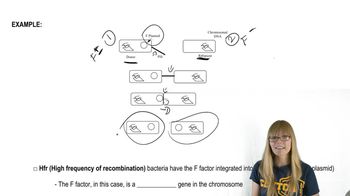
F Factor and Hfr

Genotype and Phenotype

Genotype refers to the genetic makeup of an organism, while phenotype is the observable physical or biochemical characteristics. In this scenario, the genotypes of the parents can be represented as homozygous (e.g., AA and aa), leading to a specific phenotype in the F₁ and a range of phenotypes in the F₂, reflecting the underlying genetic variation.
Recommended video:
Guided course
07:52
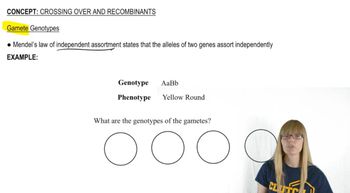
Gamete Genotypes
Related Practice
Textbook Question

In a cross between a strain of large guinea pigs and a strain of small guinea pigs, the F₁ are phenotypically uniform, with an average size about intermediate between that of the two parental strains. Among 1014 F₂ individuals, 3 are about the same size as the small parental strain and 5 are about the same size as the large parental strain. How many gene pairs are involved in the inheritance of size in these strains of guinea pigs?

529
views
Textbook Question

Type A1B brachydactyly (short middle phalanges) is a genetically determined trait that maps to the short arm of chromosome 5 in humans. If you classify individuals as either having or not having brachydactyly, the trait appears to follow a single-locus, incompletely dominant pattern of inheritance. However, if one examines the fingers and toes of affected individuals, one sees a range of expression from extremely short to only slightly short. What might cause such variation in the expression of brachydactyly?

454
views
Textbook Question

In a series of crosses between two true-breeding strains of peaches, the F₁ generation was uniform, producing 30-g peaches. The F₂ fruit mass ranges from 38 to 22 g at intervals of 2 g.

Using these data, determine the number of polygenic loci involved in the inheritance of peach mass.

683
views
Textbook Question

Students in a genetics laboratory began an experiment in an attempt to increase heat tolerance in two strains of Drosophila melanogaster. One strain was trapped from the wild six weeks before the experiment was to begin; the other was obtained from a Drosophila repository at a university laboratory. In which strain would you expect to see the most rapid and extensive response to heat-tolerance selection, and why?

512
views
Textbook Question

Consider a true-breeding plant, AABBCC, crossed with another true-breeding plant, aabbcc, whose resulting offspring are AaBbCc. If you cross the F₁ generation, and independent assortment is operational, the expected fraction of offspring in each phenotypic class is given by the expression N!/M!(N−M)! where N is the total number of alleles (six in this example) and M is the number of uppercase alleles. In a cross of AaBbCc×AaBbCc, what proportion of the offspring would be expected to contain two uppercase alleles?

548
views
Textbook Question

Floral traits in plants often play key roles in diversification, in that slight modifications of those traits, if genetically determined, may quickly lead to reproductive restrictions and evolution. Insight into genetic involvement in flower formation is often acquired through selection experiments that expose realized heritability. Lendvai and Levin (2003) conducted a series of artificial selection experiments on flower size (diameter) in Phlox drummondii. Data from their selection experiments are presented in the following table in a modified form and content.

Considering that differences in control values represent year-to-year differences in greenhouse conditions, calculate (in mm) the average response to selection over the three-year period

421
views