Pearson+ LogoPearson+ Logo
Ch. 25 - Quantitative Genetics and Multifactorial Traits
Klug - Concepts of Genetics  12th Edition
Klug12th EditionConcepts of Genetics ISBN: 9780135564776Not the one you use?Change textbook
Chapter 25, Problem 20a

Many traits of economic or medical significance are determined by quantitative trait loci (QTLs) in which many genes, usually scattered throughout the genome, contribute to expression.
What general procedures are used to identify such loci?

Verified step by step guidance
1
Understand the concept of quantitative trait loci (QTLs): QTLs are regions of the genome that are associated with the variation of a quantitative trait, such as height, weight, or disease susceptibility. These traits are typically influenced by multiple genes and environmental factors.
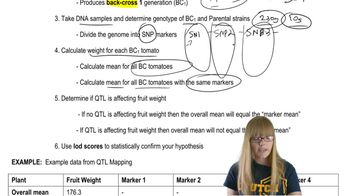
Perform a genetic cross: Begin by crossing two parental strains that differ significantly in the quantitative trait of interest. This generates offspring with varying phenotypes, which can be analyzed to identify genetic contributions to the trait.
Genotype the offspring: Use molecular markers, such as single nucleotide polymorphisms (SNPs) or microsatellites, to determine the genetic makeup of the offspring at various loci across the genome.
Perform statistical analysis: Use linkage analysis or association mapping to correlate the genotypic data with the phenotypic variation observed in the offspring. This helps identify regions of the genome that are significantly associated with the trait.
Validate and refine QTLs: Conduct further experiments, such as fine mapping or functional studies, to narrow down the identified loci and confirm their role in influencing the quantitative trait.

Verified video answer for a similar problem:

This video solution was recommended by our tutors as helpful for the problem above.
Video duration:
2m
Was this helpful?

Key Concepts

Here are the essential concepts you must grasp in order to answer the question correctly.

Quantitative Trait Loci (QTL)

Quantitative Trait Loci (QTL) are specific regions of the genome that are associated with the variation in a quantitative trait, which is a trait that can be measured and expressed numerically, such as height or blood pressure. QTLs typically involve multiple genes, each contributing a small effect to the overall phenotype. Understanding QTLs is crucial for identifying genetic factors that influence complex traits in both plants and animals.
Recommended video:

Genetic Mapping

Genetic mapping is a method used to determine the location of genes on a chromosome and the distances between them. This process often involves creating a genetic linkage map using markers, such as single nucleotide polymorphisms (SNPs), to identify regions of the genome that correlate with specific traits. Accurate genetic mapping is essential for pinpointing QTLs and understanding their role in trait variation.
Recommended video:
Guided course
11:11
Mapping Overview

Statistical Analysis in QTL Mapping

Statistical analysis plays a vital role in QTL mapping by helping researchers determine the significance of the association between genetic markers and traits. Techniques such as ANOVA, regression analysis, and mixed models are commonly used to analyze phenotypic data in relation to genotypic data. These analyses help to identify which QTLs are likely to be responsible for observed trait variations, guiding further research and applications in breeding and medicine.
Recommended video:
Related Practice
Textbook Question

Suppose you want to develop a population of Drosophila that would rapidly learn to avoid certain substances the flies could detect by smell. Based on the heritability estimate you obtained in Problem 16, do you think it would be worth doing this by artificial selection? Why or why not?

467
views
Textbook Question

In a population of tomato plants, mean fruit weight is 60 g and is 0.3. Predict the mean weight of the progeny if tomato plants whose fruit averaged 80 g were selected from the original population and interbred.

425
views
Textbook Question

In a population of 100 inbred, genotypically identical rice plants, variance for grain yield is 4.67. What is the heritability for yield? Would you advise a rice breeder to improve yield in this strain of rice plants by selection?

720
views
Textbook Question

Many traits of economic or medical significance are determined by quantitative trait loci (QTLs) in which many genes, usually scattered throughout the genome, contribute to expression.

What is meant by the term cosegregate in the context of QTL mapping? Why are markers such as RFLPs, SNPs, and microsatellites often used in QTL mapping?

454
views
Textbook Question

A 3-inch plant was crossed with a 15-inch plant, and all F₁ plants were 9 inches. The F₂ plants exhibited a 'normal distribution,' with heights of 3, 4, 5, 6, 7, 8, 9, 10, 11, 12, 13, 14, and 15 inches.

What ratio will constitute the 'normal distribution' in the F₂?

376
views
Textbook Question

A 3-inch plant was crossed with a 15-inch plant, and all F₁ plants were 9 inches. The F₂ plants exhibited a 'normal distribution,' with heights of 3, 4, 5, 6, 7, 8, 9, 10, 11, 12, 13, 14, and 15 inches.

What will be the outcome if the F₁ plants are testcrossed with plants that are homozygous for all nonadditive alleles?

627
views