Pearson+ LogoPearson+ Logo
Ch. 25 - Quantitative Genetics and Multifactorial Traits
Klug - Concepts of Genetics  12th Edition
Klug12th EditionConcepts of Genetics ISBN: 9780135564776Not the one you use?Change textbook
Chapter 25, Problem 12b

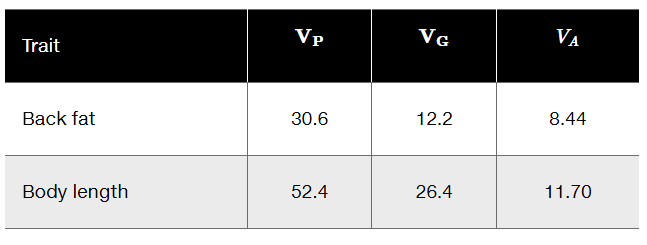
The following variances were calculated for two traits in a herd of hogs.
Table showing variances for back fat and body length traits with values for VP, VG, and VA in a hog herd.
Which of the two traits will respond best to selection by a breeder? Why?

Verified step by step guidance
1
Step 1: Understand the key variances given in the table: \(V_P\) (phenotypic variance), \(V_G\) (genetic variance), and \(V_A\) (additive genetic variance) for each trait. These variances help us understand the genetic contribution to the traits and their potential response to selection.
Step 2: Recall that the response to selection depends primarily on the narrow-sense heritability (\(h^2\)), which is the proportion of phenotypic variance due to additive genetic variance. It is calculated as: \[h^2 = \frac{V_A}{V_P}\]
Step 3: Calculate the narrow-sense heritability for each trait using the formula above. This will give you a measure of how much of the trait's variation is heritable and can be passed on to the next generation.
Step 4: Compare the heritability values for back fat and body length. The trait with the higher \(h^2\) value will respond better to selection because a greater proportion of its variation is due to additive genetic factors.
Step 5: Conclude which trait will respond best to selection based on the higher heritability value, and explain that this is because selection acts on additive genetic variance, which directly influences the trait's improvement in the population.

Verified video answer for a similar problem:

This video solution was recommended by our tutors as helpful for the problem above.
Video duration:
2m
Was this helpful?

Key Concepts

Here are the essential concepts you must grasp in order to answer the question correctly.

Phenotypic Variance (VP)

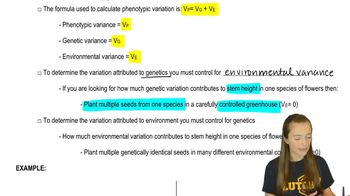
Phenotypic variance (VP) represents the total variation observed in a trait within a population. It includes both genetic variance and environmental variance, reflecting all factors that contribute to differences in the trait among individuals.
Recommended video:
Guided course
08:34
Analyzing Trait Variance

Additive Genetic Variance (VA)

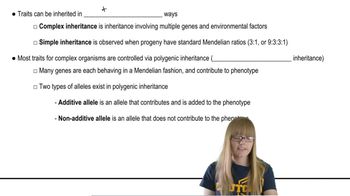
Additive genetic variance (VA) is the portion of genetic variance that contributes to the resemblance between parents and offspring. It represents the cumulative effect of individual alleles and is crucial for predicting the response to selection in breeding programs.
Recommended video:
Guided course
13:40
Traits and Variance

Heritability and Response to Selection

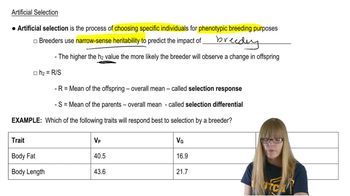
Heritability in the narrow sense (h²) is the ratio of additive genetic variance to phenotypic variance (VA/VP). It indicates the proportion of trait variation due to additive genetics and predicts how effectively a trait will respond to selection by breeders.
Recommended video:
Guided course
04:15
Artificial Selection
Related Practice
Textbook Question

List as many human traits as you can that are likely to be under the control of a polygenic mode of inheritance.

461
views
Textbook Question

Corn plants from a test plot are measured, and the distribution of heights at 10-cm intervals is recorded in the following table: 

 Height (cm)   Plants (no.)    

100          20    

110          60    

120          90    

130         130    

140         180   

 150         120    

160          70    

170         50    

180         40 

Calculate 

(a) the mean height, 

(b) the variance, 

(c) the standard deviation, and 

(d) the standard error of the mean. 

Plot a rough graph of plant height against frequency. Do the values represent a normal distribution? Based on your calculations, how would you assess the variation within this population?

940
views
Textbook Question

The following variances were calculated for two traits in a herd of hogs.

Calculate broad-sense () and narrow-sense () heritabilities for each trait in this herd.

520
views
Textbook Question

The mean and variance of plant height of two highly inbred strains (P₁ and P₂) and their progeny (F₁ and F₂) are shown here.


  Strain  Mean (cm)  Variance 

   P₁     34.2        4.2

   P₂     55.3        3.8

   F₁     44.2        5.6

   F₂     46.3       10.3


Calculate the broad-sense heritability () of plant height in this species.

812
views
Textbook Question

A hypothetical study investigated the vitamin A content and the cholesterol content of eggs from a large population of chickens. The following variances (V) were calculated.

Calculate the narrow-sense heritability () for both traits.

474
views
Textbook Question

A hypothetical study investigated the vitamin A content and the cholesterol content of eggs from a large population of chickens. The following variances (V) were calculated.

Which trait, if either, is likely to respond to selection?

515
views