Pearson+ LogoPearson+ Logo
Ch. 25 - Quantitative Genetics and Multifactorial Traits
Klug - Concepts of Genetics  12th Edition
Klug12th EditionConcepts of Genetics ISBN: 9780135564776Not the one you use?Change textbook
Chapter 25, Problem 14a

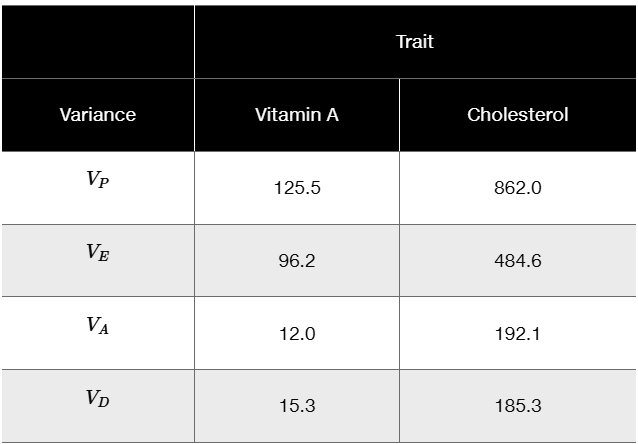
A hypothetical study investigated the vitamin A content and the cholesterol content of eggs from a large population of chickens. The following variances (V) were calculated.

Calculate the narrow-sense heritability () for both traits.

Verified step by step guidance
1
Understand that narrow-sense heritability (h²) is the proportion of the total phenotypic variance (V_P) that is due to additive genetic variance (V_A). The formula is: \(h^{2} = \frac{V_{A}}{V_{P}}\).
Identify the values for each trait from the table: for Vitamin A, V_P = 125.5 and V_A = 12.0; for Cholesterol, V_P = 862.0 and V_A = 192.1.
Apply the formula for Vitamin A: substitute V_A = 12.0 and V_P = 125.5 into \(h^{2} = \frac{V_{A}}{V_{P}}\) to express the heritability calculation.
Apply the formula for Cholesterol: substitute V_A = 192.1 and V_P = 862.0 into \(h^{2} = \frac{V_{A}}{V_{P}}\) to express the heritability calculation.
Interpret the results by understanding that higher h² values indicate a greater proportion of phenotypic variance is due to additive genetic factors, which implies stronger potential for response to selection.

Verified video answer for a similar problem:

This video solution was recommended by our tutors as helpful for the problem above.
Video duration:
51s
Was this helpful?

Key Concepts

Here are the essential concepts you must grasp in order to answer the question correctly.

Phenotypic Variance (V_P)

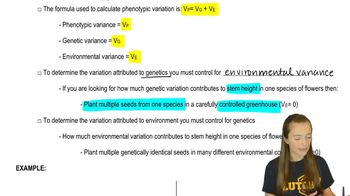
Phenotypic variance represents the total observed variation in a trait within a population. It includes genetic variance (additive, dominance, etc.) and environmental variance. Understanding V_P is essential because it forms the denominator in heritability calculations, reflecting all sources of variation affecting the trait.
Recommended video:
Guided course
08:34
Analyzing Trait Variance

Additive Genetic Variance (V_A)

Additive genetic variance is the portion of genetic variance attributed to the additive effects of alleles. It is crucial for predicting response to selection because it reflects the heritable component passed from parents to offspring. Narrow-sense heritability is calculated using V_A relative to total phenotypic variance.
Recommended video:
Guided course
13:40
Traits and Variance

Narrow-Sense Heritability (h²)

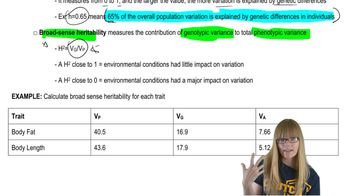
Narrow-sense heritability (h²) quantifies the proportion of phenotypic variance due to additive genetic variance (h² = V_A / V_P). It measures the potential for a trait to respond to selection and is key in breeding and evolutionary studies. Calculating h² requires knowledge of both V_A and V_P.
Recommended video:
Guided course
07:04
Calculating Heritability
Related Practice
Textbook Question

The following variances were calculated for two traits in a herd of hogs.

Calculate broad-sense () and narrow-sense () heritabilities for each trait in this herd.

520
views
Textbook Question

The following variances were calculated for two traits in a herd of hogs.

Which of the two traits will respond best to selection by a breeder? Why?

557
views
Textbook Question

The mean and variance of plant height of two highly inbred strains (P₁ and P₂) and their progeny (F₁ and F₂) are shown here.


  Strain  Mean (cm)  Variance 

   P₁     34.2        4.2

   P₂     55.3        3.8

   F₁     44.2        5.6

   F₂     46.3       10.3


Calculate the broad-sense heritability () of plant height in this species.

812
views
Textbook Question

A hypothetical study investigated the vitamin A content and the cholesterol content of eggs from a large population of chickens. The following variances (V) were calculated.

Which trait, if either, is likely to respond to selection?

515
views
Textbook Question

In a herd of dairy cows the narrow-sense heritability for milk protein content is 0.76, and for milk butterfat it is 0.82. The correlation coefficient between milk protein content and butterfat is 0.91. If the farmer selects for cows producing more butterfat in their milk, what will be the most likely effect on milk protein content in the next generation?

543
views
Textbook Question

In an assessment of learning in Drosophila, flies were trained to avoid certain olfactory cues. In one population, a mean of 8.5 trials was required. A subgroup of this parental population that was trained most quickly (mean=6.0) was interbred, and their progeny were examined. These flies demonstrated a mean training value of 7.5. Calculate realized heritability for olfactory learning in Drosophila.

435
views