Pearson+ LogoPearson+ Logo
Ch. 3 - Mendelian Genetics
Klug - Concepts of Genetics  12th Edition
Klug12th EditionConcepts of Genetics ISBN: 9780135564776Not the one you use?Change textbook
Chapter 3, Problem 5

Discuss how Mendel's monohybrid results served as the basis for all but one of his postulates. Which postulate was not based on these results? Why?

Verified step by step guidance
1
Understand Mendel's monohybrid cross: Mendel performed experiments with pea plants, focusing on one trait at a time (e.g., seed shape). He crossed true-breeding plants with contrasting traits (e.g., round seeds vs. wrinkled seeds) and observed the inheritance patterns over generations.
Identify the postulates derived from monohybrid crosses: Mendel's monohybrid results led to three key postulates: (1) The Principle of Segregation, which states that alleles separate during gamete formation; (2) The Principle of Dominance, which explains that one allele can mask the expression of another; and (3) The Concept of Unit Factors, which asserts that traits are controlled by discrete factors (now known as genes).
Determine the postulate not based on monohybrid results: The Principle of Independent Assortment was not derived from monohybrid crosses. This postulate states that alleles for different traits assort independently of one another during gamete formation.
Explain why the Principle of Independent Assortment was not based on monohybrid results: Monohybrid crosses involve only one trait, so they do not provide information about how alleles for different traits behave relative to each other. Mendel's dihybrid crosses, which examined two traits simultaneously, were necessary to establish this principle.
Summarize the connection: Mendel's monohybrid results were foundational for understanding the inheritance of single traits and led to most of his postulates. However, the Principle of Independent Assortment required experiments involving multiple traits to uncover the patterns of inheritance between them.

Verified video answer for a similar problem:

This video solution was recommended by our tutors as helpful for the problem above.
Video duration:
1m
Was this helpful?

Key Concepts

Here are the essential concepts you must grasp in order to answer the question correctly.

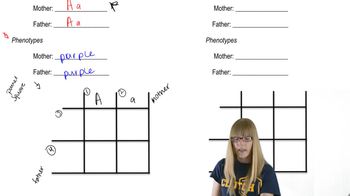
Mendel's Monohybrid Cross

Mendel's monohybrid cross experiments involved breeding pea plants that differed in a single trait, such as flower color. By analyzing the offspring, he observed a consistent 3:1 phenotypic ratio in the F2 generation, leading to the conclusion that traits are inherited as discrete units, now known as genes. This foundational work established the principles of inheritance and laid the groundwork for modern genetics.
Recommended video:
Guided course
10:20
Monohybrid Cross

Mendel's Postulates

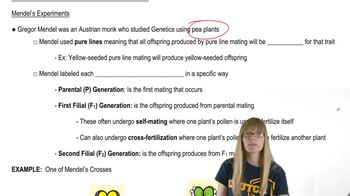
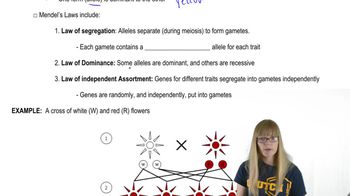
Mendel proposed several postulates based on his experimental results, including the Law of Segregation and the Law of Independent Assortment. These postulates describe how alleles segregate during gamete formation and how different traits are inherited independently. Understanding these postulates is crucial for grasping the mechanisms of inheritance and predicting genetic outcomes in offspring.
Recommended video:
Guided course
08:06
Mendel's Experiments

Law of Dominance

The Law of Dominance states that in a heterozygous individual, one allele may mask the expression of another. This concept was supported by Mendel's monohybrid crosses, where dominant traits appeared in the F1 generation. However, the postulate that was not based on these results is the Law of Independent Assortment, which pertains to the inheritance of multiple traits and was derived from dihybrid crosses rather than monohybrid results.
Recommended video:
Guided course
05:48
Mendel's Laws
Related Practice
Textbook Question

Albinism in humans is inherited as a simple recessive trait. For the following families, determine the genotypes of the parents and offspring. (When two alternative genotypes are possible, list both.)

A normal male and an albino female have six children, three normal and three albino.

1290
views
Textbook Question

Albinism in humans is inherited as a simple recessive trait. For the following families, determine the genotypes of the parents and offspring. (When two alternative genotypes are possible, list both.)

Construct a pedigree of the families in (b) and (c). Assume that one of the normal children in (b) and one of the albino children in (c) become the parents of eight children. Add these children to the pedigree, predicting their phenotypes (normal or albino).

1204
views
Textbook Question

Which of Mendel's postulates are illustrated by the pedigree that you constructed in Problem 3? List and define these postulates.

833
views
Textbook Question

What advantages were provided by Mendel's choice of the garden pea in his experiments?

778
views
Textbook Question

Mendel crossed peas having round seeds and yellow cotyledons (seed leaves) with peas having wrinkled seeds and green cotyledons. All the F₁ plants had round seeds with yellow cotyledons. Diagram this cross through the F₂ generation, using both the Punnett square and forked-line, or branch diagram, methods.

865
views
Textbook Question
Based on the preceding cross, what is the probability that an organism in the F₂ generation will have round seeds and green cotyledons and be true breeding?
621
views