Pearson+ LogoPearson+ Logo
Ch. 4 - Extensions of Mendelian Genetics
Klug - Concepts of Genetics  12th Edition
Klug12th EditionConcepts of Genetics ISBN: 9780135564776Not the one you use?Change textbook
Chapter 4, Problem 34

Discuss the topic of phenotypic expression and the many factors that impinge on it.

Verified step by step guidance
1
Phenotypic expression refers to the observable traits or characteristics of an organism, such as height, eye color, or enzyme activity, which result from the interaction of its genotype (genetic makeup) with the environment.
Begin by understanding that phenotypic expression is influenced by genetic factors, such as dominant and recessive alleles, gene interactions (e.g., epistasis), and mutations that may alter gene function or regulation.
Environmental factors also play a significant role in phenotypic expression. For example, temperature, nutrition, light, and exposure to chemicals can modify how genes are expressed. A classic example is the coat color of Himalayan rabbits, which changes based on temperature.
Epigenetic modifications, such as DNA methylation and histone modification, can regulate gene expression without altering the DNA sequence itself. These changes can be influenced by environmental factors and may even be heritable.
Finally, consider the role of pleiotropy (where one gene affects multiple traits) and polygenic inheritance (where multiple genes contribute to a single trait). These genetic complexities further illustrate how phenotypic expression is shaped by a combination of genetic and environmental factors.

Verified video answer for a similar problem:

This video solution was recommended by our tutors as helpful for the problem above.
Video duration:
2m
Was this helpful?

Key Concepts

Here are the essential concepts you must grasp in order to answer the question correctly.

Phenotype

The phenotype refers to the observable characteristics or traits of an organism, which result from the interaction of its genotype (genetic makeup) with the environment. Examples of phenotypic traits include physical attributes like height, color, and behavior. Understanding phenotypes is crucial for studying how genetic and environmental factors influence the expression of traits.
Recommended video:
Guided course
10:48
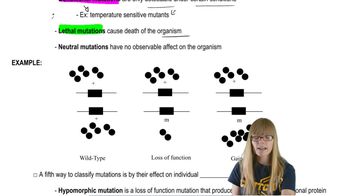
Mutations and Phenotypes

Genotype-Environment Interaction

Genotype-environment interaction describes how different genotypes respond to environmental variations, leading to diverse phenotypic outcomes. For instance, a plant's growth may vary based on soil quality, light exposure, and water availability, even if the genetic potential is the same. This concept highlights the complexity of phenotypic expression, emphasizing that genetics alone does not determine traits.
Recommended video:
Guided course
07:56
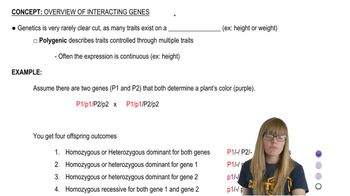
Interacting Genes Overview

Epigenetics

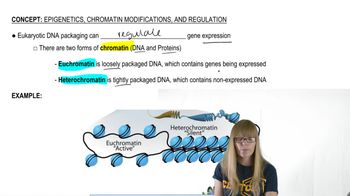
Epigenetics involves changes in gene expression that do not alter the DNA sequence but can be influenced by environmental factors, lifestyle, and experiences. These modifications can affect how genes are turned on or off, impacting phenotypic traits. For example, stress or diet can lead to epigenetic changes that may be passed to future generations, illustrating the dynamic interplay between genetics and the environment.
Recommended video:
Related Practice
Textbook Question

In goats, the development of the beard is due to a recessive gene. The following cross involving true-breeding goats was made and carried to the F₂ generation:

Offer an explanation for the inheritance and expression of this trait, diagramming the cross. Propose one or more crosses to test your hypothesis.

738
views
Textbook Question

Predict the F₁ and F₂ results of crossing a male fowl that is cock-feathered with a true-breeding hen-feathered female fowl. Recall that these traits are sex limited.

474
views
Textbook Question

Two mothers give birth to sons at the same time at a busy urban hospital. The son of mother 1 is afflicted with hemophilia, a disease caused by an X-linked recessive allele. Neither parent has the disease. Mother 2 has a normal son, despite the fact that the father has hemophilia. Several years later, couple 1 sues the hospital, claiming that these two newborns were swapped in the nursery following their birth. As a genetic counselor, you are called to testify. What information can you provide the jury concerning the allegation?

544
views
Textbook Question

Contrast penetrance and expressivity as the terms relate to phenotypic expression.

795
views
Textbook Question

Labrador retrievers may be black, brown (chocolate), or golden (yellow) in color (see chapter-opening photo). While each color may breed true, many different outcomes are seen when numerous litters are examined from a variety of matings where the parents are not necessarily true breeding. Following are just some of the many possibilities.

(a) black x brown → all black

(b) black x brown → 1/2 black, 1/2 brown

(c) black x brown → 3/4 black, 1/4 golden

(d) black x golden → all black

(e) black x golden → 4/8 golden 3/8 black 1/8 brown

(f) black x golden → 2/4 golden 1/4 black 1/4 brown

(g) brown x brown → 3/4 brown 1/4 golden

(h) black x black → 9/16 black 4/16 golden, 3/16 brown

Propose a mode of inheritance that is consistent with these data, and indicate the corresponding genotypes of the parents in each mating. Indicate as well the genotypes of dogs that breed true for each color.

1012
views
Textbook Question

A true-breeding purple-leafed plant isolated from one side of El Yunque, the rain forest in Puerto Rico, was crossed to a true-breeding white variety found on the other side. The F₁ offspring were all purple. A large number of F₁ x F₁ crosses produced the following results:

purple: 4219, white: 5781 (Total = 10,000)

Propose an explanation for the inheritance of leaf color. As a geneticist, how might you go about testing your hypothesis? Describe the genetic experiments that you would conduct.

575
views