Pearson+ LogoPearson+ Logo
Ch. 4 - Extensions of Mendelian Genetics
Klug - Concepts of Genetics  12th Edition
Klug12th EditionConcepts of Genetics ISBN: 9780135564776Not the one you use?Change textbook
Chapter 4, Problem 18b

Given the inheritance pattern of coat color in rats described in Problem 17, predict the genotype and phenotype of the parents who produced the following offspring:
9/16 gray: 3/16 yellow: 4/16 albino

Verified step by step guidance
1
Identify the inheritance pattern described in Problem 17, which likely involves two genes with epistatic interactions affecting coat color in rats. Typically, such ratios suggest a dihybrid cross with epistasis.
Assign symbols to the genes involved. For example, let gene A control pigment production (A = pigment, a = no pigment) and gene B control pigment color (B = gray, b = yellow). Albino rats result from homozygous recessive at the A locus (aa), which masks the effect of the B locus.
Write down the expected phenotypes based on genotypes: gray rats have at least one dominant A and one dominant B allele (A_B_), yellow rats have at least one dominant A allele but are homozygous recessive at B (A_bb), and albino rats are homozygous recessive at A (aa regardless of B genotype).
Use the offspring phenotypic ratios (9/16 gray : 3/16 yellow : 4/16 albino) to deduce the genotypes of the parents. These ratios correspond to a dihybrid cross where both parents are heterozygous at both loci (A/a B/b).
Conclude that the parents' genotypes are both A/a B/b, and their phenotypes are gray, since the presence of dominant alleles at both loci produces gray coat color.

Verified video answer for a similar problem:

This video solution was recommended by our tutors as helpful for the problem above.
Video duration:
1m
Was this helpful?

Key Concepts

Here are the essential concepts you must grasp in order to answer the question correctly.

Mendelian Inheritance and Dihybrid Ratios

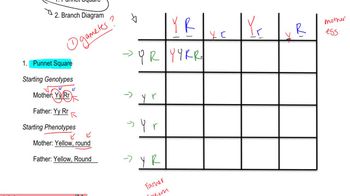
Mendelian inheritance explains how traits are passed from parents to offspring through dominant and recessive alleles. The given offspring ratios (9:3:4) suggest a dihybrid cross involving two genes, where the phenotypic ratio deviates from the classic 9:3:3:1, indicating gene interaction such as epistasis.
Recommended video:
Guided course
15:24
Punnet Square

Epistasis in Coat Color Genetics

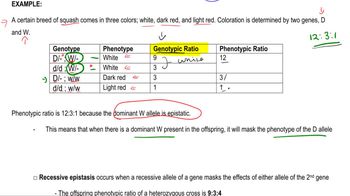
Epistasis occurs when one gene masks or modifies the expression of another gene. In rat coat color, certain alleles can suppress pigment production, leading to phenotypes like albino regardless of other color genes, explaining the altered phenotypic ratios observed in the offspring.
Recommended video:
Guided course
13:08
Epistatic Genes

Genotype-Phenotype Relationship and Predicting Parental Genotypes

Understanding how specific genotypes produce phenotypes allows prediction of parental genotypes from offspring ratios. By analyzing the proportions of gray, yellow, and albino offspring, one can infer the parents' alleles and their combinations responsible for the observed phenotypic distribution.
Recommended video:
Guided course
07:52
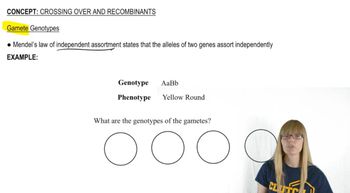
Gamete Genotypes
Related Practice
Textbook Question

In rats, the following genotypes of two independently assorting autosomal genes determine coat color:

A third gene pair on a separate autosome determines whether or not any color will be produced. The CC and Cc genotypes allow color according to the expression of the A and B alleles. However, the cc genotype results in albino rats regardless of the A and B alleles present. Determine the F₁ phenotypic ratio of the following crosses: AaBBCc×AaBBCc

760
views
Textbook Question

In rats, the following genotypes of two independently assorting autosomal genes determine coat color:

A third gene pair on a separate autosome determines whether or not any color will be produced. The CC and Cc genotypes allow color according to the expression of the A and B alleles. However, the cc genotype results in albino rats regardless of the A and B alleles present. Determine the F₁ phenotypic ratio of the following crosses:

AABbCc×AABbcc

1472
views
Textbook Question

Given the inheritance pattern of coat color in rats described in Problem 17, predict the genotype and phenotype of the parents who produced the following offspring:

9/16 gray: 3/16 yellow: 3/16 black: 1/16 cream

535
views
Textbook Question

Given the inheritance pattern of coat color in rats described in Problem 17, predict the genotype and phenotype of the parents who produced the following offspring: 27/64 gray:

16/64 albino: 9/64 yellow: 9/64 black: 3/64 cream

457
views
Textbook Question

Given the inheritance pattern of coat color in rats described in Problem 17, predict the genotype and phenotype of the parents who produced the following offspring:

3/8 black: 3/8 cream: 2/8 albino

461
views
Textbook Question

Given the inheritance pattern of coat color in rats described in Problem 17, predict the genotype and phenotype of the parents who produced the following offspring:

3/8 black: 4/8 albino: 1/8 cream

485
views