Pearson+ LogoPearson+ Logo
Ch. 4 - Extensions of Mendelian Genetics
Klug - Concepts of Genetics  12th Edition
Klug12th EditionConcepts of Genetics ISBN: 9780135564776Not the one you use?Change textbook
Chapter 4, Problem 12

Three gene pairs located on separate autosomes determine flower color and shape as well as plant height. The first pair exhibits incomplete dominance, where the color can be red, pink (the heterozygote), or white. The second pair leads to personate (dominant) or peloric (recessive) flower shape, while the third gene pair produces either the dominant tall trait or the recessive dwarf trait. Homozygous plants that are red, personate, and tall are crossed to those that are white, peloric, and dwarf. Determine the F₁ genotype(s) and phenotype(s). If the F₁ plants are interbred, what proportion of the offspring will exhibit the same phenotype as the F₁ plants?

Verified step by step guidance
1
Identify the genotypes of the parental plants based on the given traits and inheritance patterns. For the first gene pair with incomplete dominance (flower color), assign RR for red (homozygous dominant) and WW for white (homozygous recessive). For the second gene pair (flower shape), use PP for personate (dominant homozygous) and pp for peloric (recessive homozygous). For the third gene pair (plant height), use TT for tall (dominant homozygous) and tt for dwarf (recessive homozygous). Thus, the red, personate, tall parent is RR PP TT, and the white, peloric, dwarf parent is WW pp tt.
Determine the F₁ genotype by crossing the two homozygous parents. Since each parent is homozygous for each gene, all F₁ offspring will be heterozygous for each gene pair: RW for color, Pp for shape, and Tt for height. Write the F₁ genotype as RW Pp Tt.
Describe the F₁ phenotype based on the genotypes and inheritance patterns. For incomplete dominance in color, RW results in pink flowers. For flower shape, Pp results in personate flowers (dominant trait). For height, Tt results in tall plants (dominant trait). So, the F₁ phenotype is pink, personate, and tall.
To find the proportion of F₂ offspring (from F₁ interbreeding) that exhibit the same phenotype as the F₁ plants, analyze each gene separately. For incomplete dominance (color), the heterozygote RW shows pink flowers. For flower shape and height, the dominant phenotype appears in both homozygous dominant and heterozygous genotypes.
Calculate the probability for each trait to show the F₁ phenotype in the F₂ generation: For color, the heterozygous RW genotype frequency is 1/2 (from RW x RW cross). For flower shape, the dominant phenotype frequency (PP or Pp) is 3/4. For height, the dominant phenotype frequency (TT or Tt) is also 3/4. Multiply these probabilities to get the overall proportion of F₂ offspring with the same phenotype as the F₁ plants.

Verified video answer for a similar problem:

This video solution was recommended by our tutors as helpful for the problem above.
Video duration:
2m
Was this helpful?

Key Concepts

Here are the essential concepts you must grasp in order to answer the question correctly.

Incomplete Dominance

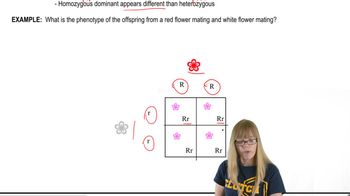
Incomplete dominance occurs when the heterozygous genotype results in a phenotype that is intermediate between the two homozygous phenotypes. For example, crossing red (RR) and white (WW) flowers produces pink (RW) offspring. This differs from complete dominance, where one allele completely masks the other.
Recommended video:
Guided course
04:37
Variations on Dominance

Mendelian Inheritance of Independent Genes

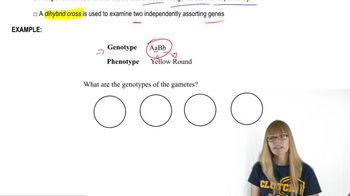
Genes located on separate autosomes assort independently during gamete formation, following Mendel's law of independent assortment. This means the inheritance of one gene pair does not affect the inheritance of another, allowing for the prediction of combined genotypes and phenotypes using Punnett squares.
Recommended video:
Guided course
04:58
Gamete Genetics and Independent Assortment

Genotypic and Phenotypic Ratios in Dihybrid and Trihybrid Crosses

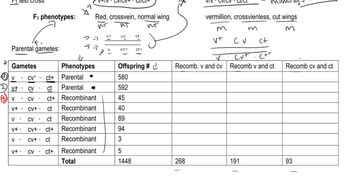
When multiple gene pairs are involved, the genotypic and phenotypic ratios can be calculated by considering each gene pair separately and then multiplying probabilities. For traits with different dominance patterns, such as incomplete dominance and complete dominance, the resulting offspring ratios reflect these inheritance modes.
Recommended video:
Guided course
26:08
Trihybrid Cross
Related Practice
Textbook Question

The A and B antigens in humans may be found in water-soluble form in secretions, including saliva, of some individuals (Se/Se and Se/se) but not in others (se/se). The population thus contains 'secretors' and 'nonsecretors.'

How will the results of such matings change if both parents are heterozygous for the gene controlling the synthesis of the H substance (Hh)?

413
views
Textbook Question

In chickens, a condition referred to as 'creeper' exists whereby the bird has very short legs and wings and appears to be creeping when it walks. If creepers are bred to normal chickens, one-half of the offspring are normal and one-half are creepers. Creepers never breed true. If bred together, they yield two-thirds creepers and one-third normal. Propose an explanation for the inheritance of this condition.

1355
views
Textbook Question

In rabbits, a series of multiple alleles controls coat color in the following way: C is dominant to all other alleles and causes full color. The chinchilla phenotype is due to the cch allele, which is dominant to all alleles other than C. The ch allele, dominant only to (albino), results in the Himalayan coat color. Thus, the order of dominance is C > cch > ch > ca. For each of the following three cases, the phenotypes of the P1 generations of two crosses are shown, as well as the phenotype of one member of the F1 generation.

For each case, determine the genotypes of the P1 generation and the F1 offspring, and predict the results of making each indicated cross between F1 individuals.

5024
views
Textbook Question

Flower color may be red, white, or pink, and flower shape may be personate or peloric. For the following crosses, determine the P₁ and F₁ genotypes:

549
views
Textbook Question

Horses can be cremello (a light cream color), chestnut (a brownish color), or palomino (a golden color with white in the horse's tail and mane). Of these phenotypes, only palominos never breed true.

From the results given above, determine the mode of inheritance by assigning gene symbols and indicating which genotypes yield which phenotypes.

1086
views
Textbook Question

Horses can be cremello (a light cream color), chestnut (a brownish color), or palomino (a golden color with white in the horse's tail and mane). Of these phenotypes, only palominos never breed true.

Predict the F1 and F2 results of many initial matings between cremello and chestnut horses.

546
views