In chickens, a condition referred to as 'creeper' exists whereby the bird has very short legs and wings and appears to be creeping when it walks. If creepers are bred to normal chickens, one-half of the offspring are normal and one-half are creepers. Creepers never breed true. If bred together, they yield two-thirds creepers and one-third normal. Propose an explanation for the inheritance of this condition.
Verified step by step guidance
Verified video answer for a similar problem:
Key Concepts
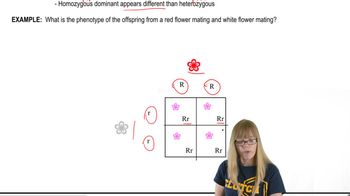
Incomplete Dominance
Lethal Alleles
Genotypic Ratios
The A and B antigens in humans may be found in water-soluble form in secretions, including saliva, of some individuals (Se/Se and Se/se) but not in others (se/se). The population thus contains 'secretors' and 'nonsecretors.'
Determine the proportion of various phenotypes (blood type and ability to secrete) in matings between individuals that are blood type AB and type O, both of whom are Se/se.
The A and B antigens in humans may be found in water-soluble form in secretions, including saliva, of some individuals (Se/Se and Se/se) but not in others (se/se). The population thus contains 'secretors' and 'nonsecretors.'
How will the results of such matings change if both parents are heterozygous for the gene controlling the synthesis of the H substance (Hh)?
In rabbits, a series of multiple alleles controls coat color in the following way: C is dominant to all other alleles and causes full color. The chinchilla phenotype is due to the cch allele, which is dominant to all alleles other than C. The ch allele, dominant only to (albino), results in the Himalayan coat color. Thus, the order of dominance is C > cch > ch > ca. For each of the following three cases, the phenotypes of the P1 generations of two crosses are shown, as well as the phenotype of one member of the F1 generation.
For each case, determine the genotypes of the P1 generation and the F1 offspring, and predict the results of making each indicated cross between F1 individuals.
Three gene pairs located on separate autosomes determine flower color and shape as well as plant height. The first pair exhibits incomplete dominance, where the color can be red, pink (the heterozygote), or white. The second pair leads to personate (dominant) or peloric (recessive) flower shape, while the third gene pair produces either the dominant tall trait or the recessive dwarf trait. Homozygous plants that are red, personate, and tall are crossed to those that are white, peloric, and dwarf. Determine the F₁ genotype(s) and phenotype(s). If the F₁ plants are interbred, what proportion of the offspring will exhibit the same phenotype as the F₁ plants?
Flower color may be red, white, or pink, and flower shape may be personate or peloric. For the following crosses, determine the P₁ and F₁ genotypes:
