Pearson+ LogoPearson+ Logo
Ch. 5 - Chromosome Mapping in Eukaryotes
Klug - Concepts of Genetics  12th Edition
Klug12th EditionConcepts of Genetics ISBN: 9780135564776Not the one you use?Change textbook
Chapter 5, Problem 15a

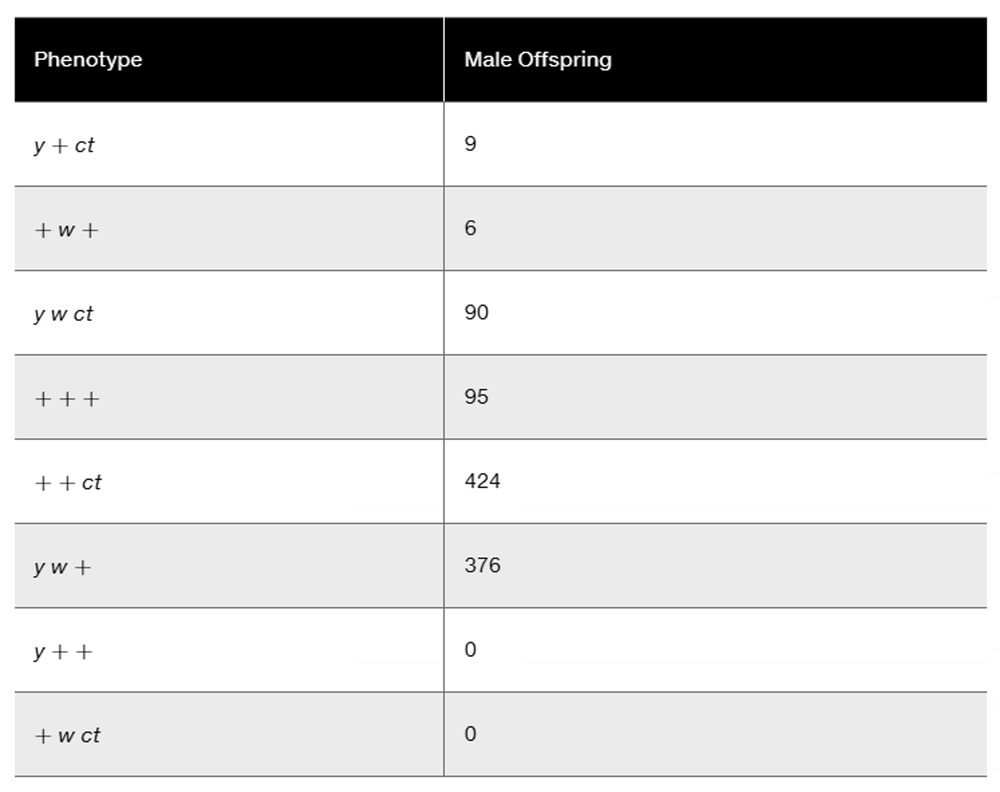
Another cross in Drosophila involved the recessive, X-linked genes yellow (y), white (w), and cut (ct). A yellow-bodied, white-eyed female with normal wings was crossed to a male whose eyes and body were normal but whose wings were cut. The F₁ females were wild type for all three traits, while the F1 males expressed the yellow-body and white-eye traits. The cross was carried to an F2 progeny, and only male offspring were tallied. On the basis of the data shown here, a genetic map was constructed.
Table showing male offspring counts for Drosophila phenotypes involving yellow, white, and cut gene combinations.
Diagram the genotypes of the F1 parents.

Verified step by step guidance
1
Step 1: Understand the inheritance pattern. The genes yellow (y), white (w), and cut (ct) are recessive and X-linked. This means that males (XY) will express the traits if they inherit the recessive allele, while females (XX) need two copies of the recessive allele to express the traits.
Step 2: Analyze the parental genotypes. The female parent is yellow-bodied (y), white-eyed (w), and has normal wings (+), indicating her genotype is X^y X^w X^+ (heterozygous for cut). The male parent has normal body (+), normal eyes (+), and cut wings (ct), indicating his genotype is X^+ Y and autosomal recessive for cut wings.
Step 3: Determine the F₁ generation. The F₁ females are wild type for all traits, meaning they are heterozygous for all three genes (X^+ X^y, X^+ X^w, X^+ X^ct). The F₁ males express yellow body and white eyes, meaning their genotype is X^y X^w Y.
Step 4: Predict the F₂ generation. The F₁ females will produce gametes with all combinations of the alleles (X^+ X^y, X^+ X^w, X^+ X^ct), while the F₁ males will contribute either X^y or X^w or Y. The F₂ generation will result from these combinations, and only male offspring are tallied.
Step 5: Use the data to construct a genetic map. The phenotypic ratios of the F₂ males indicate recombination frequencies between the genes. Recombination frequency is proportional to the distance between genes on the chromosome. Use the observed phenotypes and their frequencies to calculate the distances between y, w, and ct.

Verified video answer for a similar problem:

This video solution was recommended by our tutors as helpful for the problem above.
Video duration:
2m
Was this helpful?

Key Concepts

Here are the essential concepts you must grasp in order to answer the question correctly.

X-linked Inheritance

X-linked inheritance refers to the pattern of inheritance for genes located on the X chromosome. In Drosophila, males have one X chromosome and one Y chromosome, while females have two X chromosomes. This means that recessive traits linked to the X chromosome can manifest in males even if they have only one copy of the allele, while females require two copies to express the trait.
Recommended video:
Guided course
09:30
X-Inactivation

Phenotypic Ratios

Phenotypic ratios are the relative frequencies of different phenotypes in the offspring resulting from a genetic cross. In this case, the phenotypic ratios of the male offspring provide insights into the inheritance patterns of the traits being studied. Analyzing these ratios helps in understanding the dominance and recessiveness of the alleles involved.
Recommended video:
Guided course
10:48
Mutations and Phenotypes

Genetic Mapping

Genetic mapping is the process of determining the relative positions of genes on a chromosome based on the frequency of recombination between them. By analyzing the offspring's phenotypes and their frequencies, researchers can infer the distances between genes, which aids in constructing a genetic map. This is crucial for understanding the genetic architecture of traits and their inheritance.
Recommended video:
Guided course
11:11
Mapping Overview
Related Practice
Textbook Question

In Drosophila, a cross was made between females—all expressing the three X-linked recessive traits scute bristles (sc), sable body (s), and vermilion eyes (v)—and wild-type males. In the F1, all females were wild type, while all males expressed all three mutant traits. The cross was carried to the F2 generation, and 1000 offspring were counted, with the results shown in the following table.

No determination of sex was made in the data.

Determine the sequence of the three genes and the map distances between them.

776
views
Textbook Question

In Drosophila, a cross was made between females—all expressing the three X-linked recessive traits scute bristles (sc), sable body (s), and vermilion eyes (v)—and wild-type males. In the F1, all females were wild type, while all males expressed all three mutant traits. The cross was carried to the F2 generation, and 1000 offspring were counted, with the results shown in the following table.

No determination of sex was made in the data.

Are there more or fewer double crossovers than expected?

508
views
Textbook Question

In Drosophila, a cross was made between females, all expressing the three X-linked recessive traits scute bristles (sc), sable body (s), and vermilion eyes (v)—and wild-type males. In the F₁, all females were wild type, while all males expressed all three mutant traits. The cross was carried to the F₂ generation, and 1000 offspring were counted, with the results shown in the following table.

No determination of sex was made in the data. Calculate the coefficient of coincidence. Does it represent positive or negative interference?

908
views
Textbook Question

Another cross in Drosophila involved the recessive, X-linked genes yellow (y), white (w), and cut (ct). A yellow-bodied, white-eyed female with normal wings was crossed to a male whose eyes and body were normal but whose wings were cut. The F1 females were wild type for all three traits, while the F1 males expressed the yellow-body and white-eye traits. The cross was carried to an F2 progeny, and only male offspring were tallied. On the basis of the data shown here, a genetic map was constructed.

Construct a map, assuming that white is at locus 1.5 on the X chromosome.

1026
views
Textbook Question

Another cross in Drosophila involved the recessive, X-linked genes yellow (y), white (w), and cut (ct). A yellow-bodied, white-eyed female with normal wings was crossed to a male whose eyes and body were normal but whose wings were cut. The F₁ females were wild type for all three traits, while the F₁ males expressed the yellow-body and white-eye traits. The cross was carried to an F₂ progeny, and only male offspring were tallied. On the basis of the data shown here, a genetic map was constructed.

Were any double-crossover offspring expected?

768
views
Textbook Question

Another cross in Drosophila involved the recessive, X-linked genes yellow (y), white (w), and cut (ct). A yellow-bodied, white-eyed female with normal wings was crossed to a male whose eyes and body were normal but whose wings were cut. The F1 females were wild type for all three traits, while the F1 males expressed the yellow-body and white-eye traits. The cross was carried to an F2 progeny, and only male offspring were tallied. On the basis of the data shown here, a genetic map was constructed.

Could the F2 female offspring be used to construct the map? Why or why not?

783
views