Pearson+ LogoPearson+ Logo
Ch. 5 - Chromosome Mapping in Eukaryotes
Klug - Concepts of Genetics  12th Edition
Klug12th EditionConcepts of Genetics ISBN: 9780135564776Not the one you use?Change textbook
Chapter 5, Problem 1a

How was it established experimentally that the frequency of recombination (crossing over) between two genes is related to the distance between them along the chromosome?

Verified step by step guidance
1
Understand the concept: Recombination frequency between two genes is the proportion of offspring in which a crossover event has occurred between those genes during meiosis. This frequency is used as a measure of the physical distance between genes on a chromosome.
Set up a genetic cross: Researchers performed controlled crosses between organisms heterozygous for two linked genes. By analyzing the phenotypes of the offspring, they could identify recombinant and parental types based on the combination of traits inherited.
Calculate recombination frequency: The recombination frequency (RF) is calculated using the formula: \(\text{RF} = \frac{\text{Number of recombinant offspring}}{\text{Total number of offspring}} \times 100\%\). This gives the percentage of recombinant progeny, reflecting crossover events between the two genes.
Compare recombination frequencies for different gene pairs: By repeating these crosses for multiple pairs of genes located at various positions on the chromosome, researchers observed that gene pairs physically closer together had lower recombination frequencies, while those farther apart had higher frequencies.
Conclude the relationship: The consistent correlation between recombination frequency and physical distance led to the conclusion that recombination frequency is proportional to the distance between genes on a chromosome, forming the basis for genetic linkage maps.

Verified video answer for a similar problem:

This video solution was recommended by our tutors as helpful for the problem above.
Video duration:
2m
Was this helpful?

Key Concepts

Here are the essential concepts you must grasp in order to answer the question correctly.

Genetic Recombination and Crossing Over

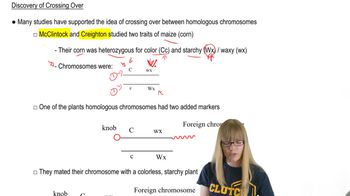
Genetic recombination occurs during meiosis when homologous chromosomes exchange segments, resulting in new allele combinations. Crossing over is the physical process that facilitates this exchange, and its frequency reflects how often two genes are separated during this event.
Recommended video:
Guided course
05:19
Discovery of Crossing Over

Linkage and Genetic Mapping

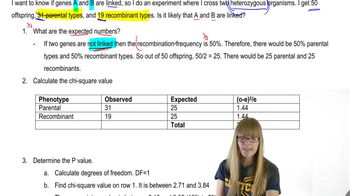
Genes located close together on the same chromosome tend to be inherited together, a phenomenon called linkage. By measuring recombination frequencies between gene pairs, scientists can estimate their relative distances, creating genetic maps that represent gene order and spacing.
Recommended video:
Guided course
07:33
Chi Square and Linkage

Experimental Measurement of Recombination Frequency

Recombination frequency is experimentally determined by crossing organisms with known genotypes and analyzing offspring phenotypes. The proportion of recombinant offspring indicates how often crossing over occurs between two genes, allowing researchers to correlate recombination rates with physical gene distances.
Recommended video:
Guided course
11:06
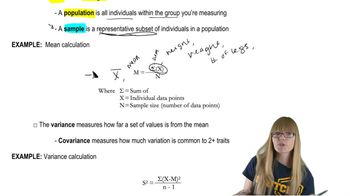
Mathematical Measurements