Pearson+ LogoPearson+ Logo
Ch. 5 - Chromosome Mapping in Eukaryotes
Klug - Concepts of Genetics  12th Edition
Klug12th EditionConcepts of Genetics ISBN: 9780135564776Not the one you use?Change textbook
Chapter 5, Problem 33a

The gene controlling the Xg blood group alleles (Xg⁺ and Xg⁻) and the gene controlling a newly described form of inherited recessive muscle weakness called episodic muscle weakness (EMWX) (Ryan et al., 1999) are closely linked on the X chromosome in humans at position Xp22.3 (the tip of the short arm). A male with EMWX who is Xg⁻ marries a woman who is Xg⁺ and they have eight daughters and one son, all of whom are normal for muscle function, the male being Xg⁺ and all the daughters being heterozygous at both the EMWX and Xg loci. Following is a table that lists three of the daughters with the phenotypes of their husbands and children. Create a pedigree that represents all data stated above and in the following table.

Verified step by step guidance
1
Step 1: Understand the inheritance pattern. The Xg blood group and EMWX traits are linked on the X chromosome. The Xg⁺ allele is dominant over Xg⁻, and EMWX is recessive. Males inherit their X chromosome from their mother and their Y chromosome from their father, while females inherit one X chromosome from each parent.
Step 2: Analyze the parental genotypes. The father is Xg⁻ and has EMWX (recessive trait), meaning his X chromosome carries both Xg⁻ and the EMWX allele. The mother is Xg⁺ and does not have EMWX, meaning her X chromosome carries Xg⁺ and no EMWX allele.
Step 3: Determine the offspring genotypes. All daughters inherit one X chromosome from each parent, making them heterozygous (Xg⁺Xg⁻) and carriers for EMWX. The son inherits the X chromosome from the mother (Xg⁺) and the Y chromosome from the father, making him Xg⁺ and unaffected by EMWX.
Step 4: Interpret the pedigree chart. The chart shows the inheritance of the Xg blood group alleles and confirms that none of the offspring exhibit EMWX symptoms, as the recessive EMWX allele is masked by the dominant normal allele in all daughters and is absent in the son.
Step 5: Use the table data to complete the pedigree. The table provides information about the phenotypes of the daughters' husbands and children, which can be used to extend the pedigree and analyze further inheritance patterns of Xg and EMWX traits.

Verified video answer for a similar problem:

This video solution was recommended by our tutors as helpful for the problem above.
Video duration:
2m
Was this helpful?

Key Concepts

Here are the essential concepts you must grasp in order to answer the question correctly.

X-Linked Inheritance

X-linked inheritance refers to the pattern of inheritance for genes located on the X chromosome. Males have one X and one Y chromosome, while females have two X chromosomes. This means that X-linked traits can be expressed differently in males and females, with males being more likely to express recessive traits due to having only one X chromosome.
Recommended video:
Guided course
09:30
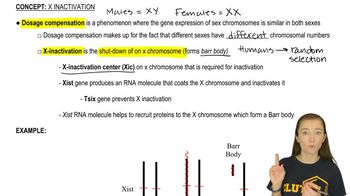
X-Inactivation

Genotype and Phenotype

Genotype refers to the genetic makeup of an individual, including the alleles present for a particular gene, while phenotype is the observable expression of those genes, influenced by both genotype and environmental factors. In the context of the question, the genotypes of the parents determine the phenotypes of their offspring, such as the presence or absence of muscle weakness and blood group alleles.
Recommended video:
Guided course
07:52
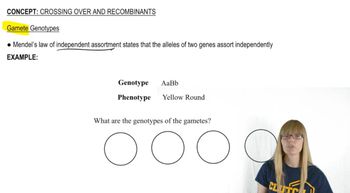
Gamete Genotypes

Pedigree Analysis

Pedigree analysis is a diagrammatic method used to trace the inheritance of traits through generations in a family. It helps visualize how genetic traits are passed from parents to offspring, allowing for the identification of carriers and the prediction of potential genetic disorders. In this case, the pedigree chart illustrates the inheritance patterns of the Xg blood group and episodic muscle weakness (EMWX) in the family.
Recommended video:
Guided course
01:59
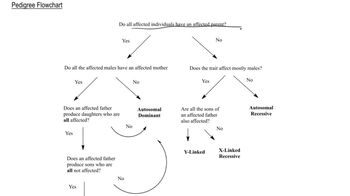
Pedigree Flowchart
Related Practice
Textbook Question

Drosophila melanogaster has one pair of sex chromosomes (XX or XY) and three pairs of autosomes, referred to as chromosomes II, III, and IV. A genetics student discovered a male fly with very short (sh) legs. Using this male, the student was able to establish a pure breeding stock of this mutant and found that it was recessive. She then incorporated the mutant into a stock containing the recessive gene black (b, body color located on chromosome II) and the recessive gene pink (p, eye color located on chromosome III). A female from the homozygous black, pink, short stock was then mated to a wild-type male. The F1 males of this cross were all wild type and were then backcrossed to the homozygous b, p, sh females. The F2 results appeared as shown in the following table. No other phenotypes were observed.

Based on these results, the student was able to assign short to a linkage group (a chromosome). Which one was it? Include your step-by-step reasoning.

3300
views
Textbook Question

Drosophila melanogaster has one pair of sex chromosomes (XX or XY) and three pairs of autosomes, referred to as chromosomes II, III, and IV. A genetics student discovered a male fly with very short (sh) legs. Using this male, the student was able to establish a pure breeding stock of this mutant and found that it was recessive. She then incorporated the mutant into a stock containing the recessive gene black (b, body color located on chromosome II) and the recessive gene pink (p, eye color located on chromosome III). A female from the homozygous black, pink, short stock was then mated to a wild-type male. The F₁ males of this cross were all wild type and were then backcrossed to the homozygous b, p, sh females. The F₂ results appeared as shown in the following table.

The student repeated the experiment, making the reciprocal cross, with F₁ females backcrossed to homozygous b, p, sh males. She observed that 85 percent of the offspring fell into the given classes, but that 15 percent of the offspring were equally divided among b + p, b + +, + sh p, and + sh + phenotypic males and females. How can these results be explained, and what information can be derived from the data?

4035
views
Textbook Question

In Drosophila, a female fly is heterozygous for three mutations, Bar eyes (B), miniature wings (m), and ebony body (e). Note that Bar is a dominant mutation. The fly is crossed to a male with normal eyes, miniature wings, and ebony body. The results of the cross are as follows.

111 miniature; 101 Bar, ebony

29 wild type; 31 Bar, miniature, ebony

117 Bar; 35 ebony

26 Bar, miniature; 115 miniature, ebony

Interpret the results of this cross. If you conclude that linkage is involved between any of the genes, determine the map distance(s) between them.

2511
views
Textbook Question

The gene controlling the Xg blood group alleles (Xg⁺ and Xg⁻) and the gene controlling a newly described form of inherited recessive muscle weakness called episodic muscle weakness (EMWX) are closely linked on the X chromosome in humans at position Xp22.3 (the tip of the short arm). A male with EMWX who is Xg⁻ marries a woman who is Xg⁺ and they have eight daughters and one son, all of whom are normal for muscle function, the male being Xg⁺ and all the daughters being heterozygous at both the EMWX and Xg loci. Following is a table that lists three of the daughters with the phenotypes of their husbands and children.

For each of the offspring, indicate whether or not a crossover was required to produce the phenotypes that are given.

483
views
Textbook Question

Because of the relatively high frequency of meiotic errors that lead to developmental abnormalities in humans, many research efforts have focused on identifying correlations between error frequency and chromosome morphology and behavior. Tease et al. (2002) studied human fetal oocytes of chromosomes 21, 18, and 13 using an immunocytological approach that allowed a direct estimate of the frequency and position of meiotic recombination. Below is a summary of information that compares recombination frequency with the frequency of trisomy for chromosomes 21, 18, and 13.

What conclusions can be drawn from these data in terms of recombination and nondisjunction frequencies? How might recombination frequencies influence trisomic frequencies?

602
views
Textbook Question

Because of the relatively high frequency of meiotic errors that lead to developmental abnormalities in humans, many research efforts have focused on identifying correlations between error frequency and chromosome morphology and behavior. Tease et al. (2002) studied human fetal oocytes of chromosomes 21, 18, and 13 using an immunocytological approach that allowed a direct estimate of the frequency and position of meiotic recombination. Below is a summary of information [modified from Tease et al. (2002)] that compares recombination frequency with the frequency of trisomy for chromosomes 21, 18, and 13. (Note: You may want to read appropriate portions of Chapter 8 for descriptions of these trisomic conditions.)

Other studies indicate that the number of crossovers per oocyte is somewhat constant, and it has been suggested that positive chromosomal interference acts to spread out a limited number of crossovers among as many chromosomes as possible. Considering information in part (a), speculate on the selective advantage positive chromosomal interference might confer.

410
views