Pearson+ LogoPearson+ Logo
Ch. 5 - Chromosome Mapping in Eukaryotes
Klug - Concepts of Genetics  12th Edition
Klug12th EditionConcepts of Genetics ISBN: 9780135564776Not the one you use?Change textbook
Chapter 5, Problem 34a

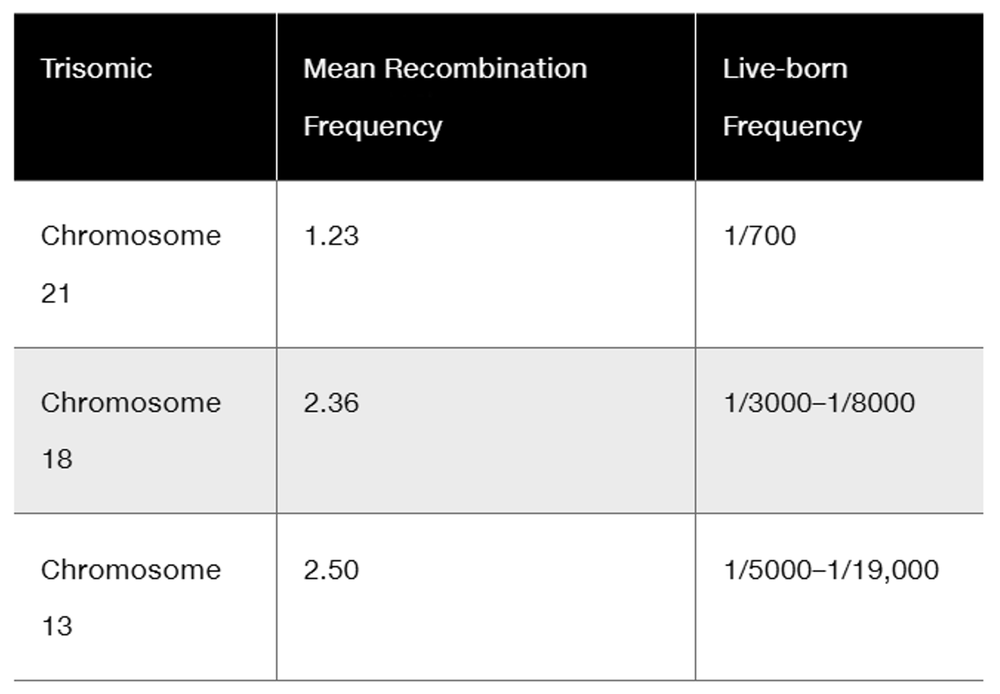
Because of the relatively high frequency of meiotic errors that lead to developmental abnormalities in humans, many research efforts have focused on identifying correlations between error frequency and chromosome morphology and behavior. Tease et al. (2002) studied human fetal oocytes of chromosomes 21, 18, and 13 using an immunocytological approach that allowed a direct estimate of the frequency and position of meiotic recombination. Below is a summary of information that compares recombination frequency with the frequency of trisomy for chromosomes 21, 18, and 13.
Table comparing chromosomes 21, 18, and 13 showing mean recombination frequencies and live-born trisomy rates.
What conclusions can be drawn from these data in terms of recombination and nondisjunction frequencies? How might recombination frequencies influence trisomic frequencies?

Verified step by step guidance
1
Understand the relationship between recombination and nondisjunction: Recombination during meiosis is a critical process that ensures proper segregation of homologous chromosomes. Errors in recombination can lead to nondisjunction, where chromosomes fail to separate properly, resulting in trisomy (an extra chromosome).
Analyze the data provided: The table shows the mean recombination frequency for chromosomes 21, 18, and 13, along with the frequency of live-born trisomic individuals. Chromosome 21 has the lowest recombination frequency (1.23) and the highest live-born trisomy frequency (1/700), while chromosomes 18 and 13 have higher recombination frequencies (2.36 and 2.50, respectively) and lower live-born trisomy frequencies.
Draw a correlation: The data suggests an inverse relationship between recombination frequency and trisomy frequency. Lower recombination frequency appears to be associated with a higher likelihood of nondisjunction, leading to trisomy. This could be because fewer recombination events may result in improper chromosome segregation during meiosis.
Consider the biological implications: Chromosome 21's lower recombination frequency may make it more prone to nondisjunction, explaining the higher frequency of live-born individuals with trisomy 21 (Down syndrome). In contrast, chromosomes 18 and 13, with higher recombination frequencies, show lower live-born trisomy frequencies, possibly due to better segregation or higher lethality of these trisomies during development.
Conclude the influence of recombination on trisomy: Recombination frequency plays a significant role in determining the likelihood of nondisjunction. Lower recombination rates increase the risk of improper chromosome segregation, leading to higher trisomy frequencies. This highlights the importance of recombination in maintaining chromosomal stability during meiosis.

Verified video answer for a similar problem:

This video solution was recommended by our tutors as helpful for the problem above.
Video duration:
2m
Was this helpful?

Key Concepts

Here are the essential concepts you must grasp in order to answer the question correctly.

Meiotic Recombination

Meiotic recombination is a process during meiosis where homologous chromosomes exchange genetic material, leading to genetic diversity in gametes. The frequency of recombination can vary between different chromosomes and is influenced by factors such as chromosome structure and the presence of recombination hotspots. Understanding this process is crucial for analyzing how variations in recombination rates may correlate with the occurrence of chromosomal abnormalities like trisomy.
Recommended video:
Guided course
03:51
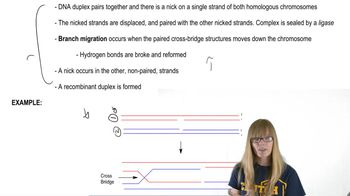
Recombination after Single Strand Breaks

Nondisjunction

Nondisjunction is the failure of homologous chromosomes or sister chromatids to separate properly during cell division, which can occur in meiosis I or II. This error can lead to aneuploidy, where cells have an abnormal number of chromosomes, such as in trisomy conditions. Recognizing the relationship between nondisjunction events and recombination frequencies is essential for understanding the mechanisms behind chromosomal abnormalities in humans.
Recommended video:
Guided course
04:34
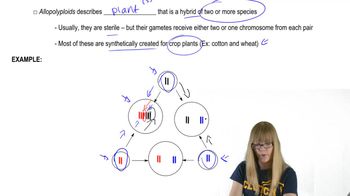
Allopolyploidy

Trisomy

Trisomy is a genetic condition where an individual has three copies of a particular chromosome instead of the usual two. This can result from nondisjunction during meiosis and is associated with various developmental and health issues, depending on the chromosome involved. The data presented in the question highlights the correlation between recombination frequency and the incidence of trisomy, suggesting that lower recombination rates may be linked to higher rates of nondisjunction and subsequent trisomic conditions.
Recommended video:
Guided course
09:31
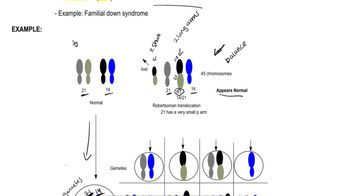
Robertsonian Translocations
Related Practice
Textbook Question

In Drosophila, a female fly is heterozygous for three mutations, Bar eyes (B), miniature wings (m), and ebony body (e). Note that Bar is a dominant mutation. The fly is crossed to a male with normal eyes, miniature wings, and ebony body. The results of the cross are as follows.

111 miniature; 101 Bar, ebony

29 wild type; 31 Bar, miniature, ebony

117 Bar; 35 ebony

26 Bar, miniature; 115 miniature, ebony

Interpret the results of this cross. If you conclude that linkage is involved between any of the genes, determine the map distance(s) between them.

2511
views
Textbook Question

The gene controlling the Xg blood group alleles (Xg⁺ and Xg⁻) and the gene controlling a newly described form of inherited recessive muscle weakness called episodic muscle weakness (EMWX) (Ryan et al., 1999) are closely linked on the X chromosome in humans at position Xp22.3 (the tip of the short arm). A male with EMWX who is Xg⁻ marries a woman who is Xg⁺ and they have eight daughters and one son, all of whom are normal for muscle function, the male being Xg⁺ and all the daughters being heterozygous at both the EMWX and Xg loci. Following is a table that lists three of the daughters with the phenotypes of their husbands and children. Create a pedigree that represents all data stated above and in the following table.


1055
views
Textbook Question

The gene controlling the Xg blood group alleles (Xg⁺ and Xg⁻) and the gene controlling a newly described form of inherited recessive muscle weakness called episodic muscle weakness (EMWX) are closely linked on the X chromosome in humans at position Xp22.3 (the tip of the short arm). A male with EMWX who is Xg⁻ marries a woman who is Xg⁺ and they have eight daughters and one son, all of whom are normal for muscle function, the male being Xg⁺ and all the daughters being heterozygous at both the EMWX and Xg loci. Following is a table that lists three of the daughters with the phenotypes of their husbands and children.

For each of the offspring, indicate whether or not a crossover was required to produce the phenotypes that are given.

483
views
Textbook Question

Because of the relatively high frequency of meiotic errors that lead to developmental abnormalities in humans, many research efforts have focused on identifying correlations between error frequency and chromosome morphology and behavior. Tease et al. (2002) studied human fetal oocytes of chromosomes 21, 18, and 13 using an immunocytological approach that allowed a direct estimate of the frequency and position of meiotic recombination. Below is a summary of information [modified from Tease et al. (2002)] that compares recombination frequency with the frequency of trisomy for chromosomes 21, 18, and 13. (Note: You may want to read appropriate portions of Chapter 8 for descriptions of these trisomic conditions.)

Other studies indicate that the number of crossovers per oocyte is somewhat constant, and it has been suggested that positive chromosomal interference acts to spread out a limited number of crossovers among as many chromosomes as possible. Considering information in part (a), speculate on the selective advantage positive chromosomal interference might confer.

410
views