
Pearson+ LogoPearson+ Logo
Ch. 6 - Genetic Analysis and Mapping in Bacteria and Bacteriophages
Klug - Concepts of Genetics  12th Edition
Klug12th EditionConcepts of Genetics ISBN: 9780135564776Not the one you use?Change textbook
Chapter 6, Problem 29d

A study was conducted in an attempt to determine which functional regions of a particular conjugative transfer gene (tra1) are involved in the transfer of plasmid R27 in Salmonella enterica. The R27 plasmid is of significant clinical interest because it is capable of encoding multiple-antibiotic resistance to typhoid fever. To identify functional regions responsible for conjugal transfer, an analysis was conducted by Lawley et al. (2002). J. Bacteriol. 184:2173-2180] was conducted in which particular regions of the tra1 gene were mutated and tested for their impact on conjugation. Shown here is a map of the regions tested and believed to be involved in conjugative transfer of the plasmid. Similar coloring indicates related function. Numbers correspond to each functional region subjected to mutation analysis.

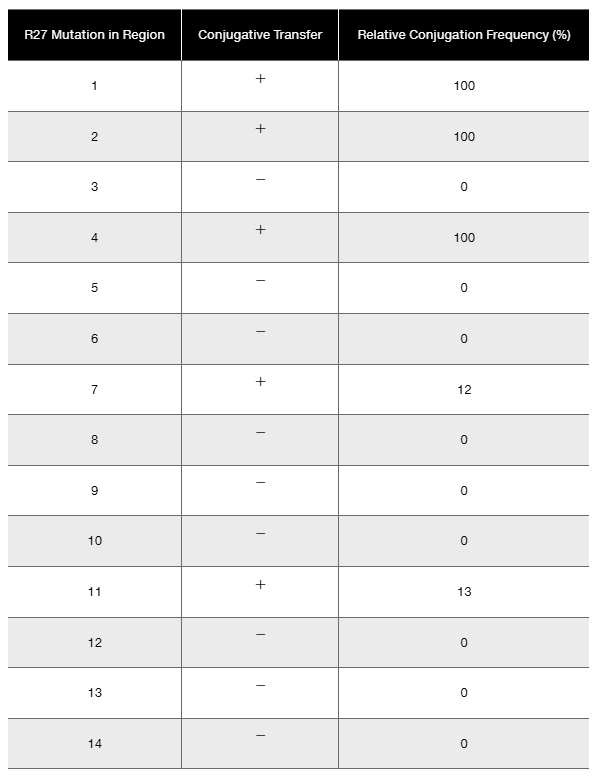
Accompanying the map is a table showing the effects of these mutations on R27 conjugation.
Effects of Mutations in Functional Regions of Transfer Region 1 (tra1) on R27 Conjugation
Table showing effects of mutations in tra1 gene regions on R27 plasmid conjugation and relative transfer frequencies.
What general conclusions might one draw from these data? 

Verified step by step guidance
1
Step 1: Examine the map of the tra1 gene regions and note the color coding, which groups regions by related functions. This helps to understand which regions might work together in conjugative transfer.
Step 2: Review the table showing the effects of mutations in each region on conjugation frequency. Pay attention to which mutations result in 0% conjugation frequency (indicating loss of function) and which maintain 100% or near 100% (indicating no effect).
Step 3: Identify that regions with mutations causing 0% conjugation frequency are essential for plasmid transfer, while those with 100% frequency are likely non-essential or redundant for this function.
Step 4: Note that regions with intermediate conjugation frequencies (e.g., 12% or 13%) suggest partial involvement or a modulatory role in conjugation efficiency.
Step 5: Integrate the data by correlating the functional grouping (color coding) with the mutation effects to conclude which functional groups and specific regions are critical for conjugative transfer of the R27 plasmid.

Verified video answer for a similar problem:

This video solution was recommended by our tutors as helpful for the problem above.
Video duration:
3m
Was this helpful?

Key Concepts

Here are the essential concepts you must grasp in order to answer the question correctly.

Conjugative Transfer and Plasmid Function

Conjugative transfer is the process by which plasmids are transferred between bacteria through direct contact, enabling the spread of traits like antibiotic resistance. The tra1 gene encodes proteins essential for this transfer, and mutations in specific regions can disrupt or reduce conjugation efficiency.
Recommended video:

Functional Regions of Genes and Mutation Analysis

Genes often contain distinct functional regions responsible for different activities. Mutation analysis involves altering these regions to determine their role by observing changes in phenotype, such as conjugation frequency, helping identify which parts are critical for gene function.
Recommended video:
Guided course
08:26
Functional Genomics

Interpreting Mutation Effects on Conjugation Frequency

By comparing conjugation frequencies of mutated regions to wild-type, one can infer the importance of each region. Regions with mutations causing 0% transfer are essential for conjugation, while those with no effect or partial reduction indicate non-essential or supportive roles.
Recommended video:
Guided course
08:52
F Factor and Hfr
Related Practice
Textbook Question

A study was conducted in an attempt to determine which functional regions of a particular conjugative transfer gene (tra1) are involved in the transfer of plasmid R27 in Salmonella enterica. The R27 plasmid is of significant clinical interest because it is capable of encoding multiple-antibiotic resistance to typhoid fever. To identify functional regions responsible for conjugal transfer, an analysis was conducted by Lawley et al. (2002). J. Bacteriol. 184:2173-2180 was conducted in which particular regions of the tra1 gene were mutated and tested for their impact on conjugation. Shown here is a map of the regions tested and believed to be involved in conjugative transfer of the plasmid. Similar coloring indicates related function. Numbers correspond to each functional region subjected to mutation analysis.

Accompanying the map is a table showing the effects of these mutations on R27 conjugation.

Effects of Mutations in Functional Regions of Transfer Region 1 (tra1) on R27 Conjugation


Given the data, do all functional regions appear to influence conjugative transfer?

576
views
Textbook Question

A study was conducted in an attempt to determine which functional regions of a particular conjugative transfer gene (tra1) are involved in the transfer of plasmid R27 in Salmonella enterica. The R27 plasmid is of significant clinical interest because it is capable of encoding multiple-antibiotic resistance to typhoid fever. To identify functional regions responsible for conjugal transfer, an analysis was conducted by Lawley et al. (2002). J. Bacteriol. 184:2173-2180 was conducted in which particular regions of the tra1 gene were mutated and tested for their impact on conjugation. Shown here is a map of the regions tested and believed to be involved in conjugative transfer of the plasmid. Similar coloring indicates related function. Numbers correspond to each functional region subjected to mutation analysis.

Accompanying the map is a table showing the effects of these mutations on R27 conjugation.


Effects of Mutations in Functional Regions of Transfer Region 1 (tra1) on R27 Conjugation

Which regions appear to have the most impact on conjugation? 

458
views
Textbook Question

A study was conducted in an attempt to determine which functional regions of a particular conjugative transfer gene (tra1) are involved in the transfer of plasmid R27 in Salmonella enterica. The R27 plasmid is of significant clinical interest because it is capable of encoding multiple-antibiotic resistance to typhoid fever. To identify functional regions responsible for conjugal transfer, an analysis was conducted by Lawley et al. (2002). J. Bacteriol. 184:2173-2180 was conducted in which particular regions of the tra1 gene were mutated and tested for their impact on conjugation. Shown here is a map of the regions tested and believed to be involved in conjugative transfer of the plasmid. Similar coloring indicates related function. Numbers correspond to each functional region subjected to mutation analysis.

Accompanying the map is a table showing the effects of these mutations on R27 conjugation.


Effects of Mutations in Functional Regions of Transfer Region 1 (tra1) on R27 Conjugation


Which regions appear to have a limited impact on conjugation?

524
views